Climate evidence, energy budgets and policy
Introduced| English | Meaning |
|---|---|
| mitigation/ˌmɪtɪˈɡeɪʃn/ | Actions addressing causes of environmental change. |
| adaptation/ˌædæpˈteɪʃn/ | A characteristic that helps an organism survive and reproduce in its environment. |
What would explain this observation?
- One cold day does not disprove a warming climate. Weather describes short-term conditions; climate describes distributions over longer times and regions.
Build the model
- The Earth energy balance includes incoming solar radiation, reflection, absorption and outgoing infrared radiation.
- Greenhouse gases absorb and emit infrared radiation.
- Feedback can alter the response to an initial forcing.
- mitigation 减缓: Actions addressing causes of environmental change.
- adaptation 适应: Actions reducing harm from environmental impacts.

Which action is adaptation to flood risk?
Difficulty 1/5 · 100 coins + a small bonus on first completion today
Adaptation reduces the impact of a risk that remains - moving equipment above flood level does exactly that. Measuring CO2 is monitoring, and ignoring the risk is neither mitigation nor adaptation.
Match each technical term to its precise meaning.
Difficulty 2/5 · 140 coins + a small bonus on first completion today
Use the definitions to distinguish related quantities and processes.
Choose evidence that can test it
- Distinguish mitigation, which addresses drivers, from adaptation, which reduces harm from impacts.
- A policy assessment needs evidence about effectiveness, cost, equity and uncertainty; one criterion is not the entire decision.
In the lab: Compare multi-year data using consistent baselines. State the region, timescale and uncertainty. At HL, connect a management decision to law, economics and ethics rather than treating these lenses as extra definitions only.
Which two habits make the investigation or model in this case more defensible?
Difficulty 2/5 · 140 coins + a small bonus on first completion today
Stating the conditions and assumptions lets others repeat the work exactly, and recording the supporting evidence lets them check the conclusion. Hiding disagreeing results removes the evidence that could challenge a wrong conclusion, and one measurement can never establish a wider claim.
Work from known quantities
- Known: a surface receives 200 power units and reflects 50.
- Absorbed input = incoming-reflected = 200-50 = 150.
- Reflected fraction = 50/200 = 0.25 = 25%.
- A change in reflectivity alters the absorbed budget under this model.
Your turn: Incoming energy is 240 units and reflected energy 72. Find reflected percentage.
Reflected, absorbed, stored or lost
Split 200 incoming power units into 50 reflected and 150 absorbed. Compare absorption with outgoing infrared power to find the signed rate of energy storage change.
Incoming energy is 240 units and reflected energy 72. Find reflected percentage.
Difficulty 2/5 · 140 coins + a small bonus on first completion today
The result is 30 %. Known: incoming 240 units; reflected 72 units. Use reflected percentage = reflected / incoming x 100. Percentage = 72/240 x 100 = 30%. The absorbed share is 70% under this budget.
Check the conclusion and its limits
- The greenhouse effect is not the same process as ozone depletion.
- A carbon footprint estimate depends on its system boundary.
Not true: One local weather observation establishes a global climate trend. Weather is a short-term local state; climate is the long-term statistical pattern. One cold day in one city cannot confirm or refute a global trend built from decades of worldwide records.
- The Earth energy balance includes incoming solar radiation, reflection, absorption and outgoing infrared radiation.
- Distinguish mitigation, which addresses drivers, from adaptation, which reduces harm from impacts.
- Watch for: the greenhouse effect is not the same process as ozone depletion.
Weather is a short-term local state; climate is the long-term statistical pattern.
Difficulty 1/5 · 100 coins + a small bonus on first completion today
True. Weather is a short-term local state; climate is the long-term statistical pattern. One cold day in one city cannot confirm or refute a global trend built from decades of worldwide records.
Actions addressing causes of environmental change: write the technical term.
Difficulty 1/5 · 100 coins + a small bonus on first completion today
mitigation means Actions addressing causes of environmental change.
Calculate the reflected percentage from the energy budget
- Incoming energy is 180 units and reflected energy is 45 units.
- Find the reflected percentage. One local weather observation is not a climate trend.
Incoming energy is 180 units and reflected energy is 45 units. What percentage is reflected, and why does one local weather observation not establish a climate trend?
Use energies measured over the same interval and boundary: reflected fraction = 45/180 = 0.25. Reflected percentage = 0.25 × 100 = 25%. The denominator is incoming energy. Climate is a long-term statistical pattern, so one local weather observation cannot establish a global trend.
For the written case with 180 incoming and 45 reflected energy units, what percentage is reflected?
Difficulty 1/5 · 100 coins + a small bonus on first completion today
45 divided by 180 is 0.25, so 25 percent is reflected. Other options — 30 percent (the lesson case of 72 units from 240); 45 units (the reflected energy).
Define the planet's energy boundary before comparing temperatures
- A planet gains radiative energy from its star and loses energy by emitting radiation to space. Radiative equilibrium means equal absorbed and emitted powers at the chosen boundary. An imbalance is a rate of energy accumulation, not a temperature by itself: the resulting warming rate also depends on heat capacity and redistribution. A temporary local imbalance need not equal the global annual one.
- The following numerical planet and layer cases are illustrative models, not measurements of today's full Earth budget. Use S = 1,360 W/m² and σ = $5.67\times10^{-8}$ in SI units where stated. A single effective emission temperature does not determine every surface location's temperature. Day/night variation, albedo, heat storage, circulation and an atmosphere all matter; a simple Earth–Moon comparison does not isolate just one of them.
Derive the factor of four from geometry
- Solar intensity S is defined on a surface perpendicular to the rays at the planet's orbital distance, above its atmosphere. A spherical planet of radius R intercepts power $S\pi R^2$ across its projected disc, while its full surface area is $4\pi R^2$. Therefore the whole-sphere mean incoming power per area is S/4, or 340 W/m² for this model.
- The geometric global mean does not require every point to receive sunlight or have equal temperature. At a point facing the Sun normally, the incoming intensity can approach S before reflection and absorption; the night side receives no direct sunlight. Do not use S as the global mean or multiply an already globally averaged 340 W/m² by another factor of four.
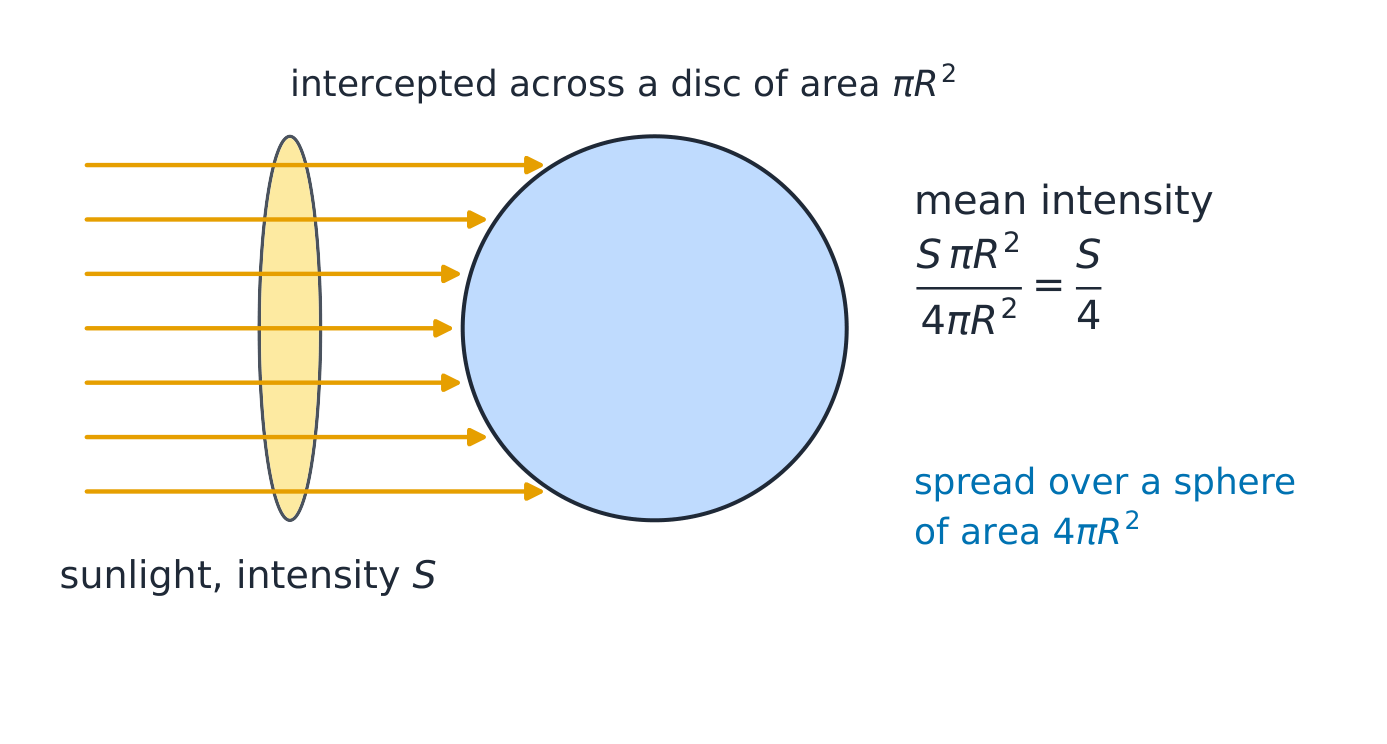
An illustrative spherical planet receives solar intensity of 1,360 W/m² on a surface perpendicular to the rays. Find the incoming intensity averaged over its whole surface, before reflection.
Difficulty 2/5 · 140 coins + a small bonus on first completion today
Intercepted area is πR² and full surface area 4πR². Their ratio gives S/4 = 1,360/4 = 340 W/m²; this does not assert uniform local illumination.
Calculate absorbed sunlight from albedo
- Albedo α is the fraction of incoming shortwave power reflected or scattered away. Absorbed solar fraction is 1 − α. With mean incoming 340 W/m² and model planetary albedo .30, reflection is 102 W/m² and absorption 238 W/m². A snowfield receiving 400 W/m² and reflecting 340 W/m² has albedo .85 and absorbs 60 W/m².
- Keep fractions distinct from percentages: .30 is 30%, not .30%. If albedo changes from .30 to .28, it falls by .02, or two percentage points; the absorbed fraction rises from .70 to .72. Albedo depends on surface, clouds, illumination angle and the wavelength range considered. A local snow value is not automatically the albedo of an entire planet.
A model snowfield receives 400 W/m² and reflects 340 W/m². Find absorbed power per area.
Difficulty 2/5 · 140 coins + a small bonus on first completion today
Absorbed power per area = incoming − reflected = 400 − 340 = 60 W/m². Albedo = reflected/incoming = 340/400 = .85. Absorbed fraction = 1 − .85 = .15; checking .15 × 400 recovers 60 W/m².
Distinguish surface emissivity from a fitted effective emissivity
- Thermal emissivity e compares a surface's emission with that of a black body at the same temperature. A grey-surface model emits $P=e\sigma AT^4$, with $0\leq e\leq1$. A surface at 300 K emitting 410 W/m² has e about .893. Albedo describes reflected incoming solar energy; thermal emissivity describes emission in another wavelength range, so do not simply set e equal to 1 − solar albedo.
- A fitted whole-planet effective emissivity can also describe the ratio of radiation reaching space to that calculated from a representative surface temperature. For 238 W/m² leaving spaceward with a reference surface at 288 K, that fitted ratio is about .61. It includes atmospheric effects and is not a claim that the actual ground has material emissivity .61. State which e a calculation uses.
An illustrative surface at 300 K emits 410 W/m². Use sigma = 5.67 × 10⁻⁸ in SI units and find thermal emissivity.
Difficulty 2/5 · 140 coins + a small bonus on first completion today
e = 410/(sigma × 300⁴) = 410/459.27 ≈ .893. This is an emitted-power ratio, not the surface’s solar albedo.
Solve the airless uniform-temperature model
- With no atmosphere, uniform temperature and stipulated thermal emissivity e, equilibrium requires $e\sigma T^4=(1-\alpha)S/4$. For α = .30 and e = 1, absorbed power per area is 238 W/m² and temperature is about 254.5 K, conventionally rounded to 255 K. This is an effective radiative model, not a prediction that every real airless surface has that arithmetic mean temperature.
- For a Mars-like model using S = 590 W/m², α = .25 and e = 1, the result is about 210.2 K. A separate model with S = 1,000 W/m², α = .20 and e = .90 gives about 250.2 K. Solve for T⁴ before taking the fourth root, use kelvin throughout and keep the full emissivity-times-sigma denominator together.
For the uniform-temperature airless model, S = 1,360 W/m², solar albedo .30 and thermal emissivity 1. Use sigma = 5.67 × 10⁻⁸ in SI units. Find equilibrium temperature in kelvin.
Difficulty 2/5 · 140 coins + a small bonus on first completion today
Absorbed mean power per area = (1 − α)S/4 = (1 − .30) × 1,360/4 = 238 W/m². At equilibrium eσT⁴ = 238. With e = 1, T = [238/(5.67 × 10⁻⁸)]^(1/4) ≈ 254.5 K, or 255 K to the nearest kelvin. This does not give every local surface temperature.
Predict how an albedo change alters the equilibrium
- Lowering albedo from .30 to .28 with S fixed at 1,360 W/m² increases absorbed mean sunlight from 238 to 244.8 W/m². In the airless black-body model, equilibrium temperature rises from about 254.5 to 256.3 K. The temperature ratio is the fourth root of .72/.70, not the ratio itself.
- More generally, at fixed albedo and e the temperature scales as the fourth root of S. A 16-fold intensity increase doubles the modeled absolute temperature; a small percentage power increase produces a much smaller percentage temperature increase. Do not treat a Celsius temperature ratio as an absolute-temperature ratio or convert this simple response directly into a realistic climate-sensitivity claim.
A model planetary albedo falls from .30 to .28. By how many percentage points did it fall?
Difficulty 2/5 · 140 coins + a small bonus on first completion today
.30 = 30% and .28 = 28%, a fall of two percentage points. It is not a 2% relative decrease; relative to the original albedo it is about 6.67%.
Balance surface, atmosphere and space separately
- The illustrative diagram has 340 W/m² incoming and 102 reflected, leaving 238 absorbed by the surface. It rounds surface emission to 390 W/m²; 304 is absorbed by the atmosphere and 86 escapes directly. The atmosphere emits 152 upward and 152 downward. At the surface, 238 + 152 = 390; in the layer, 304 = 152 + 152; at the top, 102 + 86 + 152 = 340.
- These are three boundaries, not three independent sources of energy. Downward atmospheric radiation recycles some energy within the system; it does not add a second stellar input at the top. The diagram omits solar absorption in the atmosphere, convection, evaporation, clouds and vertical temperature structure. It is an energy-conserving teaching model, not a complete observed Earth budget.
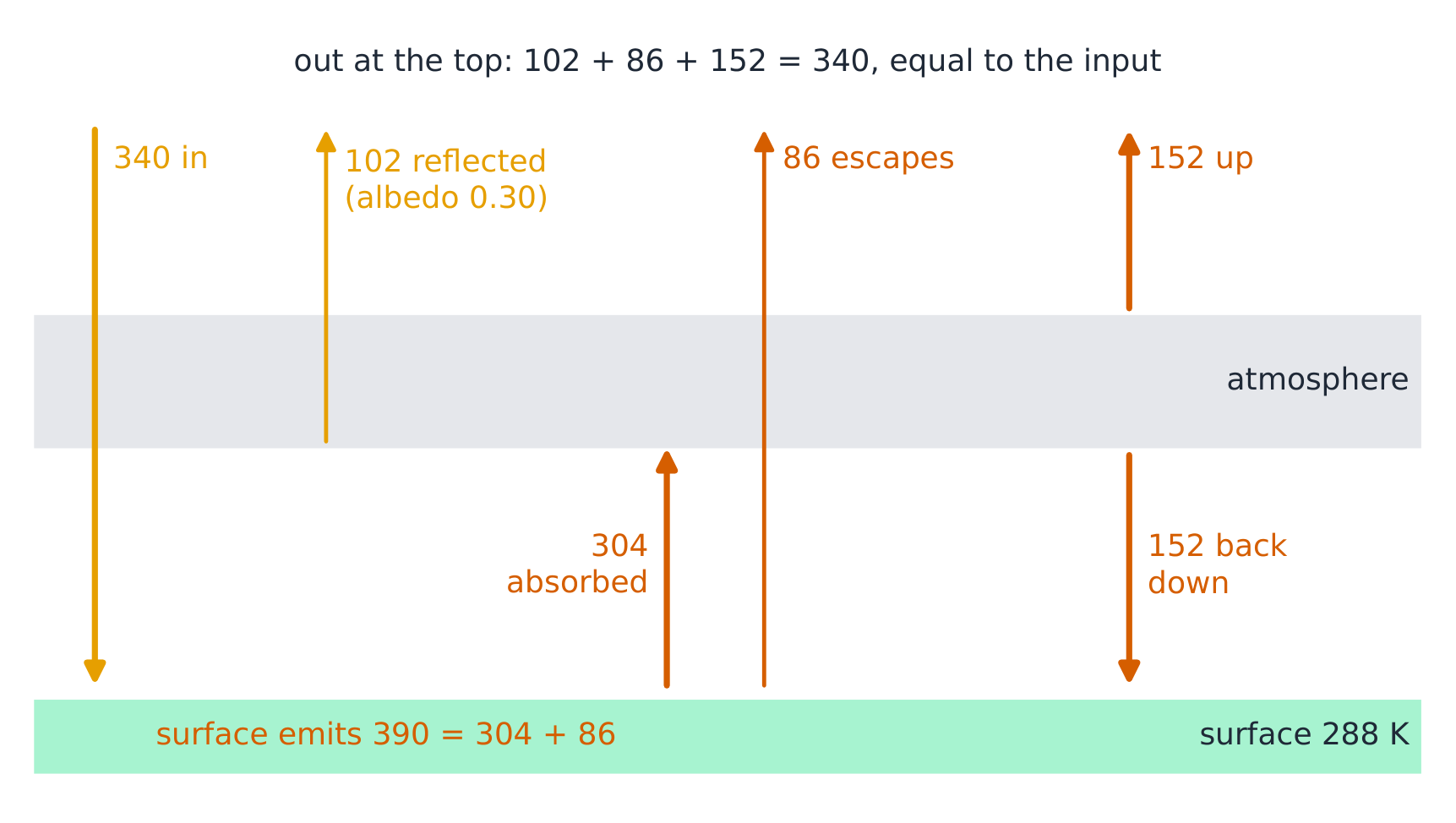
In the illustrative model, mean incoming sunlight is 340 W/m² and the surface emits 390 W/m². Which interpretation is correct?
Difficulty 1/5 · 100 coins + a small bonus on first completion today
Surface input is 238 solar + 152 downward = 390. Top outgoing is 102 reflected + 86 direct thermal + 152 layer thermal = 340. Internal recycling is not a new external energy supply.
Recalculate both layers after changing infrared absorption
- Let F be the black surface's emitted thermal power per area, and let the model atmosphere absorb fraction a of it while remaining transparent to incoming solar radiation. If it emits equally upward and downward and is in equilibrium, each direction receives aF/2. Surface balance is $F=238+aF/2$, so $F=238/(1-a/2)$.
- With a = .78, F is about 390.16 W/m², agreeing with the rounded diagram. With a = .80, the new equilibrium F is about 396.67 W/m² and the black surface temperature about 289.2 K. Holding F at its old 390 value while calculating the larger downward transfer only identifies an initial imbalance; it is not the final coupled equilibrium. The atmospheric absorption fraction a here is different from solar albedo α.
In the model, surface solar absorption is 238 W/m². The atmosphere absorbs fraction a = .80 of surface infrared and emits equal power upward and downward. Find final equilibrium surface emission F from F = 238 + aF/2.
Difficulty 2/5 · 140 coins + a small bonus on first completion today
F(1 − .80/2) = 238, so F = 238/.60 ≈ 396.67 W/m². Recomputing a downward arrow while freezing F at 390 only describes an initial imbalance.
Explain back-radiation without reversing the net heat flow
- A cooler atmosphere emits radiation downward as well as upward, while the warmer surface emits more upward. The surface–atmosphere net radiative transfer can still be from warmer to cooler: receiving some radiation from a cooler body is not forbidden. At whole-planet equilibrium, energy entering from the star still equals energy leaving to space.
- Greenhouse warming is not an endless energy multiplication. Increasing infrared opacity initially reduces the outgoing energy for an unchanged temperature structure; the system responds until transfers rebalance, subject to its other processes. The physical greenhouse effect involves infrared absorption and emission; it is not the same mechanism as reducing air circulation inside a glass greenhouse, and it is not an ozone-hole explanation.
Connect an infrared band to a molecular energy gap
- Molecules have allowed energy levels. Absorption of an infrared photon requires an allowed transition matching its energy, with $E=hf=hc/\lambda$. For a stipulated 15 micrometre photon, using h = $6.63\times10^{-34}$ J s gives energy about $1.326\times10^{-20}$ J and frequency $2.00\times10^{13}$ Hz. Keep the full wavelength, including its power of ten, in the denominator.
- Molecular vibrational motion provides a resonance model: atoms linked by bonds can absorb strongly near suitable vibrational frequencies. Not every mode absorbs infrared equally; the coupling to the radiation matters. Absorbed energy can be redistributed through collisions as well as exchanged radiatively. Do not require each absorbed surface photon to be immediately re-emitted at exactly the same energy by the same molecule before atmospheric warming can occur.
Find the energy of a 15 micrometre photon using h = 6.63 × 10⁻³⁴ J s and c = 3.00 × 10⁸ m/s. Enter the answer in joules, using scientific notation if needed.
Difficulty 2/5 · 140 coins + a small bonus on first completion today
E = hc/λ = (6.63 × 10⁻³⁴ × 3.00 × 10⁸)/(15 × 10⁻⁶) = 1.326 × 10⁻²⁰ J. The matching frequency is 2.00 × 10¹³ Hz.
Interpret an atmospheric-window sketch as a spectral model
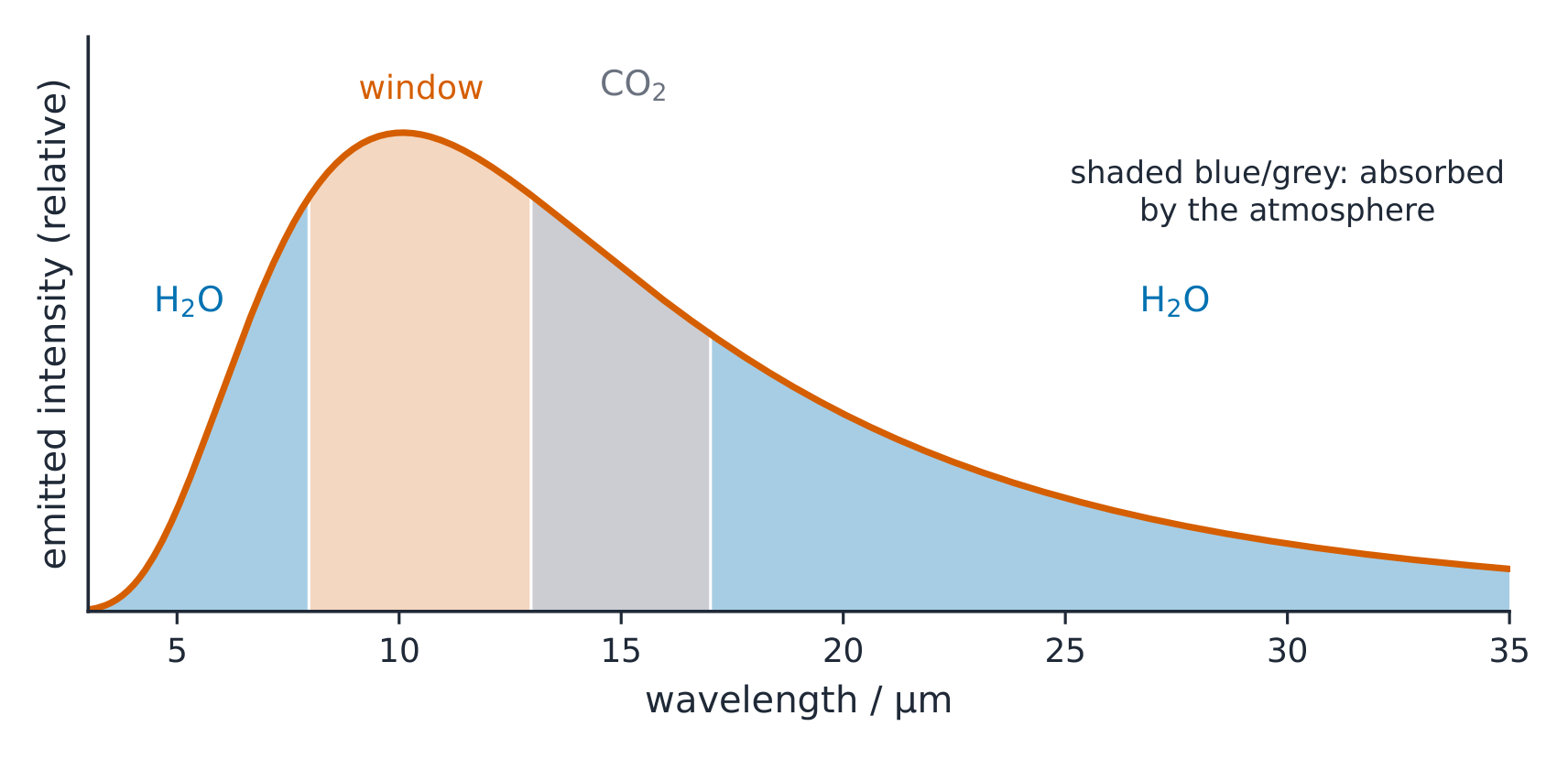
- A Sun-like 5,800 K black body peaks near 0.50 micrometres, whereas a 288 K surface peaks near 10.1 micrometres. This difference in wavelength ranges helps explain why an atmosphere can transmit much incoming sunlight yet absorb substantial outgoing thermal radiation. Greenhouse gases absorb in particular spectral bands, rather than behaving as an opaque lid at every wavelength.
- The illustrated water-vapour and carbon-dioxide bands are schematic. The 8–13 micrometre window allows relatively more direct escape in suitable conditions, not perfect transparency everywhere: other absorption, clouds and humidity affect it. Nitrogen and oxygen make up most dry air but absorb much less in the main thermal infrared bands than the gases featured in this simple model. A small atmospheric fraction can therefore have a significant radiative role.
Distinguish greenhouse-gas sources from climate feedbacks
- Water vapour, carbon dioxide, methane and nitrous oxide all have natural sources, and human activities also affect their abundances. Carbon dioxide comes from respiration and combustion among other processes; human fossil-fuel use, cement production and land-use changes add it. Wetlands are a natural methane source, whereas livestock, rice cultivation, landfill and fuel leaks are examples associated with human activity. Soil microbes produce nitrous oxide, with fertilizer use affecting its release.
- In long-term climate explanations, extra water vapour is often a feedback to an initial warming, because temperature influences how much water vapour the atmosphere can hold. This does not make it unimportant. Distinguish the initial forcing from the response that amplifies it, and do not assume the greenhouse contribution of a gas is determined only by its concentration without considering its spectrum and atmospheric distribution.
Use dated atmospheric records rather than an undated today
- The NOAA Annual Greenhouse Gas Index reports a 2025 global remote-marine-boundary-layer annual mean carbon-dioxide abundance of 425.62 ± 0.05 ppm. That specifies the year, sampling domain, gas and averaging quantity; it is not a claim about every city's air on every day. A monthly record at one station, a global surface mean and a whole-atmosphere column mean need not have identical numerical values.
- For a separate invented arithmetic example, increasing a concentration from 280 to 420 ppm is a 140 ppm absolute increase and a 50% relative increase. It is not a 140% increase, nor does it imply a proportional temperature change. Measurements constrain the atmospheric change; a radiative-transfer and energy-balance model is needed to connect it to forcing and temperature response.
The cited NOAA record gives 425.62 ppm for 2025. Which description preserves the stated meaning of that value?
Difficulty 1/5 · 100 coins + a small bonus on first completion today
The year, sampling domain, gas and averaging quantity are essential. Local observations, monthly station means and whole-atmosphere column means need not have identical values.
In a separate invented example, a concentration rises from 280 to 420 ppm. Find the relative increase as a percentage of the starting concentration.
Difficulty 2/5 · 140 coins + a small bonus on first completion today
Increase = 140 ppm. Relative increase = 140/280 × 100 = 50%. This arithmetic does not imply that temperature also rises by 50%.
Follow a feedback loop through every physical link
- In ice–albedo feedback, initial warming reduces reflective snow or ice, exposes darker surfaces, raises absorbed solar power and amplifies warming. In water-vapour feedback, initial warming permits more atmospheric vapour, increasing infrared absorption and further warming under the stated conditions. A positive feedback amplifies a perturbation; the word positive does not mean beneficial.
- Rising thermal emission with temperature provides an opposing radiative response, and real clouds have both shortwave and longwave effects. Therefore do not assume every change is an amplifying loop or that the simple one-layer model captures them all. A feedback explanation should identify the variable changed, its effect on a flux and the resulting temperature response, rather than merely listing “more warming”.
Which sequence describes amplifying ice–albedo feedback in the stated model?
Difficulty 1/5 · 100 coins + a small bonus on first completion today
Removing reflective ice exposes darker surfaces and lowers albedo. More shortwave energy is absorbed, amplifying the initial warming; positive refers to amplification rather than desirability.
Test a climate explanation with evidence and explicit assumptions
- Weather is a short-term state; climate describes statistical patterns over longer times and regions. A cold day in one location cannot settle a global long-term trend. Use records with stated coverage, time span, calibration, uncertainty and a consistent reference period. Compare the energy-budget hypothesis with evidence from more than one relevant measured quantity; do not present an illustrative flux diagram as a direct observational dataset.
- Mitigation addresses causes, such as reducing greenhouse-gas emissions or increasing durable removal; adaptation reduces harm from the impacts, such as changing heat planning or flood protection. For a physics answer, state the boundary, S/4 geometry, albedo/emissivity distinction, emitted versus net flux and layer balances. Recompute ratios and conservation checks independently, and describe which omitted processes limit the model before extending its prediction to the real climate.
Explain a greenhouse-energy model and how to check its assumptions against evidence. Include geometry, layer balances, absorption and a feedback.
A defensible explanation connects a physical mechanism to a balanced model, an independent calculation and appropriately scoped evidence.