Individual performance choices and analysis
Introduced| English | Meaning |
|---|---|
| spatial choice | a decision about where performers stand, whom they face and how close they are |
| pause | a short stop in speech or movement, used for effect |
Speaking to the audience in daylight, 1997
- Shakespeare's Globe, a reconstruction of the 1599 theatre, opened in London in 1997. Plays are performed in daylight, with standing spectators close to the stage, so actors can see the audience — and speak soliloquies straight to them, as Shakespeare's actors probably did.
- A soliloquy spoken to the audience feels like a confession shared with us; the same lines spoken inward feel like overheard private thought. One spatial choice 空间选择 changes the relationship.
Why can actors at Shakespeare's Globe speak soliloquies straight to the audience?
Difficulty 1/5 · 100 coins + a small bonus on first completion today
The space shapes the relationship.
Individual performance choices
- An actor chooses where to stand, whom to face, how close to be, and when to move. Each choice affects how the audience understands a character's relationships.
- In Literature and Performance you test such choices on a text and explain them with evidence.
Which are individual performance choices?
Difficulty 2/5 · 140 coins + a small bonus on first completion today
These shape how relationships are understood.
One line, two versions
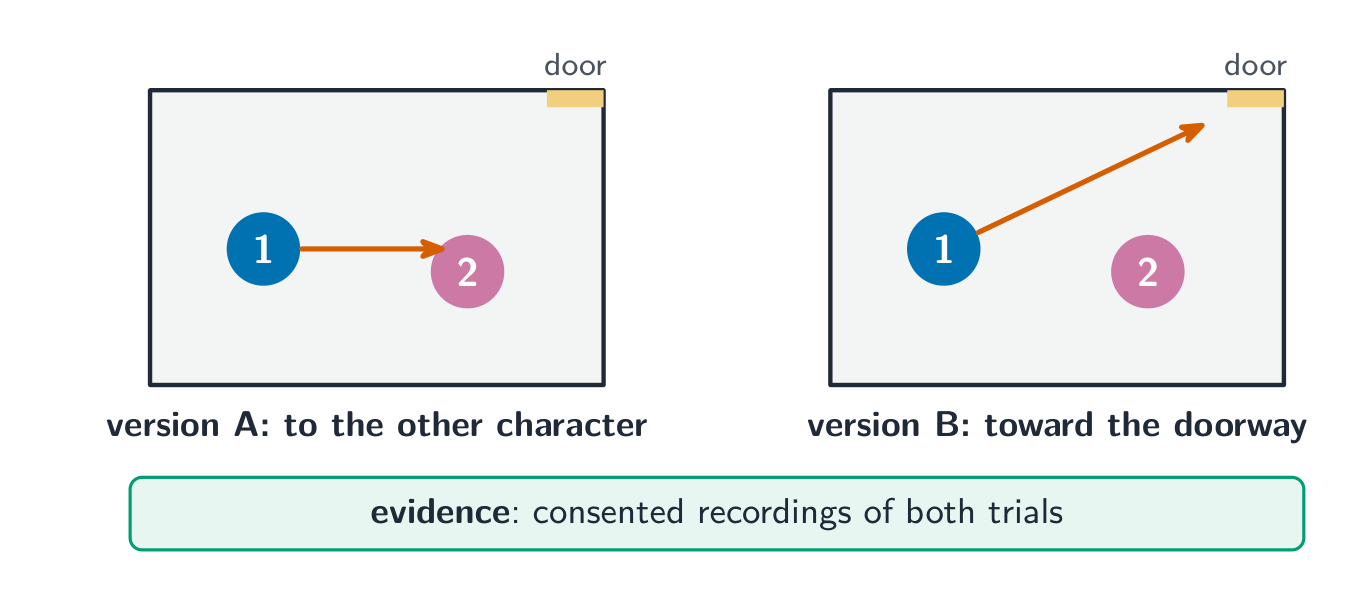
- Version A: speak a line to the other character. Version B: speak the same line towards a doorway. The words stay the same; the target changes.
- To the character, a line is a message; towards a doorway, it may be a wish to leave, or words meant for someone absent.
Match each version to a likely reading.
Difficulty 2/5 · 140 coins + a small bonus on first completion today
The target of the line changes meaning.
Worked example: testing two versions
Line from a story adapted for performance: "I will stay, if you want me to."
- Version A — to the other character: facing her, close. Test viewers read it as an offer of love; the "if" sounds gentle.
- Version B — towards the doorway: turned away, looking out. Viewers read it as reluctance; the "if" sounds like a condition, and the doorway suggests he wants to go.
- Evidence and choice: both versions were filmed with the actors' consent and shown to five viewers. For a story about a failing relationship, Version B matches the text's hesitations better, so it is chosen.
Why was Version B chosen in the worked example?
Difficulty 1/5 · 100 coins + a small bonus on first completion today
The choice follows the text's evidence.
Trials should be recorded with the performers' consent.
Difficulty 1/5 · 100 coins + a small bonus on first completion today
Consent comes first.
Voice and pace
- Pause 停顿, stress and pace also change meaning: "I will stay — if you want me to" stresses the condition.
- Mark the text with your choices — pauses, stresses, movements — so you can repeat and compare them.
What does stressing if in "I will stay — if you want me to" do?
Difficulty 1/5 · 100 coins + a small bonus on first completion today
Stress changes meaning.
Analysing your choices
- For each choice: quote the text, describe the choice, give the evidence from trials and explain how it shapes meaning.
- Show alternatives you rejected and why.
"It felt right" is not evidence. Record both versions, gather viewers' responses, and link the choice to the text. A choice that cannot be explained from the text is decoration.
"It felt right" is enough evidence for a choice.
Difficulty 1/5 · 100 coins + a small bonus on first completion today
Record versions and link to the text.
Spatial and vocal choices — whom you face, how close you stand, where you pause — change a line's meaning without changing its words. Test versions with consented recordings and viewers' responses, choose by the text's evidence, and explain rejected alternatives.
Plan two versions of the line "You never listen to me" and say how you would test them.
Two versions, test, choice.