Literary form and close reading
Introduced| English | Meaning |
|---|---|
| close reading/kləʊs ˈriːdɪŋ/ | Careful analysis of a text's words, structure and effects. |
| form/fɔːm/ | the shape and structure of a text, such as line length, stanza pattern, sentence length or rhyme |
| effect | what a writer's or artist's choice does to meaning or to the reader's response |
| literary device | A technique writers use to create meaning, such as metaphor or irony. |
| simile/ˈsɪmɪlɪ/ | A comparison that explicitly links different things using words such as like or as. |
| personification/pɜːˌsɒnɪfɪˈkeɪʃən/ | Giving human qualities to something that is not a person. |
| speaker/ˈspiːkə/ | The voice speaking in a poem. |
| narrator/nəˈreɪtə/ | The voice telling a story. |
Bent double, 1917
- In 1917, recovering at Craiglockhart hospital in Scotland, the soldier-poet Wilfred Owen drafted "Dulce et Decorum Est". It opens: "Bent double, like old beggars under sacks". Recruiting posters showed young men standing tall; Owen's first line makes them old, poor and bent.
- That is close reading 细读: noticing a choice of wording or form and explaining what it does to meaning, line by line.
What does Owen's opening simile, "Bent double, like old beggars under sacks", do?
Difficulty 1/5 · 100 coins + a small bonus on first completion today
The simile strips the soldiers of youth and glory.
Device, effect, check
- Name the literary device 文学手法, explain its effect 效果 on meaning or the reader, then check that reading against nearby details.
- In Owen's line the device is a simile 明喻 ("like old beggars"); the effect is to strip the soldiers of youth and glory; the check is the next line, "Knock-kneed, coughing like hags", which confirms exhaustion rather than heroism.
Put the steps of close reading in order.
Difficulty 3/5 · 200 coins + a small bonus on first completion today
Device, effect, check.
Personification
- Personification 拟人 gives human qualities to something non-human. "The room held its breath" makes a room behave like a nervous person.
- The device alone does not tell you the emotion. Tension could be fear or excitement; only the surrounding text decides.
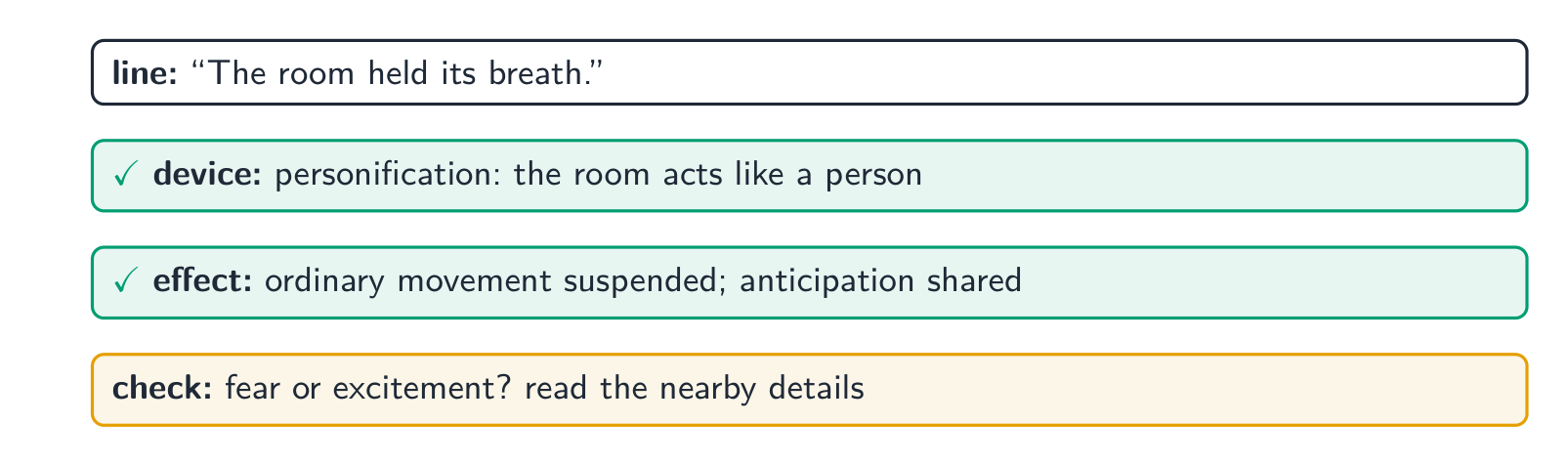
Match each example to its device.
Difficulty 2/5 · 140 coins + a small bonus on first completion today
Each choice of wording or form is a device you can analyse.
Personification on its own tells you whether the emotion is fear or excitement.
Difficulty 1/5 · 100 coins + a small bonus on first completion today
Only the surrounding text decides.
Worked example: one sentence, three steps
Passage: "The room held its breath. Then the results were read out, and someone at the back began to laugh."
- Device: personification — the room "held its breath", as a person does when waiting.
- Effect: every movement stops; the whole class seems to share one feeling of anticipation, so the reader waits too.
- Check: the laugh after the results suggests relief or joy, so the held breath reads as nervous excitement rather than dread. The short first sentence also slows the pace before the release.
In the worked example, why does the held breath read as excitement?
Difficulty 1/5 · 100 coins + a small bonus on first completion today
The laugh is the nearby detail that checks the reading.
Form as well as words
- Form 形式 — line length, stanza shape, sentence length, rhyme — also makes meaning. Owen breaks his regular rhythm when the gas attack begins: "Gas! GAS! Quick, boys!"
- Ask what changes in the form and why it changes at that moment.
Speaker and author
- The speaker 说话者 of a poem or the narrator 叙述者 of a novel is not automatically the author. Owen's speaker was a soldier, like Owen, but in many works the voice is invented.
- Write "the speaker presents…" rather than "Owen thinks…", unless you have evidence about the author.
Which sentence is safest in an essay?
Difficulty 1/5 · 100 coins + a small bonus on first completion today
Refer to the speaker unless you have evidence about the author.
"This is a vivid image" is not analysis. Say what is made vivid, how the wording does it, and why it matters for the work's meaning: "the simile makes the soldiers old before their time, which attacks the poster image of glorious youth".
"This is a vivid image" is a complete analysis.
Difficulty 1/5 · 100 coins + a small bonus on first completion today
Say what is vivid, how, and why it matters.
Close reading names a device, explains its effect on meaning, and checks that reading against nearby details. Analyse form as well as wording, distinguish the speaker from the author, and replace empty words like "vivid" with a precise effect.
Analyse this sentence using device, effect and check: "The wind clawed at the windows all night, and in the morning the house was silent."
Device, effect, check.