Climate evidence, energy budgets and policy
Introduced| English | Meaning |
|---|---|
| mitigation/ˌmɪtɪˈɡeɪʃn/ | Action that reduces the causes of climate change, mainly greenhouse gas emissions. |
| adaptation/ˌædæpˈteɪʃn/ | Actions that reduce harm from climate impacts. |
| ozone/ˈəʊzəʊn/ | The molecule O3, made of three oxygen atoms; it absorbs ultraviolet radiation in the stratosphere but is a pollutant near the ground. |
| troposphere/ˈtrɒpəsfɪə/ | The lowest layer of the atmosphere, where weather occurs. |
| stratosphere/ˈstrætəsfɪə/ | The atmospheric layer above the troposphere, containing most atmospheric ozone and generally becoming warmer with increasing height. |
| ultraviolet/ˌʊltrəˈvaɪəlɪt/ | Electromagnetic radiation with wavelengths shorter than visible violet light and longer than X-rays. |
| atmosphere/ˈætməsfɪə/ | atmosphere |
| albedo | The fraction of incoming solar radiation that a surface reflects. |
| permafrost | Ground that stays frozen for at least two consecutive years. |
| tipping point | A threshold beyond which a system shifts to a new state that is hard to reverse. |
| net zero | A state in which the greenhouse gases added to the atmosphere are balanced by those removed. |
| carbon tax | A charge on fossil fuels or emissions according to the carbon dioxide they release. |
| ozone-depleting substance | A chemical, such as a chlorofluorocarbon, that destroys ozone in the stratosphere. |
What would explain this observation?
- One cold day does not disprove a warming climate. Weather describes short-term conditions; climate describes distributions over longer times and regions.
Build the model
- The Earth energy balance includes incoming solar radiation, reflection, absorption and outgoing infrared radiation.
- Greenhouse gases absorb and emit infrared radiation.
- Feedback can alter the response to an initial forcing.
- mitigation 减缓: Actions addressing causes of environmental change.
- adaptation 适应: Actions reducing harm from environmental impacts.

Which action is adaptation to flood risk?
Difficulty 1/5 · 100 coins + a small bonus on first completion today
Adaptation reduces the impact of a risk that remains - moving equipment above flood level does exactly that. Measuring CO2 is monitoring, and ignoring the risk is neither mitigation nor adaptation.
Match each technical term to its precise meaning.
Difficulty 2/5 · 140 coins + a small bonus on first completion today
Use the definitions to distinguish related quantities and processes.
Choose evidence that can test it
- Distinguish mitigation, which addresses drivers, from adaptation, which reduces harm from impacts.
- A policy assessment needs evidence about effectiveness, cost, equity and uncertainty; one criterion is not the entire decision.
In the lab: Compare multi-year data using consistent baselines. State the region, timescale and uncertainty. At HL, connect a management decision to law, economics and ethics rather than treating these lenses as extra definitions only.
Which two habits make the investigation or model in this case more defensible?
Difficulty 2/5 · 140 coins + a small bonus on first completion today
Stating the conditions and assumptions lets others repeat the work exactly, and recording the supporting evidence lets them check the conclusion. Hiding disagreeing results removes the evidence that could challenge a wrong conclusion, and one measurement can never establish a wider claim.
Work from known quantities
- Known: a surface receives 200 power units and reflects 50.
- Absorbed input = incoming-reflected = 200-50 = 150.
- Reflected fraction = 50/200 = 0.25 = 25%.
- A change in reflectivity alters the absorbed budget under this model.
Your turn: Incoming energy is 240 units and reflected energy 72. Find reflected percentage.
Reflected, absorbed, stored or lost
Split 200 incoming power units into 50 reflected and 150 absorbed. Compare absorption with outgoing infrared power to find the signed rate of energy storage change.
Incoming energy is 240 units and reflected energy 72. Find reflected percentage.
Difficulty 2/5 · 140 coins + a small bonus on first completion today
The result is 30 %. Known: incoming 240 units; reflected 72 units. Use reflected percentage = reflected / incoming x 100. Percentage = 72/240 x 100 = 30%. The absorbed share is 70% under this budget.
Check the conclusion and its limits
- The greenhouse effect is not the same process as ozone depletion.
- A carbon footprint estimate depends on its system boundary.
Not true: One local weather observation establishes a global climate trend. Weather is a short-term local state; climate is the long-term statistical pattern. One cold day in one city cannot confirm or refute a global trend built from decades of worldwide records.
- The Earth energy balance includes incoming solar radiation, reflection, absorption and outgoing infrared radiation.
- Distinguish mitigation, which addresses drivers, from adaptation, which reduces harm from impacts.
- Watch for: the greenhouse effect is not the same process as ozone depletion.
Weather is a short-term local state; climate is the long-term statistical pattern.
Difficulty 1/5 · 100 coins + a small bonus on first completion today
True. Weather is a short-term local state; climate is the long-term statistical pattern. One cold day in one city cannot confirm or refute a global trend built from decades of worldwide records.
Actions addressing causes of environmental change: write the technical term.
Difficulty 1/5 · 100 coins + a small bonus on first completion today
mitigation means Actions addressing causes of environmental change.
Write from 20 percent reflected
- A surface receives 500 energy units and reflects 100.
- Find the reflected percentage and the absorbed input. One local weather observation does not establish a climate trend.
A surface receives 500 energy units and reflects 100. What percentage is reflected, and why does one local weather observation not establish a climate trend?
Reflected percentage is reflected energy divided by incoming energy. Weather and climate are different timescales.
A surface receives 500 energy units and reflects 100 energy units over the same interval. What percentage of the incoming energy is reflected?
Difficulty 1/5 · 100 coins + a small bonus on first completion today
Reflected percentage = reflected/incoming × 100 = 100/500 × 100 = 20%. Absorbed input = 500 − 100 = 400 energy units in this model. The 100 and 400 are energy amounts, not percentages.
Separate one warm year from long-term warming
- Paris was adopted in December 2015; signing opened in April 2016. It aims well below 2 °C while pursuing efforts towards 1.5 °C above pre-industrial conditions.
- WMO reported 2024 at 1.55 ± 0.13 °C above 1850–1900. One calendar-year result does not alone establish a long-term target breach; a cold local day cannot disprove a global multi-decade trend.
Does one calendar year above 1.5 °C alone establish a long-term Paris target breach?
Difficulty 1/5 · 100 coins + a small bonus on first completion today
Compare the same baseline and averaging period; natural variability accompanies the long-term trend.
Describe composition and atmospheric layers
- Dry air is about 78% nitrogen, 21% oxygen and 0.9% argon; variable water vapour is excluded. NOAA's global 2024 CO₂ mean was about 422.8 ppm, or 0.04228%.
- The troposphere 对流层 contains most weather and usually cools upwards, with inversions possible. The stratosphere 平流层 extends to about 50 km and warms upwards partly through ozone's UV absorption; layers are not sealed boxes.
What is excluded from dry-air percentages?
Difficulty 1/5 · 100 coins + a small bonus on first completion today
Dry air excludes water vapour; trace gases can still have strong wavelength-specific effects.
Trace three circulation cells
- Equatorial ascent, subtropical descent around 30°, ascent near 60° and polar descent create an idealised pressure/circulation pattern. Hadley and polar cells are joined by an indirect, eddy-driven Ferrel circulation.
- The model redistributes heat; seasons, mountains, continents and oceans shift the belts. It does not predict identical rainfall or daily wind at every latitude.
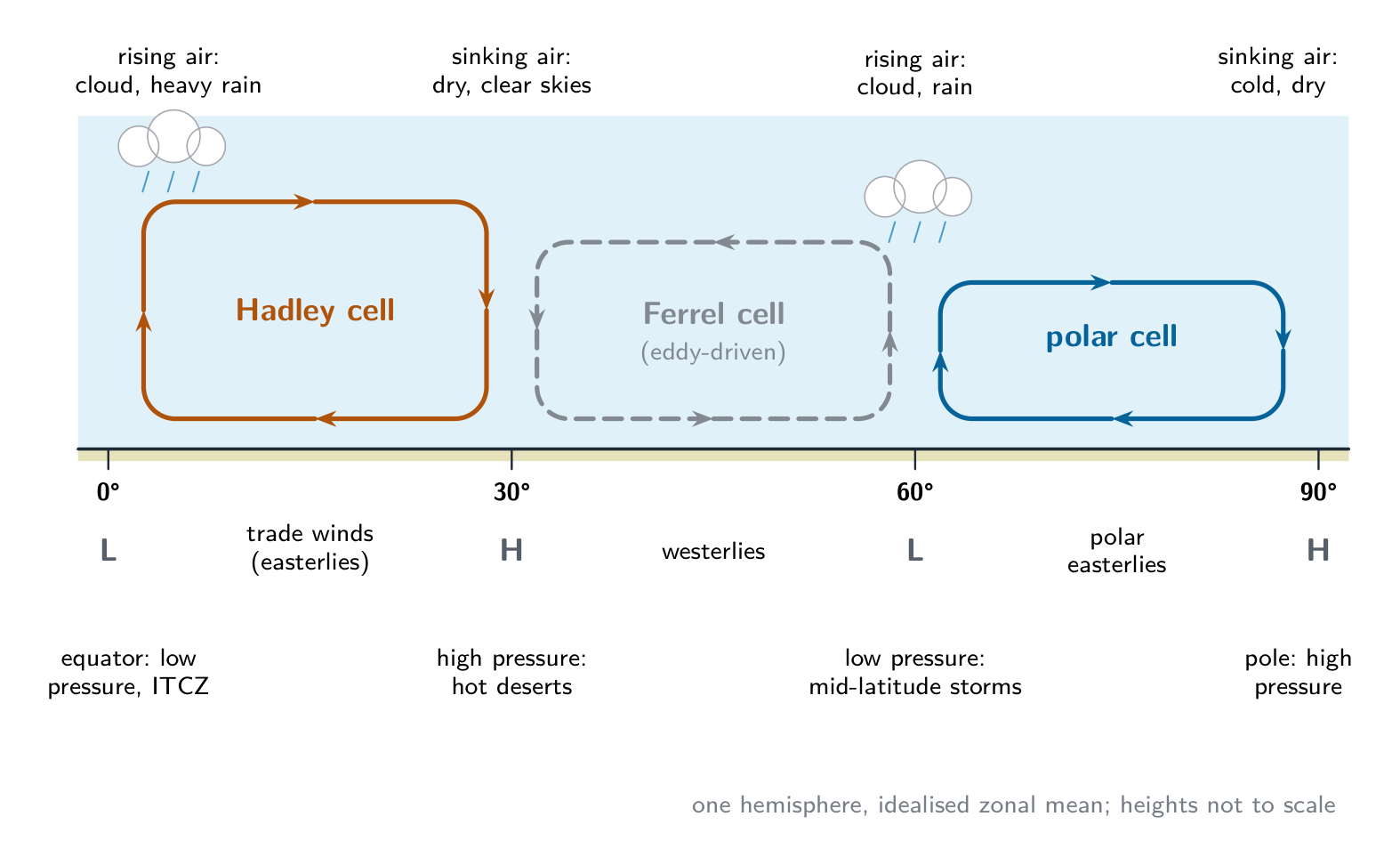
Where does air tend to descend in the idealised Hadley circulation?
Difficulty 1/5 · 100 coins + a small bonus on first completion today
Equatorial ascent and subtropical descent help explain the idealised pattern.
Name surface winds by their source
- Rotation deflects motion right in the Northern Hemisphere and left in the Southern Hemisphere. Surface trades and polar winds are easterlies; mid-latitude winds are mainly westerlies.
- “Easterly” means coming from the east, not travelling towards it. The idealised cells help explain wet and dry belts without requiring every desert to lie exactly at 30°.
An easterly wind comes from which direction?
Difficulty 1/5 · 100 coins + a small bonus on first completion today
Wind names describe where they come from; Coriolis deflection differs by hemisphere.
Follow solar and infrared pathways
- Incoming solar radiation includes visible light, near-infrared and ultraviolet 紫外线. Reflection occurs in clouds, air and surfaces; both atmosphere 大气层 and surface absorb solar energy.
- The warmed surface emits new thermal-infrared photons. Greenhouse gases absorb and emit infrared in all directions, while some escapes to space; this is different from ozone's UV protection.

Does all non-reflected solar radiation warm only the surface?
Difficulty 1/5 · 100 coins + a small bonus on first completion today
Surface thermal emission creates new infrared photons; greenhouse gases absorb and emit infrared.
Set a surface energy boundary
- Invented: incoming solar power is 340 W/m² and albedo 反照率 is 0.30. Reflected power is $340\times0.30=102\,\dfrac{\mathrm W}{\mathrm{m}^2}$; absorption is $340-102=238\,\dfrac{\mathrm W}{\mathrm{m}^2}$.
- Albedo is reflected/incoming solar radiation. This solar-only surface calculation excludes atmospheric absorption and other heat transfers; it is not a complete surface energy budget.
Incoming solar power is 340 W/m² and albedo 0.30. Find absorbed power in this solar-only surface model.
Difficulty 2/5 · 140 coins + a small bonus on first completion today
Reflected power per area = incoming × albedo = 340 × 0.30 = 102 W/m². Absorbed power per area = 340 − 102 = 238 W/m². Atmospheric absorption and other heat transfers are outside this solar-only surface model.
Compare gases with different time profiles
- CO₂ comes from combustion, cement and land-use change; removal has several timescales, with some influence persisting for centuries to millennia. Methane comes from leaks, ruminants, rice and wastes; a perturbation decays over roughly a decade rather than expiring on one date.
- N₂O is linked to nitrogen cycling, and halocarbon properties vary by compound. Water vapour is included in climate models as a feedback, not omitted because it is natural.
Is water vapour excluded from climate models because it is natural?
Difficulty 1/5 · 100 coins + a small bonus on first completion today
Water-vapour feedback, CO₂ forcing and gas-removal timescales have distinct roles.
Distinguish aerosols from greenhouse gases
- Aerosols are suspended particles or droplets: some scatter sunlight and cool, while black carbon absorbs sunlight and can darken snow. They do not all have the same sign of effect.
- Greenhouse gases interact with infrared through molecular absorption and emission. A particle that absorbs sunlight is not thereby a greenhouse-gas molecule; lifetimes and locations also matter.
Which statement is defensible?
Difficulty 1/5 · 100 coins + a small bonus on first completion today
Particles and gas molecules affect radiation through different processes.
Define the warming comparison metric
- Global warming potential compares the integrated radiative effect of an equal-mass pulse over a stated time horizon. It is not instantaneous heat trapped, gas lifetime or a guarantee that equal CO₂-equivalent emissions behave identically through time.
- Assigned teaching factor: at 28 over 100 years, 2 tonnes methane give $2\times28=56$ tonnes CO₂-equivalent. Real factors depend on assessment and assumptions; methane reductions complement CO₂ reductions.
With an assigned 100-year factor 28, what CO₂-equivalent mass represents 2 tonnes methane?
Difficulty 2/5 · 140 coins + a small bonus on first completion today
2×28=56 under this assigned metric; it is not a lifetime or identical time profile.
Distinguish concentrations from emissions
- Human emissions exceed net removal, increasing greenhouse-gas concentrations and altering radiation balance. Lower annual emissions need not immediately produce a falling atmospheric concentration.
- NOAA's Mauna Loa annual CO₂ record gives 316.91 ppm in 1960 and 424.61 ppm in 2024. A station mean differs from the global mean, monthly maximum and annual emission rate.

Does a station annual mean equal the global annual mean by definition?
Difficulty 1/5 · 100 coins + a small bonus on first completion today
Concentration, emissions, seasonal maxima and global/station averages differ.
Combine independent climate evidence
- Instruments track temperature and ocean heat; glaciers, sea level, sea ice and biological timing provide other evidence. Sea level responds to warming water and loss of land ice; floating sea-ice melt has little direct effect on water level.
- A proxy needs calibration and dating: ice-core bubbles preserve ancient gases, while ice isotopes, tree rings, pollen and sediments provide different climate-related evidence. They do not all directly measure ancient CO₂.
Which directly preserves samples of ancient atmospheric gases?
Difficulty 1/5 · 100 coins + a small bonus on first completion today
Other proxies need calibration and do not all directly measure gas composition.
Keep averaging periods visible
- IPCC reports 1.09 °C warming for the 2011–2020 mean relative to 1850–1900. WMO reports 1.55 °C for the single year 2024 using that baseline; these statistics have different averaging periods.
- These two observations do not make a complete temperature series or independently determine a recent warming rate. Correlation also needs physical mechanisms and tests of alternative explanations for attribution.
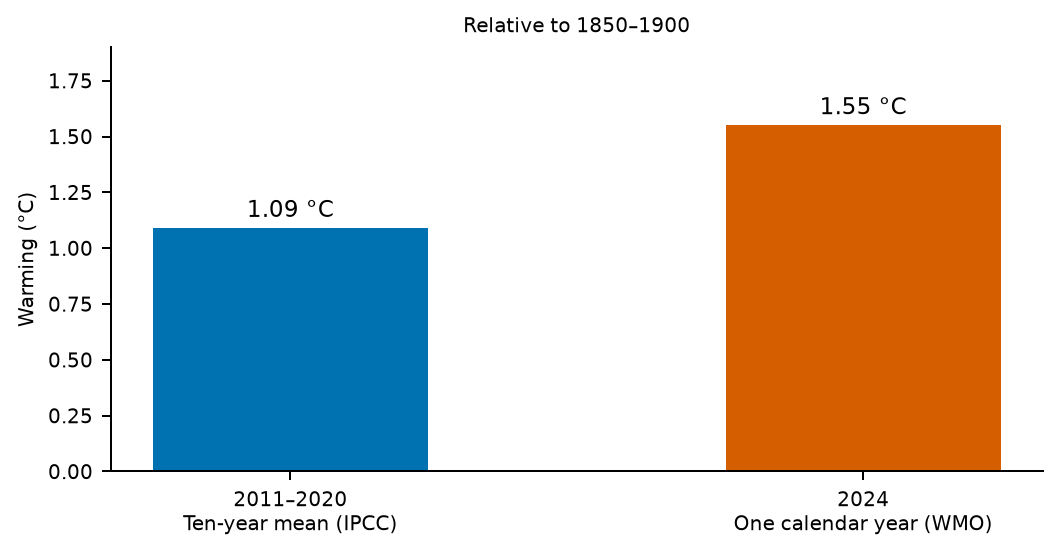
Can the decade mean and one annual value shown determine a complete recent warming rate?
Difficulty 1/5 · 100 coins + a small bonus on first completion today
Use matching periods and suitable complete records for rate estimates.
Read direct sector emissions
- IPCC's rounded 2019 estimates are energy supply 20, industry 14, agriculture/forestry/other land use 13, transport 8.7 and buildings 3.3 GtCO₂-equivalent: these sum to 59.
- Electricity belongs to energy supply in this allocation. Moving it to end users changes shares; do not add end-use electricity figures again or mix annual totals with cumulative emissions.
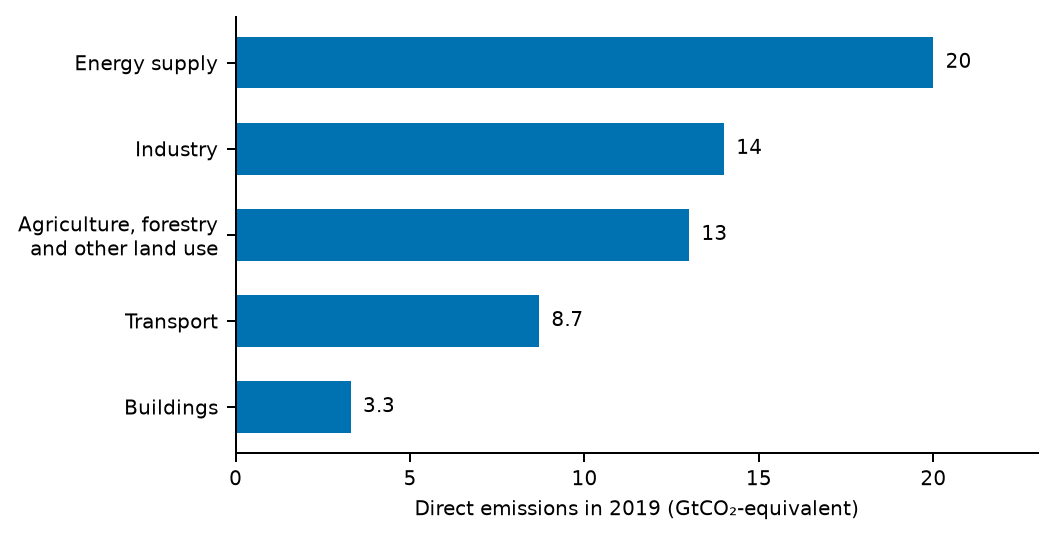
Add the rounded sector values 20, 14, 13, 8.7 and 3.3 GtCO₂-equivalent.
Difficulty 2/5 · 140 coins + a small bonus on first completion today
20+14+13+8.7+3.3=59; do not count electricity again after allocating it to energy supply.
Interpret the climate planetary boundary
- A commonly used climate-boundary CO₂ control value is 350 ppm; NOAA's dated global 2024 value of about 422.8 ppm exceeds it. Radiative forcing is another climate control variable.
- This precautionary risk framework is different from Paris's temperature goal or a national legal allowance. Exceedance is not proof every tipping element has crossed its threshold or that all places collapse on one date.
Is the 350 ppm climate control value the same quantity as the Paris 1.5 °C goal?
Difficulty 1/5 · 100 coins + a small bonus on first completion today
A planetary boundary is a precautionary risk framework, not a direct national legal allowance.
Read climate distributions and regional risk
- Invented: A has 1200 mm/year concentrated in summer; temperature varies 10–30 °C, a range of 20 °C. B has 100 mm/month and 25 °C throughout: the same annual rainfall, but no monthly temperature range. Read rainfall bars on the left axis and temperature lines on the right.
- Equal annual rainfall does not establish equal dry-season stress. Match periods and compare seasonality; regional cyclone intensity or rainfall changes do not require greater storm frequency in every basin.
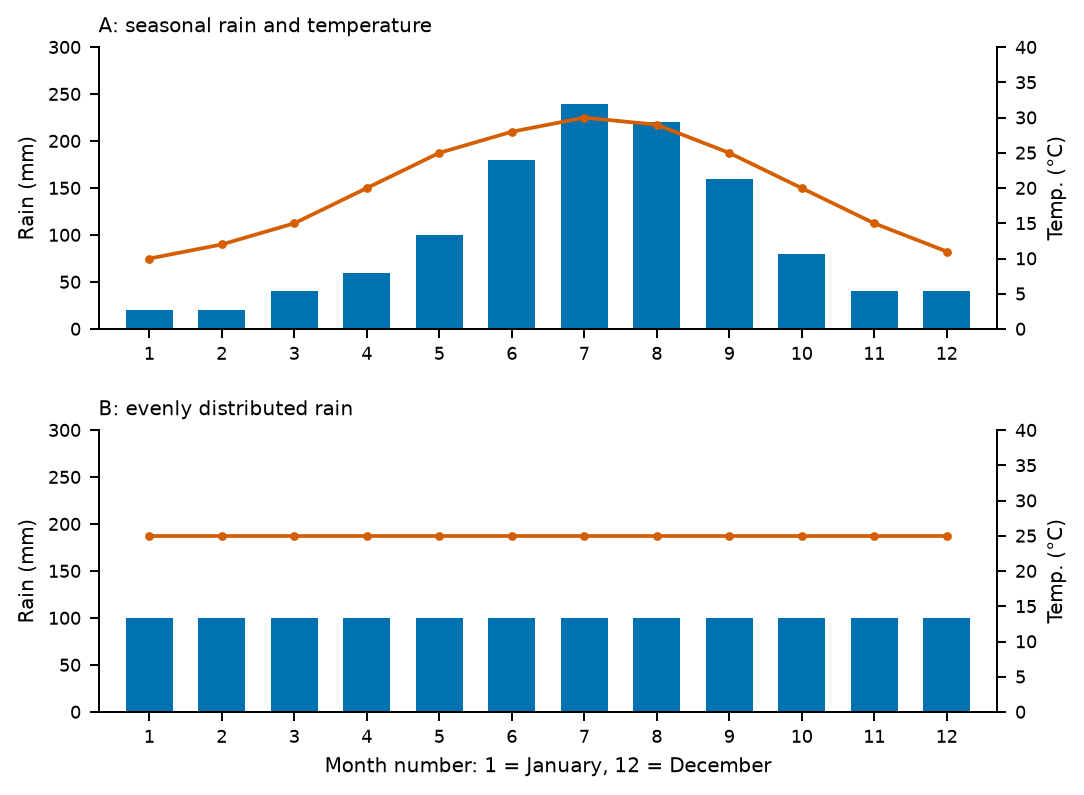
Do equal annual rainfall totals imply equal seasonal water stress?
Difficulty 1/5 · 100 coins + a small bonus on first completion today
Compare monthly distributions, extremes and matching time periods.
Explain ecosystem impacts in context
- Marine heat stress caused widespread Great Barrier Reef bleaching in 2024. Loss of symbiotic algae reduces energy supply; bleaching need not mean immediate death, but repeated or prolonged stress can kill coral and reduce habitat.
- Ranges and seasonal timing can shift; fragmentation and movement rates constrain responses. Some cooler sites may gain growing-season length, but nutrients, water, pests and heat limit productivity gains.
Does coral bleaching necessarily mean immediate coral death?
Difficulty 1/5 · 100 coins + a small bonus on first completion today
Loss of symbiotic algae can reduce energy supply and repeated/prolonged stress can cause mortality.
Compare vulnerability and adaptive capacity
- Tuvalu faces coastal flooding, erosion, saltwater intrusion and infrastructure risks despite a small emissions contribution. UNDP reported handover of 7.3 ha of reclaimed land in October 2024 under its coastal adaptation project.
- Raised land is a specific action, not proof of permanent safety or one inevitable abandonment date. Exposure, sensitivity and adaptive capacity vary with housing, income, occupation, health, rights and finance, including within countries.
Does a coastal adaptation action prove permanent safety for every island?
Difficulty 1/5 · 100 coins + a small bonus on first completion today
Exposure, sensitivity and adaptive capacity vary across groups and time.
Trace ice-albedo amplification
- Warming reduces ice/snow, exposes darker surfaces, reduces reflected sunlight and increases absorbed solar energy, amplifying warming. Positive feedback means amplification, not a favourable result.
- Water vapour and permafrost 永久冻土 carbon can also amplify warming. Warmer bodies radiate more, while extra plant uptake has limits from nutrients, water, heat and disturbance; it cannot be assumed to cancel emissions.

What makes ice-albedo feedback positive?
Difficulty 1/5 · 100 coins + a small bonus on first completion today
Less ice exposes darker surfaces, reducing reflection and increasing absorption.
Separate feedback from tipping claims
- A tipping point 临界点 is a threshold beyond which a component's change may become self-sustaining. Ice sheets, circulation and ecosystems have different mechanisms, uncertainties and response times.
- Positive feedback alone does not locate a threshold or prove immediate global collapse. Perspectives reflect evidence, livelihoods, trust and values; a value label does not predict every individual's policy preference.
Does positive feedback alone prove a particular tipping threshold has been crossed?
Difficulty 1/5 · 100 coins + a small bonus on first completion today
State the mechanism, threshold evidence and response timescale.
Classify mitigation and adaptation by mechanism
- Mitigation reduces emissions or increases net atmospheric removal; adaptation reduces exposure or vulnerability to impacts. An insulated home may do both through different mechanisms.
- Both are needed, and adaptation has limits. Net-zero 净零排放 CO₂ does not instantly restore past sea level, remove all greenhouse gases or make every vulnerable community safe.
Which mechanism describes adaptation?
Difficulty 1/5 · 100 coins + a small bonus on first completion today
An action may have both mitigation and adaptation mechanisms.
Compare avoidance, removal and solar intervention
- Replacing fossil electricity, reducing methane leaks and protecting existing forests can avoid emissions. Reforestation, soil-carbon gains and direct air capture/storage may remove atmospheric CO₂ if the net balance is negative and storage lasts.
- Reflective surfaces and proposed stratospheric aerosol intervention alter solar absorption rather than directly removing CO₂. Technology scale, maturity, land/energy costs, permanence, rights and rainfall effects differ among options.
Which requires a negative complete net balance and durable storage to count as atmospheric removal?
Difficulty 1/5 · 100 coins + a small bonus on first completion today
Capture, avoidance and net removal are different accounting claims.
Evaluate point-source capture honestly
- Capturing CO₂ at a fossil plant or cement kiln can avoid part of a new release. It is not automatically removal of carbon already in the air; direct air capture is a different potential pathway.
- Check capture fraction, residual emissions, energy penalty, upstream inputs, transport, storage and monitoring. Trees/soil also need permanence and saturation checks; a temporary store is not identical to permanent avoidance.
Does capture at a fossil plant automatically remove existing atmospheric carbon?
Difficulty 1/5 · 100 coins + a small bonus on first completion today
Evaluate complete emissions and storage as well as the capture fraction.
Compare structural and non-structural adaptation
- Structural measures include flood barriers, raised buildings, drainage and storage infrastructure. Non-structural measures include warnings, zoning, standards, changed planting dates and emergency plans.
- Mangrove/wetland restoration is ecosystem-based adaptation. Evaluate maintenance, beneficiaries, residual risk, ecology, cost and displaced erosion; desalination also needs energy and brine management.
Which pair gives non-structural adaptation examples?
Difficulty 1/5 · 100 coins + a small bonus on first completion today
Infrastructure and institutions can complement each other.
Explain sponge approaches and planning
- Permeable paving, planted storage and wetlands retain water or slow runoff. Saturation, extreme rain, blocked outlets and maintenance can exceed design capacity; vegetation's shade is a separate heat benefit.
- National adaptation plans address medium/long-term priorities, funding, delivery and monitoring. Earlier NAPAs focused on urgent least-developed-country needs; neither is simply an NDC or an emissions inventory.
What distinguishes a NAP from an NDC?
Difficulty 1/5 · 100 coins + a small bonus on first completion today
Plans need priorities, budgets, implementation and monitoring; names alone do not deliver outcomes.
Collect attitudes without leading respondents
- Use neutral questions, voluntary informed participation, privacy and transparent sampling. Record non-response and recognise that a convenience sample may not represent the whole population.
- Preference, affordability, intention and observed behaviour differ. Participation, local knowledge and rights matter when evaluating retreat, new infrastructure or who receives protection.
Which survey is more defensible?
Difficulty 1/5 · 100 coins + a small bonus on first completion today
Preference, affordability and action are distinct evidence.
Distinguish treaties and implementation
- UNFCCC (1992) provides a framework; Kyoto (1997) set commitments for relevant participating developed-country Parties. Paris (2015) uses successive NDCs, transparency and collective assessment.
- Procedural duties do not guarantee target achievement. A conditional pathway reaching global net-zero CO₂ around the early 2050s is not a universal treaty deadline for every country's net-zero all gases.
Does Paris create a universal legal 2050 deadline for every country to reach net-zero all gases?
Difficulty 1/5 · 100 coins + a small bonus on first completion today
Distinguish CO₂/all gases and conditional global pathways from national implementation.
Compare price and quantity instruments
- A carbon tax 碳税 sets price while emissions response varies. Absolute-cap trading limits covered quantity while allowance price varies; real coverage, monitoring, allocations and offsets affect performance.
- Revenue can fund investment or protect low-income groups. Border measures, finance and technology support raise measurement and fairness questions; a funding announcement differs from money delivered and outcomes achieved.
What does a carbon tax directly set?
Difficulty 1/5 · 100 coins + a small bonus on first completion today
The resulting quantity depends on response; absolute-cap trading fixes covered quantity instead.
Explain the ozone shield
- Shorter electromagnetic wavelength means higher frequency and photon energy. O₂/ozone absorb essentially all solar UV-C and much UV-B, while much UV-A reaches the ground; ozone does not block all sunlight.
- Extra UV-B can damage DNA, raise skin-cancer/cataract risk and harm crops and phytoplankton. The same ozone molecule near ground level is a harmful sunlight-driven secondary pollutant and greenhouse gas.
Which statement about UV protection is accurate?
Difficulty 1/5 · 100 coins + a small bonus on first completion today
Location, wavelengths and chemical processes distinguish the ozone shield and ground-level pollution.
Trace dynamic ozone balance and depletion
- Ozone molecules form and break down continuously; balanced average rates can maintain concentration. Stable CFCs reach the stratosphere, where UV releases reactive chlorine that participates repeatedly in catalytic destruction.
- Chlorine/bromine chemistry, cold polar cloud surfaces, confinement and returning spring sunlight help explain Antarctic ozone loss. The “hole” is severe seasonal depletion rather than empty atmosphere; chlorine atoms are not chloride ions.
In dynamic equilibrium, do ozone molecules stop reacting?
Difficulty 1/5 · 100 coins + a small bonus on first completion today
A steady concentration does not imply zero chemical turnover.
Evaluate Montreal and recovery evidence
- Montreal (1987) controls ozone-depleting substances 消耗臭氧层物质; universal ratification, alternatives, finance, assessment and monitoring supported reductions. Recovery depends physically on lower atmospheric burdens and is delayed by long lifetimes.
- The 2022 assessment projected 1980 ozone values around 2040 near-globally, 2045 Arctic and 2066 Antarctic under stated conditions. Global boundary measures and regional damage differ; annual weather variability does not alone disprove recovery.
Does one annual large Antarctic hole alone disprove long-term ozone recovery?
Difficulty 1/5 · 100 coins + a small bonus on first completion today
Compare regions, periods, conditions and observations rather than a single year.
Link refrigerants to climate protection
- HFCs generally have negligible ozone-depletion potential but compound-specific warming effects. Kigali (2016) phases down controlled HFCs; the phase-out of chlorine-containing HCFCs is a separate Montreal measure.
- Narrower industrial sources and replacements helped ozone cooperation, while climate emissions span many systems. This comparison does not make climate cooperation impossible or ozone protection complete.
Which chemicals are phased down by the Kigali Amendment?
Difficulty 1/5 · 100 coins + a small bonus on first completion today
HCFC phase-out is a separate ozone-depleting-substance measure; HFC warming varies by compound.