Biodiversity, conservation and sampling evidence
Introduced| English | Meaning |
|---|---|
| evenness/ˈiːvənnəs/ | A measure of how similar the abundances of different species are within a community. |
| biodiversity/ˌbaɪəʊdaɪˈvɜːsɪti/ | The variety of life, including genetic diversity, species diversity and ecosystem diversity. |
| species richness/ˈspiːsiːz ˈrɪtʃnəs/ | The number of different species present in an area or community. |
| species diversity | The variety of species in a community, combining their number and relative abundance. |
| habitat diversity | The range of different habitats found in an ecosystem or region. |
| pollution/pəˈluːʃn/ | The introduction of substances or energy into the environment at levels that cause harm. |
| evolution/ɪvəˈluːʃn/ | The change in inherited characteristics of a population over successive generations. |
| speciation/ˌspiːʃɪˈeɪʃn/ | speciation |
| overharvesting/ˌəʊvəˈhɑːvɪstɪŋ/ | overharvesting |
| climate change/ˈklaɪmət tʃeɪndʒ/ | A long-term change in the statistical patterns of temperature, rainfall or other aspects of climate. |
| Data Deficient | A Red List category for a species with too little information to assess its extinction risk. |
| habitat loss/ˈhæbɪtæt lɒs/ | habitat loss |
| seed bank/siːd bæŋk/ | A stored collection of seeds for conservation or a reserve of viable seeds naturally present in soil. |
| captive breeding/ˈkæptɪv ˈbriːdɪŋ/ | Breeding a threatened species in zoos or similar facilities, often for later release. |
| reintroduction | Releasing a species into an area where it had disappeared, to re-establish a population. |
| corridor | A strip of habitat that links separated reserves or patches so that organisms can move between them. |
| buffer zone | Land around a protected core area where human activity is limited to reduce outside pressure. |
| rewilding | Large-scale restoration that lets natural processes return, often with missing species reintroduced. |
| Red List | The IUCN inventory that assesses the extinction risk of species worldwide. |
| mass extinction | A short geological period in which a large share of Earth's species die out. |
| biodiversity hotspot | biodiversity hotspot |
What would explain this observation?
- A site with many individuals can still be dominated by one species. Abundance, richness and evenness 均匀度 describe different features of biodiversity.
Build the model
- Species richness 物种丰富度 counts species.
- Evenness concerns relative abundance.
- Conservation can protect habitats, populations or genetic diversity; a management judgement must state the conservation goal.
- species richness: The number of species recorded.
- evenness: How evenly individuals are distributed among species.

Two sites have three species each. Which can still differ?
Difficulty 1/5 · 100 coins + a small bonus on first completion today
Richness counts species only; evenness describes how individuals are shared among them. Two sites can both have three species while one is dominated by a single species and the other is balanced - different evenness, same richness.
Match each technical term to its precise meaning.
Difficulty 2/5 · 140 coins + a small bonus on first completion today
Use the definitions to distinguish related quantities and processes.
Choose evidence that can test it
- Compare surveys with similar area, effort, season and identification rules.
- A diversity index is meaningful only with its formula and conventions specified.
- Habitat fragmentation can affect movement and gene flow even when total area changes little.
In the lab: Use non-destructive field sampling approved by the school. Identify organisms with a suitable key and record uncertain identifications rather than inventing species. Combine ecological evidence with stakeholder perspectives on land use.
Which two habits make the investigation or model in this case more defensible?
Difficulty 2/5 · 140 coins + a small bonus on first completion today
Stating the conditions and assumptions lets others repeat the work exactly, and recording the supporting evidence lets them check the conclusion. Hiding disagreeing results removes the evidence that could challenge a wrong conclusion, and one measurement can never establish a wider claim.
Work from known quantities
- Known: site A has counts 8, 1 and 1; site B has 4, 3 and 3.
- Both have richness 3 and total abundance 10.
- The most abundant species occupies 80% in A and 40% in B.
- B is more even under these counts.
Your turn: A survey records 6, 5, 3 and 2 individuals in four species. Find species richness.
Same richness, different distribution
Start with A: 8, 1, 1 and B: 4, 3, 3. Both record 3 species and 10 individuals, but the largest species shares are 80% and 40%. Separate richness, total abundance and distribution.
A survey records 6, 5, 3 and 2 individuals in four species. Find species richness.
Difficulty 2/5 · 140 coins + a small bonus on first completion today
The result is 4 species. Known: counts 6, 5, 3 and 2 across four species. Species richness = number of species = 4. Total abundance = 16; evenness would need the distribution, which richness ignores.
Check the conclusion and its limits
- An index cannot by itself explain the cause of a difference.
- A newly recorded species may reflect improved observation rather than a recent ecological arrival.
Not true: A larger total number of individuals always means greater species richness. Richness counts how many species are present, not how many individuals. Ten thousand individuals of one species give richness 1, while ten species with one individual each give richness 10.
- Species richness counts species.
- Compare surveys with similar area, effort, season and identification rules.
- Watch for: an index cannot by itself explain the cause of a difference.
Richness counts how many species are present, not how many individuals.
Difficulty 1/5 · 100 coins + a small bonus on first completion today
True. Richness counts how many species are present, not how many individuals. Ten thousand individuals of one species give richness 1, while ten species with one individual each give richness 10.
The number of species recorded: write the technical term.
Difficulty 1/5 · 100 coins + a small bonus on first completion today
species richness means The number of species recorded.
Write from the data: find the richness
- A survey records 7, 2, 2, 2 and 1 individuals across five species.
- State the species richness. A larger total of individuals is not greater richness.
A survey records 7, 2, 2, 2 and 1 individuals in five species. What is the species richness, and why is the total of 14 not the richness?
Richness counts species. Abundance counts individuals.
A survey records 7, 2, 2, 2 and 1 individuals in five different species. What is the species richness?
Difficulty 1/5 · 100 coins + a small bonus on first completion today
Count the five species with nonzero observations: richness = 5 species. Total abundance = 7 + 2 + 2 + 2 + 1 = 14 individuals. The largest count, 7, belongs to one species; neither 14 nor 7 is richness.
Separate three levels of biodiversity
- Genetic diversity concerns inherited variation within a species; species diversity 物种多样性 concerns richness and relative abundances in a community; habitat diversity 生境多样性 concerns the range of habitats. A landscape can gain one habitat type while losing another, and a population can retain its species name while losing genetic variation. Choose the level that matches the observation rather than substituting the total number of individual organisms.
- Variation in responses and functions can support resilience, but richness does not guarantee recovery from every disturbance. A community of several species all vulnerable to the same pollutant may lose several functions at once. Ask what functions are present, how responses differ and whether habitat remains suitable; “more diversity” alone is not a complete mechanism.
A population retains its species name but loses inherited variation. Which level has directly changed?
Difficulty 1/5 · 100 coins + a small bonus on first completion today
Genetic, species and habitat diversity concern different properties.
Calculate the stated reciprocal index
- For invented counts 8, 1 and 1, total N is 10 and the sum of n(n−1) is 56. For counts 4, 3 and 3, N is also 10 but the sum is 24. Using the stated finite-sample convention, the respective indices are 90/56 = 1.607 and 90/24 = 3.75. The second sample is more even under equal observed richness.
- State the formula: $D=\dfrac{N(N-1)}{\sum n(n-1)}$. This reciprocal index is different from Simpson dominance or one minus dominance. The finite-sample expression can exceed observed richness, so 3.75 is not automatically wrong because three species were observed. An index compares a feature of the samples; it does not identify pollution 污染 or prove why the communities differ.

Counts are 12, 4 and 4. Use D = N(N−1)/Σn(n−1). Find D.
Difficulty 2/5 · 140 coins + a small bonus on first completion today
Total N = 12 + 4 + 4 = 20. Sum n(n−1) = 12×11 + 4×3 + 4×3 = 132 + 12 + 12 = 156. D = 20×19/156 = 380/156 = 2.435897…, or 2.4 to two significant figures (2.44 to three). This reciprocal index is distinct from dominance or one minus dominance.
With counts 4, 3 and 3, can the stated finite-sample reciprocal index be 3.75?
Difficulty 1/5 · 100 coins + a small bonus on first completion today
90/(12+6+6)=3.75. Do not silently substitute another convention.
Compare surveys before comparing diversity
- Use comparable area, effort, season, sampling method and identification rules. A longer search can record more species without a real ecological increase. Repeated random or appropriately stratified samples help characterise variation; an accurately calculated index cannot repair a design that sampled only the easiest or richest patches.
- Keep uncertain identifications, missing observations and individual counts visible. A species not detected in one visit is not necessarily absent. Citizen scientists, trained local experts, parabiologists, museums and agencies can improve records with dates, locations and verification. Follow permissions and avoid disclosing sensitive locations of threatened organisms where that could increase harm.
A longer search records two more species. What is justified?
Difficulty 1/5 · 100 coins + a small bonus on first completion today
Detection and ecological change are different explanations.
Explain selection through reproduction
- Individuals vary, some variation is heritable, and environmental conditions affect survival and reproduction. When variants differ in their contribution to later generations, inherited characteristics can change in frequency. Fitness concerns reproductive contribution in a stated setting; the largest, strongest or longest-lived individual need not leave the most descendants.
- Individuals do not evolve a needed inherited trait by trying harder. Selection is not a deliberate search for perfection, and the environment can change which traits are advantageous. Evolution 进化 need not create a new species, while a short-term change in body condition need not be heritable evolution at all. Separate the population, generations and evidence for inheritance.
What does fitness concern in natural selection?
Difficulty 1/5 · 100 coins + a small bonus on first completion today
Heritable variation and differential reproductive success connect selection to evolution.
Distinguish isolation from completed speciation 物种形成
- A physical barrier can reduce gene flow between populations. Different selection, mutation and drift may then produce divergence, and reproductive isolation can develop. Separation is an opportunity, not a guarantee: populations may remain reproductively compatible or mix again when a barrier disappears.
- Reproductive isolation can also involve breeding time, habitat use or mate recognition without a complete geographical barrier. Test the proposed mechanism rather than assuming that different colours mean different species. A biological species concept has limits for fossils, asexual organisms and some hybridising groups; classify using evidence appropriate to the organisms and question.
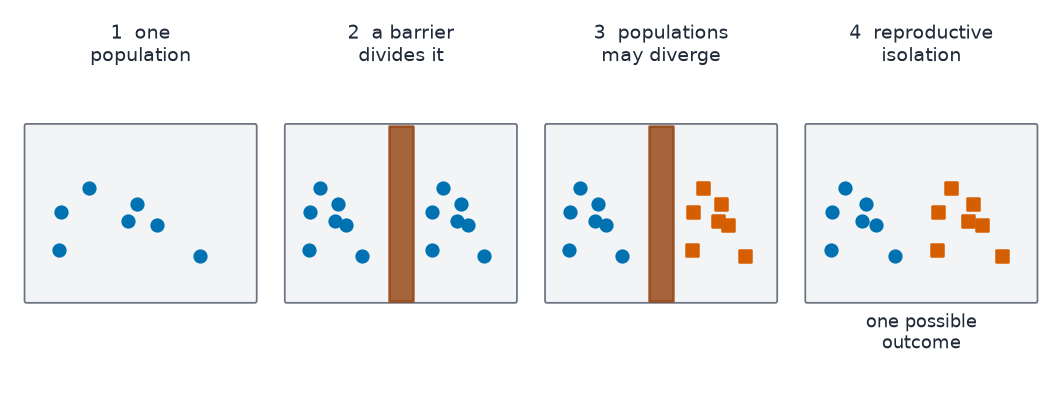
Does a new geographical barrier guarantee a new species?
Difficulty 1/5 · 100 coins + a small bonus on first completion today
Separation can enable divergence without guaranteeing its completion.
Read a loss statistic without changing its meaning
- A decline in population abundance is different from loss of species, and a global index is different from a complete census. The dated 2024 Living Planet Report described a 73% decline in its monitored-vertebrate population index from 1970 to 2020. It did not show that 73% of vertebrate species became extinct or that every monitored population declined.
- Check which organisms, locations and years were included and how trends were combined. Changing a database can change an index estimate; two report editions need not be directly comparable. A biodiversity threat estimate, an IUCN assessment and a local sample answer different questions. Use each with its date and uncertainty rather than combining their percentages as if they shared one denominator.
A 73% decline in a monitored-population index means which?
Difficulty 1/5 · 100 coins + a small bonus on first completion today
Specify organisms, weighting, coverage and dates; do not change the denominator.
Trace interacting causes of biodiversity loss
- Habitat conversion removes or changes resources and living space. Overharvesting 过度捕捞 removes organisms faster than suitable replacement; pollution alters conditions or directly harms them; invasive alien species can change competition, predation and disease; climate change 气候变化 shifts temperature, water and disturbance regimes. Population, consumption, technology and governance influence these pressures.
- Mechanisms can combine: fragmented habitat can prevent movement toward suitable climate, while pollution reduces survival in the remaining patches. A list of HIPPO words is weaker than a chain from action to exposure, biological effect and population outcome. Identify the scale and alternative explanations before declaring one pressure responsible for every local decline.
Why can a corridor fail to solve a climate-related range problem?
Difficulty 1/5 · 100 coins + a small bonus on first completion today
Management must address the actual constraints, not just one map feature.
Distinguish introduced from invasive
- An alien species occurs outside its native range through human movement; an invasive alien establishes, spreads and causes damaging effects under the relevant definition. Not every introduction becomes invasive, and an abundant native species is not an alien merely because it causes a problem. Transport pathways, reproduction, suitable habitat and interactions affect establishment.
- Prevention, early detection, removal or containment need a named target and follow-up. A mammalian predator-exclusion fence and pest removal at Zealandia illustrate a habitat intervention for selected introduced threats; a fence cannot exclude every organism or maintain itself. Compare reinvasion, non-target harm, feasibility and ecological recovery rather than equating the number removed with permanent success.
Is every introduced organism an invasive alien?
Difficulty 1/5 · 100 coins + a small bonus on first completion today
Native range and harmful invasion are different properties.
Evaluate fragmentation through a species' needs
- Fragmentation divides habitat and can increase edge exposure or reduce movement and gene flow. Temperature, light, wind, moisture and predators can differ near an edge, but the direction and depth of effects vary. An interior specialist and an edge-tolerant species need not respond alike to the same road or clearing.
- An invented square reserve has side 1000 m and an assigned uniform edge depth of 100 m. Interior side length is 800 m, so interior area is 640000 m², or 64% of the original million square metres. This is a geometry model, not a measured universal ecological boundary. Real influence can cross any assigned core through water, air, fire and animal movement.
A square reserve has side 1000 m and an assigned 100 m edge depth on every side. What percentage is interior?
Difficulty 2/5 · 140 coins + a small bonus on first completion today
Interior side = 1000 − 2×100 = 800 m. Interior area = 800² = 640000 m². Total area = 1000² = 1000000 m². Interior percentage = 640000/1000000 × 100 = 64% under the assigned edge model.
Read threat categories as assessments
- IUCN assessments use specified evidence and criteria concerning decline, population, range and extinction risk. Vulnerable, Endangered and Critically Endangered are the three threatened categories. Least Concern and Near Threatened do not mean an organism is immune to future threats; Extinct in the Wild and Extinct describe different conditions.
- Data Deficient 数据缺乏 means evidence is insufficient for a suitable assessment; Not Evaluated means the assessment has not been made. Neither is a low-risk rung below Least Concern. Listing can guide research, funding and rules, but it does not itself supply enforcement, habitat or a guaranteed recovery plan. Specify the date, taxon and geographical scope of a status claim.

What does Data Deficient establish?
Difficulty 1/5 · 100 coins + a small bonus on first completion today
Unknown risk is not zero risk.
Use case histories with dated evidence
- The baiji is described as Critically Endangered (Possibly Extinct) in the cited assessment; non-detection in a major survey is serious evidence without being the same as a confirmed Extinct listing. The passenger pigeon is a confirmed extinction case: intensive exploitation and habitat loss 栖息地丧失 overwhelmed a once-abundant species. Former abundance does not guarantee protection from rapid decline.
- The Yangtze finless porpoise and giant panda illustrate different conservation histories, involving habitat measures, threat reduction and monitoring. An increased estimate after intervention is encouraging but does not isolate the effect of one action or guarantee permanent recovery. Compare methods and intervals, consider other changes and distinguish local recovery from global risk status.
Why distinguish Possibly Extinct from the Extinct category?
Difficulty 1/5 · 100 coins + a small bonus on first completion today
Serious non-detection must be reported accurately without overstating classification.
Explain an open-access resource problem
- When users receive private benefits from an extra harvest but share depletion costs, incentives can favour overuse. That is one tragedy-of-the-commons mechanism. Shared ownership is not automatically unrestricted access: communities can establish effective rules, rights, monitoring and sanctions that change incentives and protect a common resource.
- In an invented fishery, stock growth of 120 tonnes and catches of 150 tonnes imply a 30-tonne decrease if other flows are ignored. A fixed allowance based on one good year is unsafe as a universal inference. Recruitment, migration, climate, food webs and compliance matter; reducing catches needs attention to livelihoods and displacement of fishing elsewhere too.
Ignoring other flows, annual growth is 120 tonnes and catch 150 tonnes. Find the magnitude of stock decrease.
Difficulty 2/5 · 140 coins + a small bonus on first completion today
Stock change=120−150=−30 tonnes. The requested decrease magnitude is 30; stock and flow units must remain explicit.
Does shared ownership inevitably cause overuse?
Difficulty 1/5 · 100 coins + a small bonus on first completion today
An open-access incentive model is not a universal claim about communal management.
Make conservation values explicit
- Intrinsic arguments value organisms or ecosystems in themselves. Instrumental arguments concern benefits such as food, medicines, water regulation, cultural relationships or scientific knowledge. Ethical, ecological, aesthetic, economic and social reasons can coexist; a stakeholder need not fit one exclusive environmental-value box.
- Conflicts require specifying who benefits, who pays and which effects cannot easily be priced. A project's revenue does not measure every cultural or ecological value. Compare options against the stated goal and consider fairness as well as total benefit. A claim that a species is useful to people does not make that its only possible reason for protection.
Which is an intrinsic-value argument?
Difficulty 1/5 · 100 coins + a small bonus on first completion today
Instrumental and intrinsic reasons can coexist without being identical.
Connect agreements to their actual roles
- CITES regulates international trade in listed species through its framework and national implementation; it is not a universal ban on every domestic use. The Convention on Biological Diversity concerns conservation, sustainable use and fair sharing of genetic-resource benefits. Legal commitments require implementation, resources and monitoring before their intended effects can be assumed.
- The Kunming–Montreal framework's Target 3 aims for at least 30% conservation of terrestrial/inland-water areas and marine/coastal areas by 2030. Effective management, representation, connectivity, equitable governance and Indigenous/local rights accompany the area target. Announcing a boundary around an unsuitable or unenforced area does not establish that biodiversity has been protected.
Does announcing a 30% protected area alone demonstrate Target 3 success?
Difficulty 1/5 · 100 coins + a small bonus on first completion today
Area alone does not establish a functional and equitable conservation outcome.
Match species measures to remaining threats
- Ex situ conservation keeps organisms or genetic resources outside their natural habitats, such as botanic gardens, suitable seed banks 种子库 or captive-breeding 圈养繁殖 programmes. In situ measures conserve organisms within their ecological settings. Species-focused protection can also occur in situ; species-based and ex situ are not identical categories.
- Captive breeding can prevent immediate loss and support reintroduction 重新引入, but needs genetic management, suitable behaviour, disease precautions and habitat where threats are controlled. Many seeds tolerate drying and cold storage; not all do, so other collections may be necessary. A flagship attracts attention, while a keystone has disproportionate ecological effects; one organism can have both roles, but the terms are different.
Is every species-focused measure ex situ?
Difficulty 1/5 · 100 coins + a small bonus on first completion today
Species focus and the location of conservation describe different classifications.
Design reserves as trade-offs
- Larger connected habitat can support movement and larger populations, while several separated sites can spread the risk of one local disaster. At equal area, a compact shape generally has less perimeter than an elongated one; the ecological benefit depends on edge-sensitive species and conditions. Compare like areas before claiming that shape alone caused an advantage.
- Corridors 生态廊道 can aid dispersal and gene flow but can also transmit invasive organisms, disease or fire and require land and management. Buffer zones 缓冲区 can reduce disturbance; surrounding roads, farms, settlements and water flows still matter. A design is a hypothesis about species and threats, not a universal ranking of pictures from bad to good.

Which comparison isolates the geometric role of compactness?
Difficulty 1/5 · 100 coins + a small bonus on first completion today
State controlled quantities and ecological assumptions before ranking layouts.
Combine restoration, processes and people
- Habitat protection may require active management, such as restoring drainage, controlling damaging invaders or allowing native regeneration. Rewilding 再野化 aims to restore ecological processes, sometimes including reintroductions and improved connectivity. It does not simply mean abandoning a site regardless of neighbours, animal welfare, fire or food production.
- A biosphere-reserve model distinguishes a protected core, a buffer and a transition zone with compatible human activity. Wuyishan offers a named subtropical-forest conservation setting. Zoning should connect biodiversity goals with livelihoods and participation; a label alone does not establish that rules are fair, enforced or ecologically effective.
Judge outcomes rather than announcements
- Planting trees, erecting a fence or announcing protected hectares measures activity. Native regeneration, survival, breeding success, connectivity and community benefits measure different outcomes. Define a baseline and monitoring period, retain uncertainty and compare suitable sites or trends where possible; one before-and-after pair rarely rules out climate or other concurrent changes.
- In an invented comparison, breeding pairs rise from 40 to 60 at the restored site and from 50 to 55 at an untreated site. The additional change is (60−40)−(55−50) = 15 pairs under the comparison model. It supports a qualified interpretation only if the sites would otherwise have followed sufficiently comparable trends; it is not a randomised experiment merely because subtraction was possible.
Breeding pairs change 40→60 at a restored site and 50→55 at a comparison site. Find the difference-in-changes.
Difficulty 2/5 · 140 coins + a small bonus on first completion today
Restored-site increase = 60 − 40 = 20 pairs. Comparison-site increase = 55 − 50 = 5 pairs. Difference-in-changes = 20 − 5 = 15 pairs, conditional on comparable trends and other design assumptions.
Build a conservation judgement from evidence
- State the conservation goal, target organisms, pressures and relevant level of biodiversity. Select evidence that can measure change with comparable effort and suitable identification. Explain the mechanism by which each proposed action addresses a pressure; connect constraints such as dispersal, resources, law, costs and public acceptance to likely outcomes.
- Compare at least two feasible approaches, including benefits, limits and effects on local people. A mixed strategy can combine immediate species rescue with longer-term habitat protection. End with a justified decision and monitoring that could reveal failure, rather than treating a Red List 红色名录 category, an index or an attractive reserve diagram as a complete answer.
Evaluate a proposal combining captive breeding, a habitat corridor and local tourism income.
A conservation judgement connects evidence, mechanisms, trade-offs and an explicit goal.
AHL: Separate new alleles from new combinations
- Mutation can create new alleles; sexual reproduction recombines existing variation through meiosis and fertilisation. Selection changes relative reproductive success, while drift can alter frequencies by chance. Human-directed breeding deliberately selects parents; repeated use of a narrow parental base can reduce variation and increase shared vulnerability, though loss is not inevitable in every programme.
- Tusklessness in Gorongosa elephants illustrates selection associated with ivory poaching, not a deliberate decision by elephants or proof of a new species. Preservation of diverse breeding lines and wild relatives can retain adaptive possibilities. State the inherited variation, selective pressure and evidence rather than assuming that any useful change arose because an organism needed it.
Which process can create a new allele?
Difficulty 1/5 · 100 coins + a small bonus on first completion today
Meiosis and fertilisation create combinations; mutation can create a new sequence variant.
AHL: Compare routes toward reproductive isolation
- Geographical separation can reduce gene flow, while habitat use, breeding time or mate recognition can restrict it in the same broad region. Island endemism can reflect limited colonisation and isolation, but a narrow range also makes some populations vulnerable to a single disturbance or introduction. Isolation, divergence and complete speciation are distinct claims.
- Research on the Big Bird finch lineage documented reproductive isolation following hybrid ancestry; apple and hawthorn host races of Rhagoletis show partial isolation during ongoing divergence. These examples do not establish that every hybrid becomes a species or that the host races are fully separate species already. Use the actual reproductive and genetic evidence, with the observation period and species concept stated.
What is supported by partial host-associated isolation in Rhagoletis?
Difficulty 1/5 · 100 coins + a small bonus on first completion today
Separate mechanism, degree of isolation and final taxonomic claims.
AHL: Put fossils and extinction on the right timescale
- Fossils, sedimentary context and dating help reconstruct change over Earth's roughly 4.5-billion-year history. Eons contain eras, which contain periods and epochs. Preservation is uneven, so first or last observed fossils constrain recorded occurrences rather than perfectly capturing an organism's origin or exact extinction date.
- Tectonic changes can isolate populations, connect faunas, build mountains and shift climates. Different mass-extinction 大灭绝 intervals involved different combinations of volcanism, climate/ocean change, sea levels and impact. The end-Cretaceous event removed non-avian dinosaurs; birds survived. Post-extinction diversification does not imply that lost functions and communities are quickly or exactly replaced.
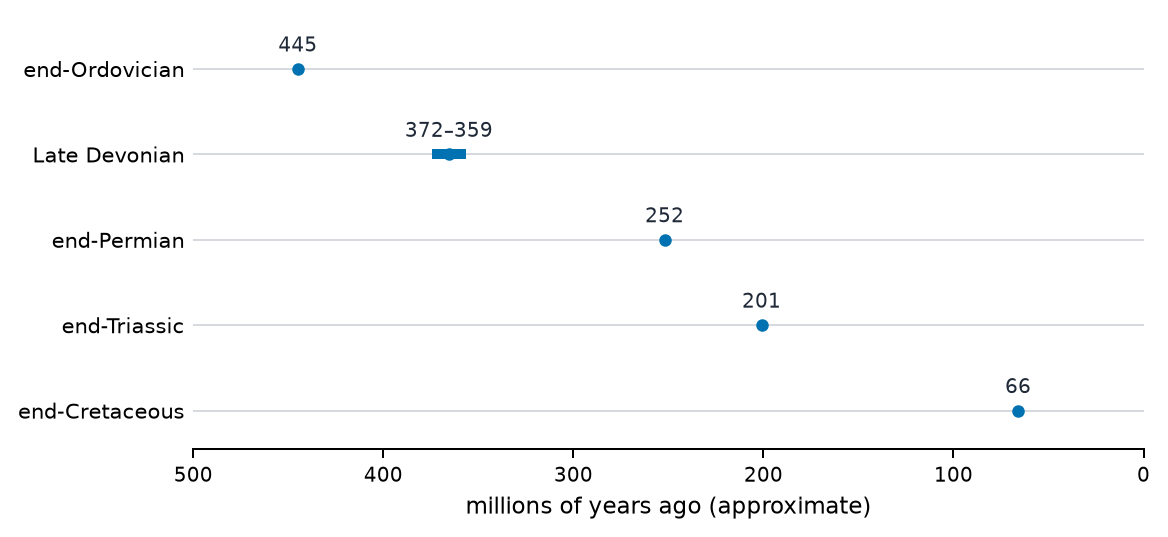
Does the last fossil found give an exact extinction date?
Difficulty 1/5 · 100 coins + a small bonus on first completion today
Distinguish last recorded occurrence from the true extinction event.
AHL: Distinguish human signatures from a formal epoch
- Artificial radionuclides, combustion particles, plastics and other new materials, altered sedimentation and redistributed organisms can leave human signals in geological records. A proposed boundary marker needs a dated position, preservation and useful correlation across sites. Evidence of human influence is different from agreement about one formal start date.
- The proposed Anthropocene epoch was rejected by IUGS/ICS in 2024; the term remains in wider scientific and social use. This formal classification decision did not erase human impacts or declare environmental pressures harmless. Separate observations, models, proposed nomenclature and adopted classifications when evaluating the claim.
Did rejecting a formal Anthropocene epoch erase evidence of human impacts?
Difficulty 1/5 · 100 coins + a small bonus on first completion today
Formal geological nomenclature is a different claim from the existence of human signatures.
AHL: Prioritise sites with explicit criteria
- A terrestrial biodiversity hotspot 生物多样性热点 requires at least 1500 endemic vascular plant species and loss of at least 70% of original natural vegetation under the stated definition. A key biodiversity area identifies a globally important site using qualifying biodiversity evidence; neither designation is automatically a legal reserve. High richness, a hotspot region and a formally identified site are different categories.
- Two confirmed database examples are Kakadu Savanna, assessed in 2018, and Tanjung Puting, with a legacy assessment from 2001. Savanna management in the first requires attention to fire and introduced species; the second includes peat-swamp and heath forest with historical logging, conversion and fire pressures. Habitat protection must address the relevant organisms and processes. Dated records do not establish today's exact populations, and KBA recognition does not itself enforce a legal reserve.
A rich region has 1600 endemic vascular plant species but has lost only 20% of its original vegetation. Does it satisfy both stated hotspot thresholds?
Difficulty 1/5 · 100 coins + a small bonus on first completion today
Both the endemism and loss criteria must be assessed under the stated definition.
AHL: Evaluate knowledge, rights and management
- Kakadu's Bininj/Mungguy and park staff combine cultural burning with contemporary management. Patchy burns under suitable conditions can reduce fuel continuity and extensive later fires. Disrupted land access, knowledge transfer, invasive grasses and climate change can challenge this approach. A named practice is evidence to examine, not a stereotype that every Indigenous community manages land identically.
- Conservation justice asks who decides, who can remain, who loses access and who benefits. Dated UN communications concerning Maasai communities in Ngorongoro record allegations of pressure and displacement. Distinguish allegations, findings and outcomes, and assess participation, livelihoods and grievance mechanisms alongside biodiversity effects. An ecological objective does not automatically establish that a project's social costs are justified.
What belongs in evaluating conservation justice?
Difficulty 1/5 · 100 coins + a small bonus on first completion today
A biodiversity goal does not remove the need to assess social consequences and evidence.
AHL: Trace restoration feedback without changing its sign
- In an illustrative woodland model, more trees provide more seed and shelter, which can increase recruitment and support more trees. This is reinforcing positive feedback because it amplifies a change, not because the outcome is welcomed. Competition, water limits and grazing can oppose growth; a measured increase alone does not prove a tipping threshold or alternative stable states.
- Rewilding can reconnect habitat and restore natural processes but may change neighbouring farms, food supply, wildlife conflict and employment. Government agencies, international bodies and NGOs have different funding, powers, influence and constraints. UNEP does not enforce every domestic law; NGOs can campaign or pursue litigation without being legislatures. Compare actual capacity and results rather than fixed stereotypes about speed or independence.
More trees → more seed and shelter → more recruitment → more trees is what kind of model loop?
Difficulty 1/5 · 100 coins + a small bonus on first completion today
The sign depends on amplification of change, not whether the outcome is desired.
AHL: Evaluate restoration and tourism at several levels
- Check whether the planned activity happened, whether ecological and social outcomes improved, and whether the project was a defensible choice compared with alternatives. An invented difference-in-changes of 15 breeding pairs needs comparable-trend assumptions; success also depends on other species, habitat processes, funding continuity and community acceptance.
- For invented tourism, 8000 visits at 20 currency units generate 160000 gross receipts; operating costs of 110000 leave 50000 before omitted costs. Revenue is not profit, and neither automatically equals conservation funding or local benefit. Monitor disturbance, water, waste, prices and distribution as well as visitor totals. An attractive project account is not by itself an independent evaluation of long-term recovery.
8000 visits each pay 20 currency units. Operating costs are 110000. Find the remaining amount before omitted costs.
Difficulty 2/5 · 140 coins + a small bonus on first completion today
Gross receipts=8000×20=160000; subtract 110000=50000. State what costs and distribution are still excluded.