Redox and electrolysis
Introduced| English | Meaning |
|---|---|
| oxidation/ˌɒksɪˈdeɪʃn/ | A chemical change involving a loss of electrons or an increase in oxidation state. |
| reduction/rɪˈdʌkʃn/ | A chemical change involving a gain of electrons or a decrease in oxidation state. |
| oxidation state/ˌɒksɪˈdeɪʃn steɪt/ | A number showing the charge an atom would have if all of its bonds were ionic. |
| oxidizing agent/ˈɒksɪdaɪzɪŋ ˈeɪdʒənt/ | oxidizing agent |
| reducing agent/rɪˈdjuːsɪŋ ˈeɪdʒənt/ | A substance that donates electrons to another substance and is itself oxidised. |
| displacement/dɪˈspleɪsmənt/ | A reaction in which one element replaces another in a compound. |
| salt bridge/sɒlt brɪdʒ/ | A link of ions between two half-cells that completes the circuit. |
| secondary cell | A rechargeable cell. |
| primary cell | A cell that cannot be recharged. |
| fuel cell/ˈfjuːəl sel/ | An electrochemical device that converts the chemical energy of a continuously supplied fuel and oxidant into electricity. |
| spontaneous/spɒnˈteɪnɪəs/ | Able to happen without continuous outside energy; ΔG is negative. |
| distillation/dɪstɪˈleɪʃn/ | Separating substances by vaporising and condensing them, using differences in volatility or boiling point. |
| reflux/ˈriːflʌks/ | Heating a reaction mixture while condensing its vapour and returning the condensate to the same vessel. |
| hydrogenation/haɪˈdrɒdʒəneɪʃn/ | The addition of hydrogen to a substance, often across a carbon-carbon double bond using a catalyst. |
| cell potential/sel pəˈtenʃl/ | The potential difference between the electrodes of an electrochemical cell. |
| standard hydrogen electrode/ˈstændəd ˈhaɪdrədʒn ɪˈlektrəʊd/ | The hydrogen reference electrode assigned a standard electrode potential of zero volts. |
| inert electrode/ɪˈnɜːt ɪˈlektrəʊd/ | An electrode, such as platinum or graphite, that does not take part in the reaction. |
What would explain this observation?
- An aqueous salt solution can produce different electrode products from the molten salt. Water introduces competing species into the system.
Build the model
- Oxidation 氧化 is loss of electrons and reduction 还原 is gain of electrons.
- In electrolysis, cations move toward the cathode and anions toward the anode.
- Reduction occurs at the cathode.
- oxidation: Loss of electrons.
- reduction: Gain of electrons.

What happens to Cu²⁺ at the cathode?
Difficulty 1/5 · 100 coins + a small bonus on first completion today
The cathode is where reduction happens: Cu2+ gains two electrons and becomes copper metal, Cu2+ + 2e- -> Cu. Ions do not gain neutrons, and losing protons would change the element, which chemistry cannot do.
Match each technical term to its precise meaning.
Difficulty 2/5 · 140 coins + a small bonus on first completion today
Use the definitions to distinguish related quantities and processes.
Choose evidence that can test it
- Predict products using the specified electrolyte and electrode material.
- In an aqueous solution, hydrogen or oxygen may form because water-related species compete.
- Molten salts contain only the ions of the salt.
In the lab: Use a low-voltage direct-current supply, approved electrodes, and the school risk assessment. Collect gases only by an approved method. Keep chlorine demonstrations teacher-controlled; do not ask students to generate hazardous gases independently.
Which two habits make the investigation or model in this case more defensible?
Difficulty 2/5 · 140 coins + a small bonus on first completion today
Stating the conditions and assumptions lets others repeat the work exactly, and recording the supporting evidence lets them check the conclusion. Hiding disagreeing results removes the evidence that could challenge a wrong conclusion, and one measurement can never establish a wider claim.
Work from known quantities
- Known: a copper ion gains two electrons.
- Half-equation: Cu²⁺ + 2e⁻ → Cu.
- One mole of Cu²⁺ requires two moles of electrons.
- For 0.050 mol of copper, electron amount = 2 × 0.050 = 0.100 mol.
Your turn: How many moles of electrons reduce 0.20 mol of Cu²⁺ to copper?
Two electrons per copper ion, at either cathode
Reducing 0.050 mol Cu²⁺ to copper requires 0.100 mol electrons. Track copper and electron amounts, then compare cathode signs while keeping reduction and the 2:1 ratio unchanged.
How many moles of electrons reduce 0.20 mol of Cu²⁺ to copper?
Difficulty 2/5 · 140 coins + a small bonus on first completion today
The result is 0.4 mol. Known: 0.20 mol of Cu2+; the half-equation is Cu2+ + 2e- -> Cu, so 1 mol of Cu2+ needs 2 mol of electrons. Electron amount = 2 x 0.20 = 0.40 mol. The half-equation supplies the mole ratio.
Check the conclusion and its limits
- Electrode signs depend on the cell type.
- In an electrolytic cell the cathode is negative; reduction remains the defining process at a cathode in every cell.
Not true: Reduction means loss of electrons. Reduction is defined as gain of electrons (OILRIG: oxidation is loss, reduction is gain). At a cathode, reduction occurs in every cell type, whatever the electrode sign.
- Oxidation is loss of electrons and reduction is gain of electrons.
- Predict products using the specified electrolyte and electrode material.
- Watch for: electrode signs depend on the cell type.
Write from the data given
- The half-equation is Cu2+ plus 2e- to Cu.
- Find the electron amount that reduces 0.25 mol of copper(II) ions. Reduction is gain of electrons.
Reduction means loss of electrons.
Difficulty 1/5 · 100 coins + a small bonus on first completion today
Reduction is defined as gain of electrons (OILRIG: oxidation is loss, reduction is gain). At a cathode, reduction occurs in every cell type, whatever the electrode sign.
Loss of electrons: write the technical term.
Difficulty 1/5 · 100 coins + a small bonus on first completion today
oxidation means Loss of electrons.
How many moles of electrons reduce 0.25 mol of copper(II) ions to copper, and what does reduction mean?
Use Cu²⁺ + 2e⁻ → Cu. Electron amount = 2 × copper-ion amount = 2 × 0.25 = 0.50 mol. Cu²⁺ gains electrons, so it is reduced; reduction is gain of electrons in every cell type.
How many moles of electrons reduce 0.25 mol of Cu²⁺ to copper?
Difficulty 1/5 · 100 coins + a small bonus on first completion today
Cu²⁺ + 2e⁻ → Cu uses two moles of electrons per mole of copper(II) ions. For 0.25 mol of ions, the electron amount is 2 × 0.25 = 0.50 mol. The copper amount itself misses the factor of two; 0.40 mol would apply to the earlier 0.20 mol example.
R3.2: Track oxidation and reduction together
- Oxidation loses electrons or increases oxidation state 氧化态; reduction gains electrons or decreases oxidation state. In Zn + Cu²⁺ → Zn²⁺ + Cu, zinc changes 0 → + 2 and copper + 2 → 0. The coupled changes conserve charge and electron amount.
- In covalent organic reactions, oxidation states are formal accounting rather than evidence that free electrons are released into the solution. Oxygen gain or hydrogen loss often indicates oxidation, but the electron/oxidation-state definition also works when no oxygen or hydrogen is involved.
Which change is oxidation in the supplied zinc/copper reaction?
Difficulty 1/5 · 100 coins + a small bonus on first completion today
Zinc loses two electrons; copper gains them.
R3.2: Use oxidation state without inventing actual ionic charges
- An element on its own has oxidation state zero; a monatomic ion has its charge. Sum oxidation states to the species charge. Fluorine is−1 in its compounds, oxygen usually−2 and hydrogen usually + 1. Peroxide oxygen is−1; hydrogen in a metal hydride can be−1.
- For MnO₄⁻, x + 4(−2) = −1 gives Mn + 7. For Cr₂O₇²⁻, 2x + 7(−2) = −2 gives Cr + 6. In H₂O, the formal states + 1 and−2 do not mean the molecule contains free H⁺ and O²⁻ ions. FeCl₂ and FeCl₃ illustrate iron(II) and iron(III).
What is the oxidation state of chromium in Cr₂O₇²⁻?
Difficulty 1/5 · 100 coins + a small bonus on first completion today
Let each Cr have state x. Seven oxygen atoms at −2 contribute −14. Sum to the ion charge: 2x − 14 = −2, hence 2x = 12 and x = +6. The total +12 is shared by the two chromium atoms.
R3.2: Name the agent that changes the other species
- The oxidizing agent 氧化剂 causes oxidation and is itself reduced. The reducing agent 还原剂 causes reduction and is itself oxidized. In the supplied Zn/Cu²⁺ reaction, Cu²⁺ is the oxidizing agent and Zn the reducing agent. Do not choose the final Cu product as the reagent causing reduction.
- In Fe₂O₃ + 3CO → 2Fe + 3CO₂, iron goes + 3 → 0 while carbon goes + 2 → + 4. Fe₂O₃ is the oxidizing agent, CO the reducing agent. Give the reacting species and its oxidation-state change rather than saying the oxidizing agent is whatever substance contains oxygen.
Which agent is reduced in a redox reaction?
Difficulty 1/5 · 100 coins + a small bonus on first completion today
Agent names describe what they do to the other reactant.
R3.2: Balance an acidic half equation in a fixed order
- For MnO₄⁻ → Mn²⁺ in acid, balance manganese, add 4H₂O on the right for oxygen and 8H⁺ on the left for hydrogen. The left charge is + 7 and right + 2, so add 5e⁻ on the left. Reduction must consume electrons.
- The result is MnO₄⁻ + 8H⁺ + 5e⁻ → Mn²⁺ + 4H₂O. Both sides have one Mn, four O, eight H and total charge + 2. For dichromate, the corresponding equation is Cr₂O₇²⁻ + 14H⁺ + 6e⁻ → 2Cr³⁺ + 7H₂O. Check charge separately from atom counts.
In acid, permanganate MnO₄⁻ is reduced to Mn²⁺, with oxygen at oxidation state −2. How many electrons are consumed per permanganate ion?
Difficulty 1/5 · 100 coins + a small bonus on first completion today
In MnO₄⁻, x + 4(−2) = −1 gives manganese state +7. Reaching +2 is a decrease of 7 − 2 = 5, requiring five electrons. The balanced acidic half-equation is MnO₄⁻ + 8H⁺ + 5e⁻ → Mn²⁺ + 4H₂O.
How many electrons are consumed per MnO₄⁻ reduced to Mn²⁺ in acid?
Difficulty 2/5 · 140 coins + a small bonus on first completion today
In MnO₄⁻, four oxygen atoms contribute −8, so manganese is +7. Reaching Mn²⁺ lowers its oxidation state by five, requiring five electrons per permanganate ion. The acid half-equation is MnO₄⁻ + 8H⁺ + 5e⁻ → Mn²⁺ + 4H₂O. Atoms balance, and the total charge on each side is +2.
R3.2: Cancel electron amounts before adding half equations
- Combine MnO₄⁻ + 8H⁺ + 5e⁻ → Mn²⁺ + 4H₂O with Fe²⁺ → Fe³⁺ + e⁻. Multiply the iron half equation by five. Adding cancels every electron and gives MnO₄⁻ + 8H⁺ + 5Fe²⁺ → Mn²⁺ + 5Fe³⁺ + 4H₂O.
- Overall charge is + 17 on each side. Coefficients multiply every species in their half equation, not just the electrons. In a titration, this equation gives a 1:5 permanganate/iron(II) mole ratio. Excess purple permanganate can supply a visible endpoint; an observed colour criterion still differs from stoichiometric equivalence.
In acid, MnO₄⁻ + 8H⁺ + 5e⁻ → Mn²⁺ + 4H₂O combines with Fe²⁺ → Fe³⁺ + e⁻. What permanganate:iron(II) reacting mole ratio follows?
Difficulty 1/5 · 100 coins + a small bonus on first completion today
One permanganate ion consumes five electrons; each Fe²⁺ supplies one. Multiply the iron half- equation by five to cancel electrons. The overall reaction therefore consumes one MnO₄⁻ per five Fe²⁺, a 1:5 mole ratio.
R3.2: Let the medium determine the half equation
- In a neutral or alkaline oxygen-reduction example, O₂ + 2H₂O + 4e⁻ → 4OH⁻ conserves atoms and charge. A neutral starting solution can develop a higher local pH when OH⁻ is formed. Do not force an acidic H⁺-consuming equation onto every medium without explaining its conditions.
- With supplied MnO₂ as the reduction product, MnO₄⁻ + 2H₂O + 3e⁻ → MnO₂ + 4OH⁻ is another neutral/alkaline equation. The product differs from the Mn²⁺ acid example. State the medium and product first, then balance; formal oxidation state alone does not determine every possible product.
Does a neutral starting solution require the local electrode pH to remain seven throughout reaction?
Difficulty 1/5 · 100 coins + a small bonus on first completion today
The half equation describes changes in the local composition.
R3.2: Infer metal displacement 置换 from supplied evidence
- In the idealized classroom comparisons, zinc displaces copper from Cu²⁺ solution, while copper does not displace zinc from Zn²⁺ solution. Zinc is more readily oxidized in this comparison. A supplied subset Mg>Zn>Fe>Cu>Ag orders expected simple displacement reactions.
- A protective oxide film or slow kinetics can hide a thermodynamically favoured change. Observed main-group water-reaction rates and aqueous standard potentials are not the same ranking. A position gap in an activity list also has no fixed numerical voltage value. Use the evidence and conditions supplied.
Can the number of positions between two metals in a ranking directly give their voltage difference?
Difficulty 1/5 · 100 coins + a small bonus on first completion today
An ordinal list has no defined equal voltage intervals.
R3.2: Distinguish halogen oxidants and halide reductants
- Among chlorine, bromine and iodine, halogen oxidizing strength generally decreases down group 17. Cl₂ + 2Br⁻ → 2Cl⁻ + Br₂ shows chlorine gaining electrons and bromide losing them. Bromine formation gives an orange/yellow-brown aqueous colour under suitable conditions.
- The halide ions have the opposite reducing-agent trend: an ion more readily losing electrons is a stronger reducing agent. Colour depends on concentration and solvent. Reactive metals with suitable dilute non-oxidizing acids such as HCl can release H₂; nitric acid and passivated surfaces need separate treatment.
What species is oxidized when chlorine reacts with bromide?
Difficulty 1/5 · 100 coins + a small bonus on first completion today
Bromide loses electrons while chlorine is reduced.
R3.2: Identify electrodes by process before polarity
- Oxidation defines the anode and reduction defines the cathode in every cell. In a voltaic cell on discharge, the anode is negative and cathode positive. In an electrolytic cell driven by a supply, the anode is positive and cathode negative. The names do not switch definitions.
- For a Zn/Cu voltaic cell, Zn → Zn²⁺ + 2e⁻ occurs at the zinc anode and Cu²⁺ + 2e⁻ → Cu at the copper cathode. External electrons flow from zinc through the conducting circuit to copper. Zinc loses mass and copper gains mass in the simple discharge model.
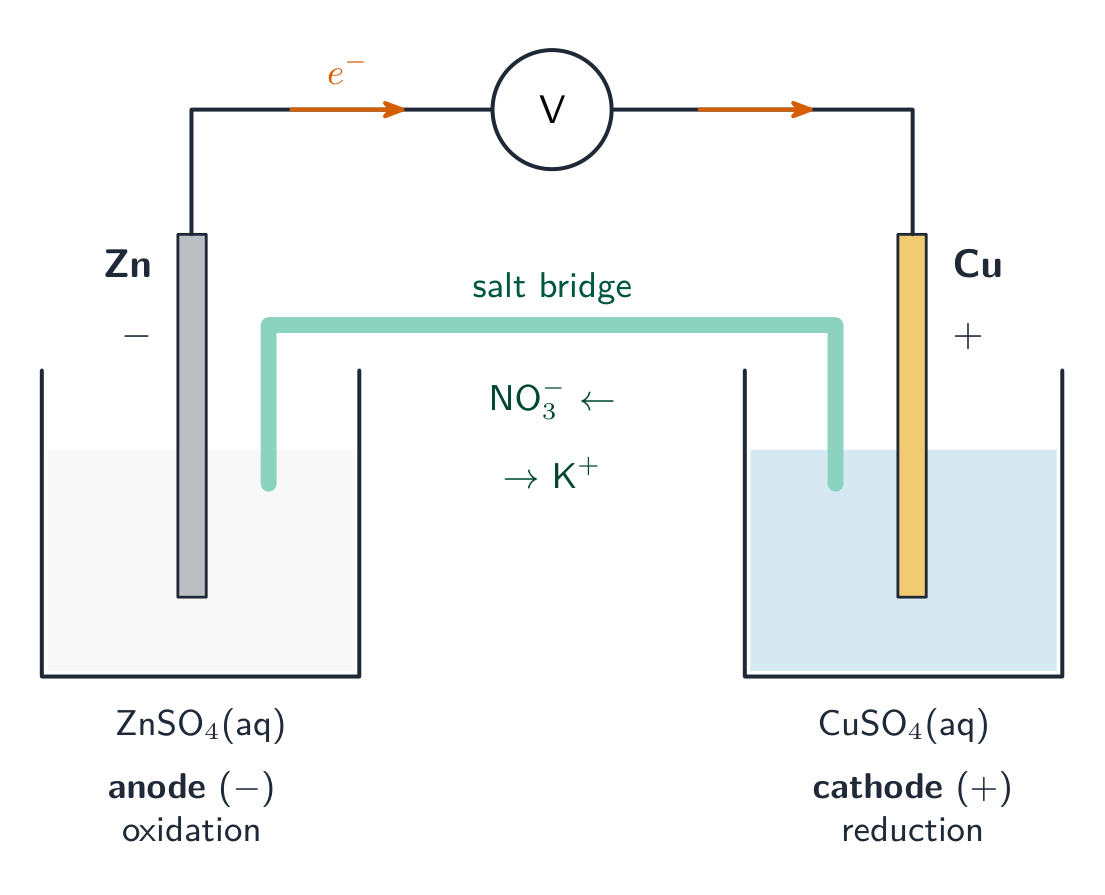
What process always occurs at the anode?
Difficulty 1/5 · 100 coins + a small bonus on first completion today
The process defines the electrode name; polarity depends on operating mode.
R3.2: Follow ions in the bridge and electrons in the wire
- In the Zn/Cu cell with a suitable KNO₃ bridge, nitrate anions move towards the zinc compartment as Zn²⁺ forms. Potassium cations move towards the copper compartment as Cu²⁺ is removed. This maintains approximate bulk electrical neutrality, not necessarily neutral pH.
- Electrons travel through the external metallic circuit, not through the salt bridge 盐桥. Choose bridge ions that do not significantly react with either half-cell solution. A high-resistance voltmeter draws very little current; appreciable power delivery requires a conducting load. The bridge and external circuit provide different charge-carrying paths.
Which charge carriers cross the salt bridge in this model?
Difficulty 1/5 · 100 coins + a small bonus on first completion today
Ionic migration balances the changing solution charges.
R3.2: Reverse the supplied rechargeable reaction
- A supplied lead–acid discharge model is Pb + PbO₂ + 2H₂SO₄ → 2PbSO₄ + 2H₂O. Charging reverses it:2PbSO₄ + 2H₂O → Pb + PbO₂ + 2H₂SO₄. Each supplied half equation is reversed by swapping its electrons and species between sides.
- A secondary cell 二次电池 operates in voltaic mode while discharging; it does not become a primary-cell 一次电池 design. On charging, the physical electrode where oxidation occurs changes, but oxidation still defines the anode. Being able to reverse an equation on paper does not make every primary battery designed for safe repeated recharging.
Does a rechargeable cell become a primary cell whenever it discharges?
Difficulty 1/5 · 100 coins + a small bonus on first completion today
Cell design and operating mode are different classifications.
R3.2: Compare primary secondary and fuel cells 燃料电池
- Primary cells are convenient without charging equipment, but need replacement after their useful discharge. Secondary cells can be reused for many cycles, but need charging energy and equipment and deteriorate. Specific energy, mass, cost and risks depend on the actual chemistry and design.
- An ideal hydrogen/oxygen fuel cell is supplied continuously: anode 2H₂ → 4H⁺ + 4e⁻ and cathodeO₂ + 4H⁺ + 4e⁻ → 2H₂O in the acidic version. Net 2H₂ + O₂ → 2H₂O. Wider environmental impacts also depend on hydrogen production, storage and delivery, not just the water product at the cell.
What makes a hydrogen fuel cell different from a battery being periodically recharged?
Difficulty 1/5 · 100 coins + a small bonus on first completion today
The cell continues while the external reactant supply is maintained.
R3.2: Predict molten salt products and charge carriers
- In molten NaCl, mobile Na⁺ moves towards the negative cathode and gains an electron to form sodium. Cl⁻ moves towards the positive anode and is oxidized:2Cl⁻ → Cl₂ + 2e⁻. The external supply drives the non-spontaneous 自发的 overall conversion.
- Wires carry electronic current; molten electrolyte carries ionic current. Water is absent from the ideal molten-salt example, so aqueous water competition is not used to predict its products. For molten PbBr₂, Pb²⁺ + 2e⁻ → Pb and 2Br⁻ → Br₂ + 2e⁻. Chlorine/bromine demonstrations remain teacher-controlled under the school procedure.
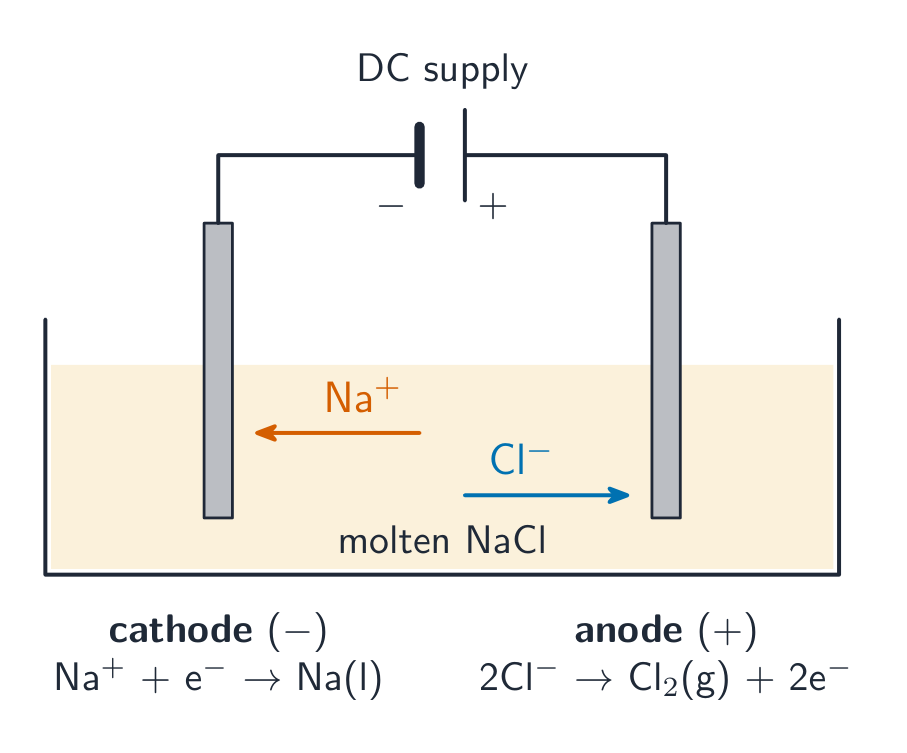
What is formed at the cathode in the ideal molten NaCl example?
Difficulty 1/5 · 100 coins + a small bonus on first completion today
Follow the actual species present in the electrolyte.
For Cu²⁺ + 2e⁻ → Cu, give electron amount in mol needed for 0.35 mol Cu²⁺.
Difficulty 2/5 · 140 coins + a small bonus on first completion today
The half-equation consumes two moles of electrons for each mole of Cu²⁺ reduced. Therefore electron amount = 2 × 0.35 = 0.70 mol. This is an amount of electrons, not a count of individual electrons or a charge in coulombs. The stoichiometric coefficient two determines the ratio.
R3.2: Oxidize alcohols under the stated conditions
- A primary alcohol can form an aldehyde, then a carboxylic acid. Ethanol + [O] → ethanal + H₂O; ethanol + 2[O] → ethanoic acid + H₂O. A secondary alcohol gives a ketone; propan-2-ol gives propanone. Tertiary alcohols resist the usual alcohol-oxidation conditions because there is no H on the C–OH carbon.
- Harsh oxidation can break carbon–carbon bonds, so never oxidized is too broad. Acidified dichromate is a useful orange-to-green example, but this syllabus objective assesses products, equations and apparatus rather than requiring memorization of particular reagent names or mechanisms. [O] is a stoichiometric oxidizing equivalent.
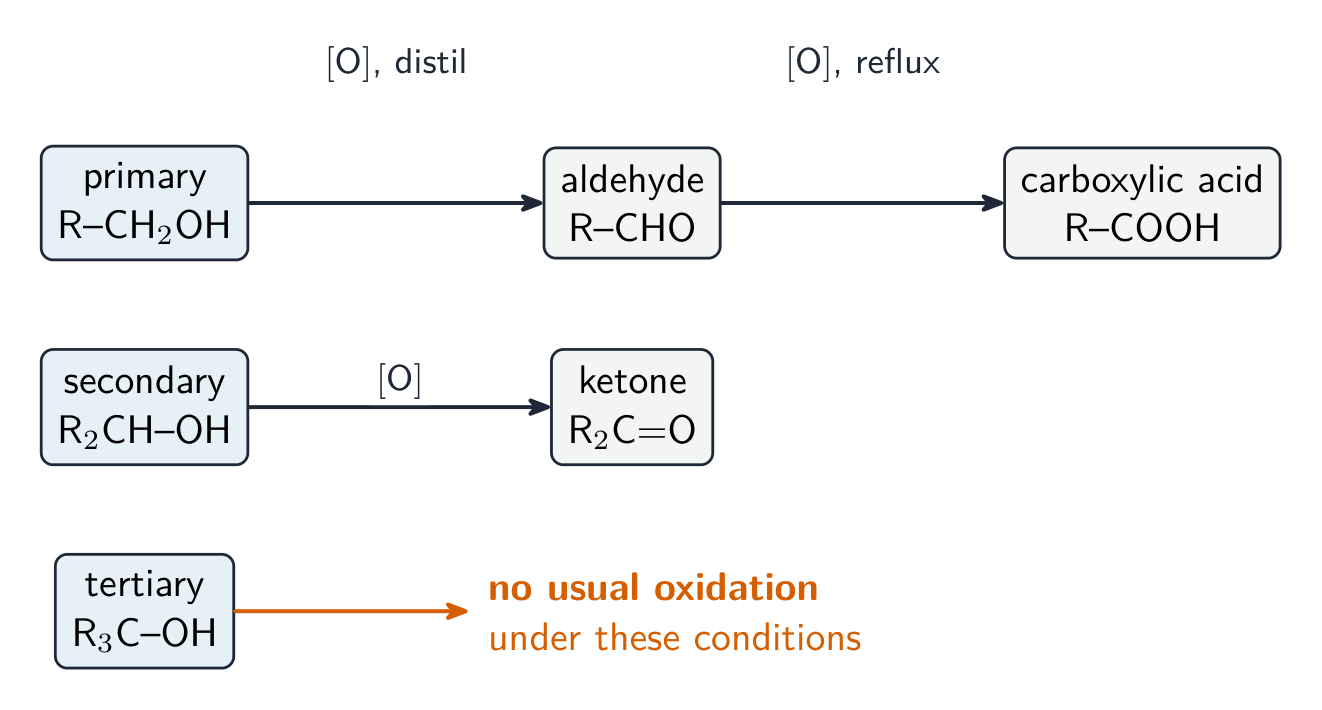
What usual product follows oxidation of butan-2-ol?
Difficulty 1/5 · 100 coins + a small bonus on first completion today
A secondary alcohol produces a ketone under the usual conditions.
R3.2: Explain the apparatus that controls collection
- Distillation 蒸馏 directs vapour through a condenser into a separate receiver, removing a suitable more volatile aldehyde as it forms. Reflux 回流 uses a vertical condenser returning condensed vapour to the same flask, allowing continued heating with sufficient oxidant for the carboxylic acid.
- The apparatus is not a sealed pressure vessel. Cooling water enters a condenser at the lower connection and leaves at the upper one. Saying heat alone does not identify what is collected or whether further oxidation is intended. Match apparatus, oxidant amount and the functional-group endpoint.
Which arrangement returns condensed vapour to the same heated flask?
Difficulty 1/5 · 100 coins + a small bonus on first completion today
Reflux retains material for continued reaction.
R3.2: Count hydride electrons and reducing equivalents
- A hydride ion H⁻ carries a hydrogen nucleus and two electrons. In simple aldehyde/ketone reduction it supplies an electron pair to the carbonyl carbon, followed by protonation to give an alcohol. It is not bare H⁺ or a single-electron radical. The [H] shorthand counts reducing hydrogen equivalents.
- Acid + 2[H] → aldehyde + H₂O, then aldehyde + 2[H] → primary alcohol, so acid-to-alcohol uses 4[H]. A ketone uses 2[H] to form a secondary alcohol. Named hydride reagents are useful examples, but their names/formulas and detailed reduction mechanisms are not assessed in this objective.
How many [H] equivalents appear in the overall carboxylic-acid to primary-alcohol equation?
Difficulty 1/5 · 100 coins + a small bonus on first completion today
The first reduction is RCOOH + 2[H] → RCHO + H₂O; the second is RCHO + 2[H] → RCH₂OH. Add and cancel RCHO to obtain RCOOH + 4[H] → RCH₂OH + H₂O. Total reducing hydrogen equivalents = 2 + 2 = 4.
R3.2: Reduce unsaturation with the right hydrogen amount
- Hydrogenation 氢化 adds H₂ across a multiple bond using an appropriate catalyst and conditions. Ethene + H₂ → ethane removes one degree of unsaturation. Ethyne needs two H₂ equivalents for complete conversion to ethane, passing through an alkene-level intermediate.
- An unrestricted catalytic alkyne reaction need not stop cleanly at the alkene. Partially hydrogenated oils can contain product mixtures and cis/trans changes. State complete versus partial hydrogenation and the supplied hydrogen amount instead of assuming a universal reaction temperature or single product for every substrate.
How many H₂ equivalents are needed for complete ethyne-to-ethane hydrogenation?
Difficulty 1/5 · 100 coins + a small bonus on first completion today
An alkyne has two degrees of unsaturation to remove.
Give H₂ equivalents needed for complete ethyne-to-ethane hydrogenation.
Difficulty 2/5 · 140 coins + a small bonus on first completion today
Balance the complete addition: C₂H₂ + 2H₂ → C₂H₆. One mole of ethyne needs two moles of hydrogen, so the required amount is two equivalents of H₂. One equivalent supplies only half the hydrogen needed for complete conversion of all starting ethyne to ethane.
AHL R3.2: Use a reference half cell and stated standard states
- A half-cell potential 电池电势 is specified relative to a reference. The standard hydrogen electrode 标准氢电极 is assigned 0.00 V; it involves hydrogen gas, platinum and hydrated hydrogen ions. For 298 K booklet examples, gas pressure 100 kPa and unit ionic activities define the reference;1.00 M is the usual ideal concentration approximation.
- E° is defined at a stated temperature; standard state does not universally mean every temperature is 298 K. Real activities need not equal raw molar concentrations. Pure solid phases have unit activity. Report the reference and conditions rather than treating a half-cell number as an absolute isolated voltage.
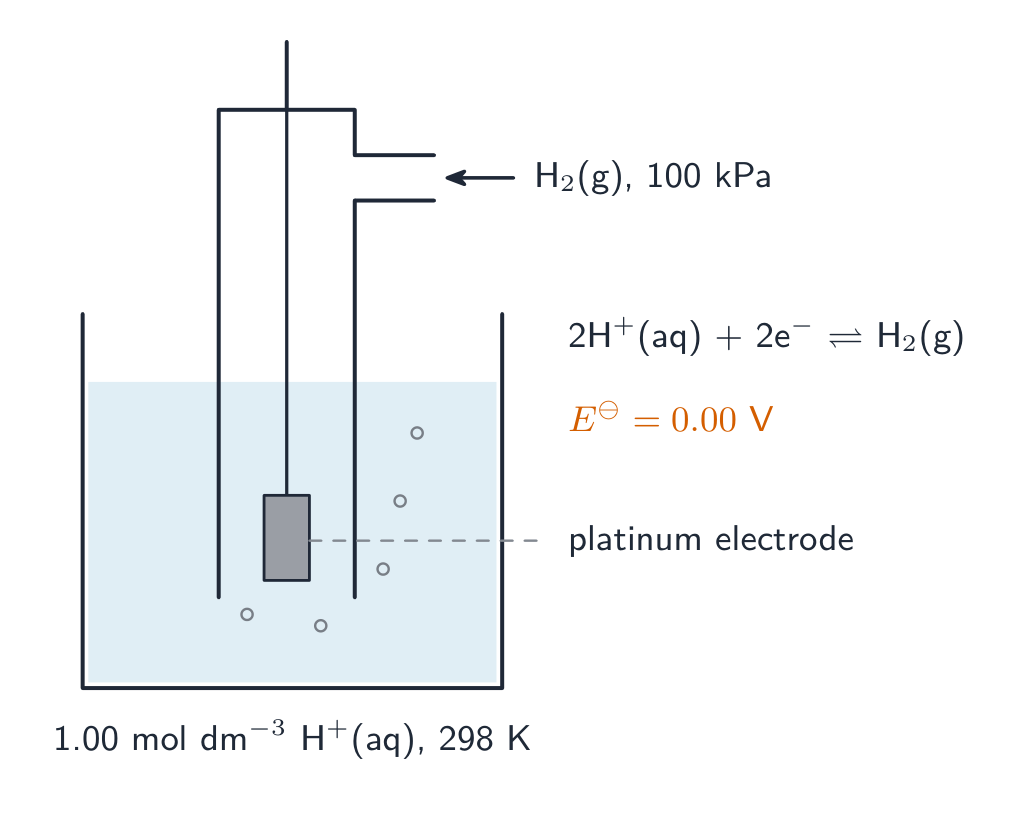
What is assigned by convention to the standard hydrogen electrode?
Difficulty 1/5 · 100 coins + a small bonus on first completion today
The table uses an agreed zero to define relative electrode potentials.
AHL R3.2: Match the exact reduction half equation
- More positive standard reduction potential means the oxidized form is more readily reduced under those reference conditions. The reduced form of a more negative entry is generally a stronger reducing agent in the same comparison. These statements refer to the selected table, not every possible chemical species.
- Fe²⁺/Fe at a supplied−0.45 V differs from Fe³⁺/Fe²⁺ at + 0.77 V. They involve different oxidation states and cannot be substituted for each other. Li⁺/Li has a very negative aqueous standard value, but actual lithium metal also reacts with water; the table does not guarantee a stable aqueous lithium electrode.
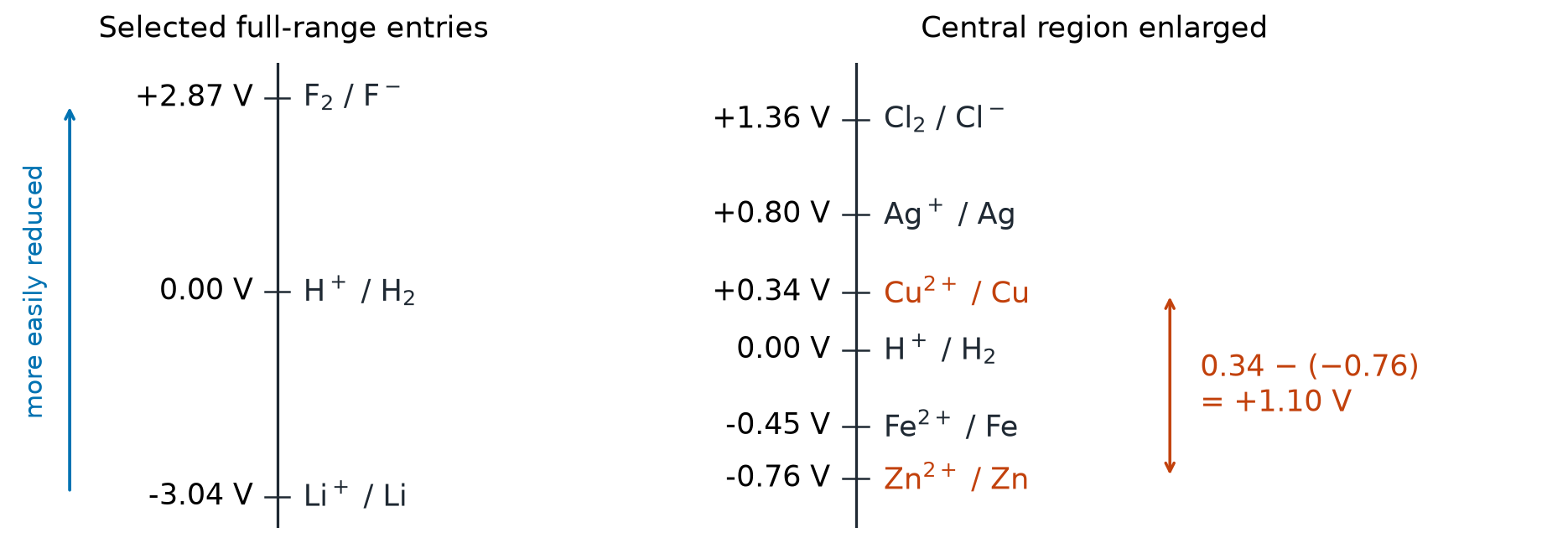
May Fe²⁺/Fe replace Fe³⁺/Fe²⁺ when predicting oxidation of Fe²⁺ to Fe³⁺?
Difficulty 1/5 · 100 coins + a small bonus on first completion today
The oxidation-state pair and electron count must match the reaction.
AHL R3.2: Calculate voltage from reduction entries
- For a Zn/Ag cell with supplied E°(Ag⁺/Ag) = + 0.80 V and E°(Zn²⁺/Zn) = −0.76 V, Ag⁺ is reduced at the cathode and zinc oxidized at the anode. E°cell = E°cathode−E°anode = 0.80−(−0.76) = + 1.56 V.
- Electron balance gives Zn + 2Ag⁺ → Zn²⁺ + 2Ag. Do not multiply the silver potential by two: potential is intensive. Reversing the overall reaction changes the sign of the cell potential. Both reference entries in the subtraction remain written as reductions.
Why is the Ag⁺/Ag potential not multiplied by two?
Difficulty 1/5 · 100 coins + a small bonus on first completion today
Electron amounts scale the equations, not their intensive potentials.
Use supplied Ag⁺/Ag + 0.80 V and Zn²⁺/Zn−0.76 V. Give positive Zn/Ag E°cell in V.
Difficulty 2/5 · 140 coins + a small bonus on first completion today
Silver ions are reduced at the cathode and zinc is oxidized at the anode. Using both tabulated entries as reduction potentials, E°cell = E°cathode − E°anode = 0.80 − (−0.76) = +1.56 V. The balanced reaction is Zn + 2Ag⁺ → Zn²⁺ + 2Ag. Multiplying the silver half-equation by two balances electrons but does not double its electrode potential.
AHL R3.2: Separate standard direction from reaction speed
- Using supplied I₂/I⁻ + 0.54 V and Fe³⁺/Fe²⁺ + 0.77 V for iodine oxidizing iron(II), E°cell = 0.54−0.77 = −0.23 V. The proposed forward reaction is not thermodynamically favoured under standard conditions; the reverse is favoured there.
- A negative standard value is not proof that no forward change can ever occur at any composition. Concentration and gas pressure can alter the actual potential. A positive standard value also does not guarantee a rapid visible reaction: activation barriers and surface passivation can matter.
What does positive E°cell establish for the forward reaction?
Difficulty 1/5 · 100 coins + a small bonus on first completion today
Thermodynamic direction is distinct from kinetics and non-standard conditions.
Use I₂/I⁻ + 0.54 V and Fe³⁺/Fe²⁺ + 0.77 V for iodine oxidizing Fe²⁺. Give E°cell in V.
Difficulty 2/5 · 140 coins + a small bonus on first completion today
For the proposed reaction I₂ + 2Fe²⁺ → 2I⁻ + 2Fe³⁺, iodine is reduced and iron(II) oxidized. Therefore E°cell = 0.54 − 0.77 = −0.23 V, using the supplied reduction potentials. The negative result means this direction is not thermodynamically favoured under standard conditions. The reverse has +0.23 V; changed concentrations would require a separate assessment.
AHL R3.2: Convert electrical potential to reaction energy
- ΔG° = −nFE°cell, where n is electron amount per mole of the balanced overall equation and F is supplied 96500 C/mol. For Zn + 2Ag⁺ → Zn²⁺ + 2Ag, n 2 and E°1.56 V give−2 × 96500 × 1.56 = −301080 J/mol, or−301.08 kJ/mol.
- Use joules initially because volt × coulomb = joule. Doubling the overall equation doubles n and ΔG° but leaves E° unchanged. The Zn/Cu example with E°1.10 V gives−212.3 kJ per mole of its equation; doubling that equation gives−424.6 kJ per mole of the doubled equation.
What happens to E° when every coefficient in an overall equation is doubled?
Difficulty 1/5 · 100 coins + a small bonus on first completion today
Potential is intensive; the reaction energy and amount are extensive.
For Zn + 2Ag⁺ → Zn²⁺ + 2Ag, E°1.56 V and F 96500 C/mol. Give ΔG° in kJ per mol of the equation.
Difficulty 2/5 · 140 coins + a small bonus on first completion today
Two electrons transfer per balanced equation, so ΔG° = −nFE° = −2 × 96500 × 1.56 = −301080 J per mol of the equation. Divide by 1000: −301.08 kJ/mol, or −301 kJ/mol to three significant figures. Balancing the silver coefficient does not multiply E°.
AHL R3.2: Predict aqueous products with competing reactions
- In aqueous electrolysis, compare water-related reactions with dissolved-ion reactions at each electrode. Cu²⁺ and Ag⁺ commonly deposit as metals at the cathode; Na⁺ or K⁺ solution commonly gives H₂ instead. Electrolyte identity alone is insufficient without electrode material and concentration.
- With inert electrodes 惰性电极, concentrated NaCl commonly gives H₂/Cl₂, dilute NaCl mainly H₂/O₂, and CuSO₄ gives Cu/O₂ in the classroom model. Chloride concentration and electrode kinetics affect competition at the anode. These are conditional predictions, not a rule that the biggest unmatched standard number always wins.
What additional information is needed alongside electrolyte identity?
Difficulty 1/5 · 100 coins + a small bonus on first completion today
Competing reactions depend on the actual electrolyte and electrode conditions.
AHL R3.2: Keep the water half cell pH references consistent
- The written water reduction 2H₂O + 2e⁻ → H₂ + 2OH⁻ has E°−0.83 V for unit OH⁻ activity. O₂ + 4H⁺ + 4e⁻ → 2H₂O has E° + 1.23 V for unit H⁺ activity. Those are different pH references, not matched half-cells for a universal 2.06 V water-splitting claim.
- At matched pH and standard gas activities, the equilibrium water-splitting gap is about 1.23 V at 298 K. Practical cells require extra voltage because of kinetic overpotentials and resistance. This explanation does not require an unintroduced Nernst calculation; it explains why conditions must match before comparing potentials.
Why cannot the two listed water numbers be subtracted as a universal minimum voltage?
Difficulty 1/5 · 100 coins + a small bonus on first completion today
A meaningful cell comparison needs consistent chemical conditions.
AHL R3.2: Change the anode and change the reaction
- In CuSO₄(aq), the simple cathode process is Cu²⁺ + 2e⁻ → Cu. An inert anode can support oxygen evolution from water-related species. A copper anode instead commonly dissolves through Cu → Cu²⁺ + 2e⁻, supplying ions that replace those deposited.
- An inert electrode is not a main stoichiometric reactant in that model, but its surface can still affect reaction rates and overpotential. Graphite can be consumed under some conditions. Specify the modeled process instead of claiming every conducting electrode is chemically irrelevant.
What anode process is expected for a copper anode in the stated CuSO₄ plating model?
Difficulty 1/5 · 100 coins + a small bonus on first completion today
Copper dissolves by oxidation at the anode.
AHL R3.2: Explain plating through both electrode equations
- In the supplied copper-plating model, the object is the negative cathode: Cu²⁺ + 2e⁻ → Cu coats it. The copper anode dissolves: Cu → Cu²⁺ + 2e⁻. The electrolyte contains available copper ions. Silver plating uses the corresponding Ag⁺ + e⁻ → Ag and Ag → Ag⁺ + e⁻ pair.
- If metal dissolution and deposition dominate, equal electron charge transfers equal metal amount between matching metal-ion half reactions. Bulk metal-ion concentration can stay approximately constant at fixed volume and good mixing. Side reactions, current inefficiency or an inert anode can require replenishment and alter that conclusion.
Which electrode should be the object receiving a metal coating?
Difficulty 1/5 · 100 coins + a small bonus on first completion today
A positive metal ion gains electrons to become deposited metal.
AHL R3.2: Derive the water electrolysis gas ratio
- In an acidic water-electrolysis model, cathode 4H⁺ + 4e⁻ → 2H₂ and anode 2H₂O → O₂ + 4H⁺ + 4e⁻ cancel to 2H₂O → 2H₂ + O₂. Hydrogen forms at the cathode and oxygen at the anode.
- At matched temperature and pressure with no gas loss or competing reactions, volumes are proportional to gas amounts, giving H₂:O₂ = 2:1. Dissolved gases, leakage and side reactions can spoil a measured ratio. Pure water conducts poorly; added suitable electrolyte supports charge transport without necessarily becoming a net reaction product.
For ideal water electrolysis, 2H₂O → 2H₂ + O₂. At the same temperature and pressure, with no gas loss or competing reactions, what H₂:O₂ gas-volume ratio follows?
Difficulty 1/5 · 100 coins + a small bonus on first completion today
The balanced equation forms two moles H₂ per mole O₂. At matched temperature and pressure, ideal gas volume is proportional to amount, so H₂:O₂ = 2:1. Count gas molecules, rather than the atoms within each molecule.
If ideal water electrolysis collects 40.0 cm³ H₂, give O₂ volume in cm³ at matched conditions.
Difficulty 2/5 · 140 coins + a small bonus on first completion today
Balance the overall water electrolysis: 2H₂O → 2H₂ + O₂. At the same temperature and pressure, ideal gas volumes follow the mole ratio H₂:O₂ = 2:1. Thus oxygen volume = 40.0/2 = 20.0 cm³. The ratio assumes comparable collection conditions without differential gas loss.