Gas models and absolute temperature
Introduced| English | Meaning |
|---|---|
| absolute temperature/ˈæbsəluːt ˈtemprɪtʃə/ | Temperature on the kelvin scale. |
| ideal gas/aɪˈdɪəl ɡæs/ | A model of a gas with point particles that exert no intermolecular forces except during perfectly elastic collisions. |
| element/ˈelɪmənt/ | A substance made of atoms with the same proton number. |
| compound/ˈkɒmpaʊnd/ | A substance containing two or more different elements chemically bonded in fixed proportions. |
| mixture/ˈmɪkstʃə/ | A combination of substances that are not chemically bonded together in fixed proportions. |
| purity/ˈpjʊərɪti/ | How free a substance is of other substances; a pure substance has a sharp melting point. |
| homogeneous/ˌhɒməˈdʒiːniəs/ | Of a mixture: uniform throughout, with one phase and no visible boundaries. |
| heterogeneous | Of a mixture: not uniform, with visibly different parts or phases. |
| filtration/fɪlˈtreɪʃn/ | Separating insoluble particles from a fluid by passing the mixture through a porous barrier. |
| crystallization | Forming solid crystals from a solution, often by cooling or evaporating the solvent. |
| distillation/dɪstɪˈleɪʃn/ | Separating substances by vaporising and condensing them, using differences in volatility or boiling point. |
| evaporation/ɪˌvæpəˈreɪʃn/ | The escape of particles from the surface of a liquid into its vapour without the whole liquid boiling. |
| sublimation/ˌsʌblɪˈmeɪʃn/ | The direct change of a substance from solid to gas without passing through a liquid phase. |
| deposition | A gas changing directly into a solid. |
| average kinetic energy/ˈævrɪdʒ kɪˈnetɪk ˈenədʒi/ | The mean energy of motion of the particles, proportional to absolute temperature. |
| real gas/rɪəl ɡæs/ | A gas whose particles have volume and attract each other, deviating at high pressure and low temperature. |
| molar volume | The volume of one mole of gas, 22.7 dm³ at STP. |
What would explain this observation?
- A sealed gas container changes pressure when heated. Celsius ratios cannot predict the pressure change because the gas model uses absolute temperature 绝对温度.
Build the model
- In a gas model, particles move randomly and pressure results from momentum transfer at walls.
- The ideal gas 理想气体 equation connects pressure, volume, amount and absolute temperature.
- absolute temperature: Temperature on the kelvin scale.
- ideal gas: A gas model with specified simplifying assumptions.

Which scale belongs in a gas-law temperature ratio?
Difficulty 1/5 · 100 coins + a small bonus on first completion today
Gas-law ratios rest on absolute temperature measured from absolute zero, so kelvin is required. Celsius shifts the zero by 273.15 and breaks every ratio, even though a temperature DIFFERENCE is the same size in both scales.
Match each technical term to its precise meaning.
Difficulty 2/5 · 140 coins + a small bonus on first completion today
Use the definitions to distinguish related quantities and processes.
Choose evidence that can test it
- At fixed amount and volume, pressure is proportional to kelvin temperature.
- At fixed temperature and amount, pressure is inversely proportional to volume.
- State which quantities are fixed before choosing a relationship.
In the lab: Use approved apparatus with a temperature range and pressure limit set by the teacher. Allow thermal equilibrium and record pressure against kelvin temperature. Never heat an improvised sealed vessel.
Which two habits make the investigation or model in this case more defensible?
Difficulty 2/5 · 140 coins + a small bonus on first completion today
Stating the conditions and assumptions lets others repeat the work exactly, and recording the supporting evidence lets them check the conclusion. Hiding disagreeing results removes the evidence that could challenge a wrong conclusion, and one measurement can never establish a wider claim.
Work from known quantities
- Known: pressure is 100 kPa at 300 K, with fixed volume and amount.
- At 330 K, p2/p1=T2/T1. p2=p1 T2/T1=100×330/300=110 kPa.
- A 30 °C rise is a 30 K change, but the temperature ratio must use kelvin.
Your turn: At fixed volume, pressure is 120 kPa at 300 K. Find pressure at 350 K.
Gas pressure uses kelvin temperature
$\frac{p_2}{p_1}=\frac{T_2}{T_1}\frac{V_1}{V_2}$
For a fixed amount of ideal gas, pressure rises with kelvin temperature and falls as volume increases.
At fixed volume, pressure is 120 kPa at 300 K. Find pressure at 350 K.
Difficulty 2/5 · 140 coins + a small bonus on first completion today
The result is 140 kPa. Known: p1 = 120 kPa at T1 = 300 K, fixed volume and amount; T2 = 350 K. Use p2/p1 = T2/T1. Rearranging: p2 = p1 x T2/T1 = 120 x 350/300 = 140 kPa. The ratio works only because both temperatures are in kelvin.
Check the conclusion and its limits
- An ideal gas is a model with conditions of validity.
- Celsius zero is not zero molecular motion, and internal energy is not determined by pressure alone.
Not true: A gas pressure ratio can always use Celsius temperatures. Ratios of temperatures are meaningful only from absolute zero. 300 K to 350 K is a ratio of 350/300; the same temperatures in Celsius, 27 and 77, give 77/27 - a different, wrong answer.
- In a gas model, particles move randomly and pressure results from momentum transfer at walls.
- At fixed amount and volume, pressure is proportional to kelvin temperature.
- Watch for: an ideal gas is a model with conditions of validity.
A gas pressure ratio can always use Celsius temperatures.
Difficulty 1/5 · 100 coins + a small bonus on first completion today
Ratios of temperatures are meaningful only from absolute zero. 300 K to 350 K is a ratio of 350/300; the same temperatures in Celsius, 27 and 77, give 77/27 - a different, wrong answer.
Temperature on the kelvin scale: write the technical term.
Difficulty 1/5 · 100 coins + a small bonus on first completion today
absolute temperature means Temperature on the kelvin scale.
Write from a pressure of 108 kPa
- At fixed volume, the pressure is 90 kPa at 250 K.
- Find the pressure at 300 K. The ratio must use kelvin.
At fixed volume and amount, the pressure is 90 kPa at 250 K. What is the pressure at 300 K, and why must the ratio use kelvin?
At fixed amount and volume, p₂/p₁ = T₂/T₁. Hence p₂ = 90 × 300/250 = 108 kPa. Use absolute temperatures because pressure is proportional to kelvin temperature, not Celsius temperature.
A fixed amount of ideal gas has absolute pressure 90 kPa at 250 K in a rigid container. What is its pressure at 300 K?
Difficulty 1/5 · 100 coins + a small bonus on first completion today
At fixed amount and volume, p₂/p₁ = T₂/T₁, so p₂ = p₁T₂/T₁ = 90 × 300/250 = 108 kPa. The 90 kPa option ignores warming; 140 kPa belongs to the separate 120 kPa, 300→350 K example.
S1.1: Distinguish particles and substances
- An element 元素 contains one type of atom and cannot be chemically broken down into simpler substances; it may consist of individual atoms or molecules such as O₂. A compound 化合物 contains different elements chemically combined in a fixed ratio.
- A mixture 混合物 contains more than one element or compound in variable proportions. Components retain chemical identities, but their bulk properties can change on mixing. Do not count different colours in a sketch without defining what they represent.
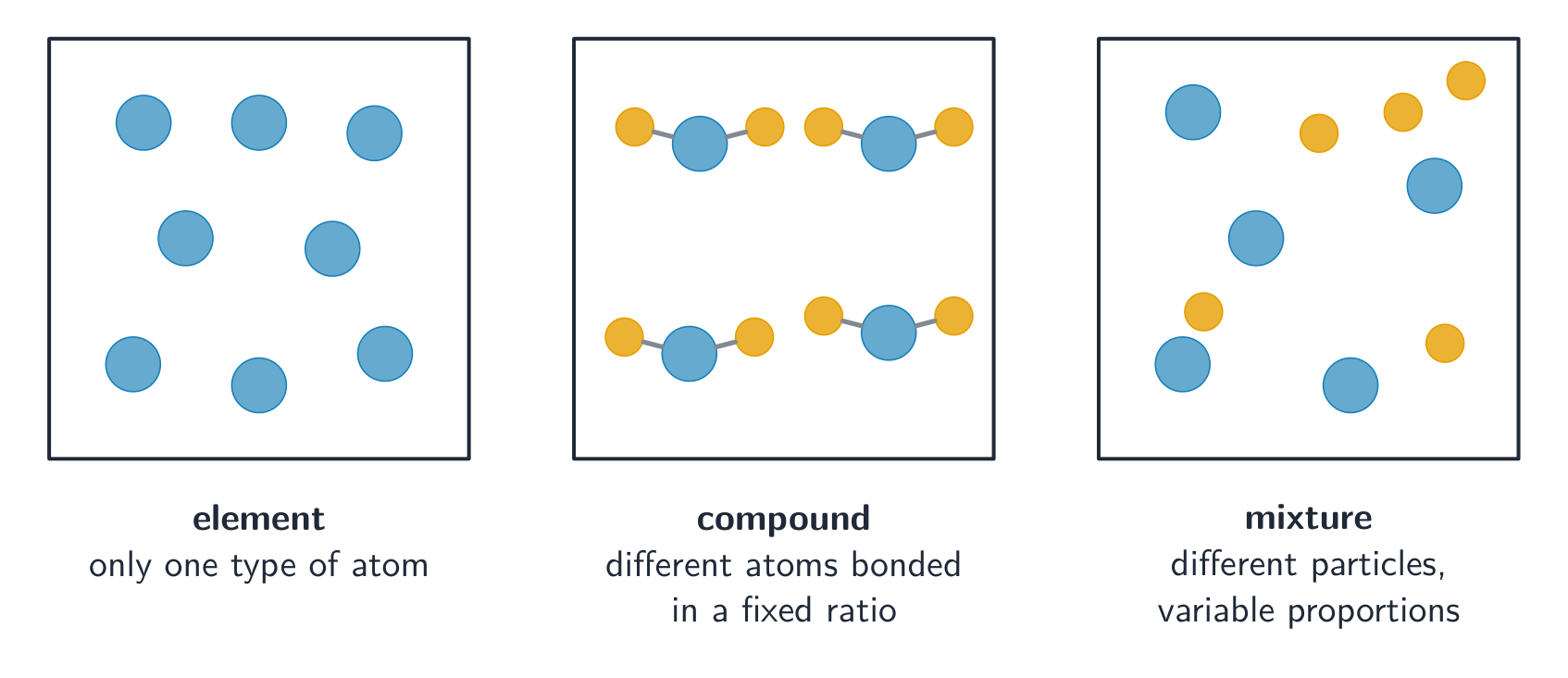
Is oxygen O₂ a compound because each molecule has two atoms?
Difficulty 1/5 · 100 coins + a small bonus on first completion today
Count types of atom, not just atoms per particle.
S1.1: Interpret a mixture diagram
- A mixture can contain molecules that have internal chemical bonds. The components have not all become one new fixed-composition compound.
- A single particle picture is a model, not proof of macroscopic purity 纯度. A pure compound can contain more than one atom colour, while several different particle types can indicate a mixture.
Can molecules inside a mixture still contain chemical bonds?
Difficulty 1/5 · 100 coins + a small bonus on first completion today
Separate bonds inside particles from the composition of the whole sample.
S1.1: Compare uniform and non-uniform samples
- A homogeneous 均匀的 mixture has uniform composition on the relevant scale, such as a well-mixed salt solution. A heterogeneous 不均匀的 sample contains non-uniform regions or phases, such as sand in water.
- An alloy may have one or more phases; the word alloy alone does not prove homogeneity. A uniform appearance does not establish that a sample is one pure substance.
Does a transparent uniform solution have to be a pure substance?
Difficulty 1/5 · 100 coins + a small bonus on first completion today
Appearance and composition are different evidence.
S1.1: Choose separation by a property
- Physical separation uses differences such as solubility, particle size or volatility. Filtration 过滤 can retain an insoluble solid; crystallization 结晶 can recover a suitable dissolved solid; distillation 蒸馏 collects a volatile component by condensation.
- Sand and salt are an insoluble/soluble pair in water, not two water-soluble solids. Define which component is wanted before choosing a method.
Which property separates sand from salt after adding suitable water?
Difficulty 1/5 · 100 coins + a small bonus on first completion today
Name the actual solvent and contrasting property.
S1.1: Explain residue and filtrate
- A suitable filter retains undissolved sand as residue while the salt solution passes as filtrate. Dissolved ions and water particles are far smaller than the retained sand particles.
- Ordinary filtration does not recover dissolved salt from water by itself. Choose an appropriate filter and follow approved practical instructions rather than assuming every impurity is retained.
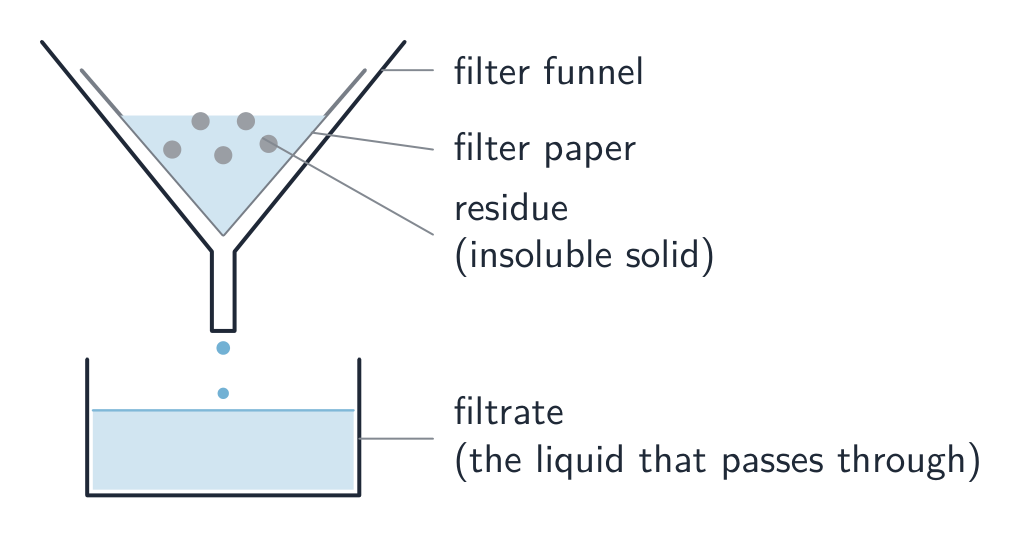
Where is the dissolved salt after filtering sand from a salt solution?
Difficulty 1/5 · 100 coins + a small bonus on first completion today
Dissolved solute can pass through the filter with the solvent.
S1.1: Recover crystals thoughtfully
- Concentrate a suitable solution, then cool when the solubility decreases enough to form crystals. Filter, wash with a little appropriate cold solvent and dry according to an approved protocol.
- Some solute remains in the mother liquor; washing and transfer can lose material. Evaporation 蒸发 to dryness may retain impurities or damage a heat-sensitive solid, and does not universally produce only powder.
Why can crystallization give less than complete solute recovery?
Difficulty 1/5 · 100 coins + a small bonus on first completion today
A mass shortfall does not identify its mechanism by itself.
S1.1: Calculate recovery against the right reference
- An invented 12.0 g sand/salt mixture contains 7.50 g salt;6.60 g dry salt is recovered. Initial sand is 12.0−7.50=4.50 g.
- Salt recovery is 6.60/7.50×100=88.0%, using the initial salt mass rather than total mixture mass. Dryness and contamination affect interpretation of a measured recovered mass.
A 12.0 g sand/salt mixture initially contains 7.50 g salt; 6.60 g dry salt is recovered. Which denominator gives percentage salt recovery?
Difficulty 1/5 · 100 coins + a small bonus on first completion today
Recovery compares recovered salt with initial salt: recovery = 6.60/7.50 × 100 = 88.0%. The 12.0 g total includes sand, so it is not the reference mass for salt recovery.
Find initial sand mass in 12.0 g mixture containing 7.50 g salt.
Difficulty 2/5 · 140 coins + a small bonus on first completion today
12.0−7.50=4.50 g.
Find percentage salt recovery:6.60 g from initial 7.50 g salt.
Difficulty 2/5 · 140 coins + a small bonus on first completion today
6.60/7.50×100=88.0%.
S1.1: Distil and collect a fraction
- Vapour from water with a non-volatile solute can be condensed and collected while salt remains. Real samples may contain volatile impurities, so the method and evidence determine purity.
- For two volatile liquids, vapour may be enriched in the more volatile component without being pure. They do not generally wait to boil one at a time; a fractionating column supplies repeated vaporization and condensation.
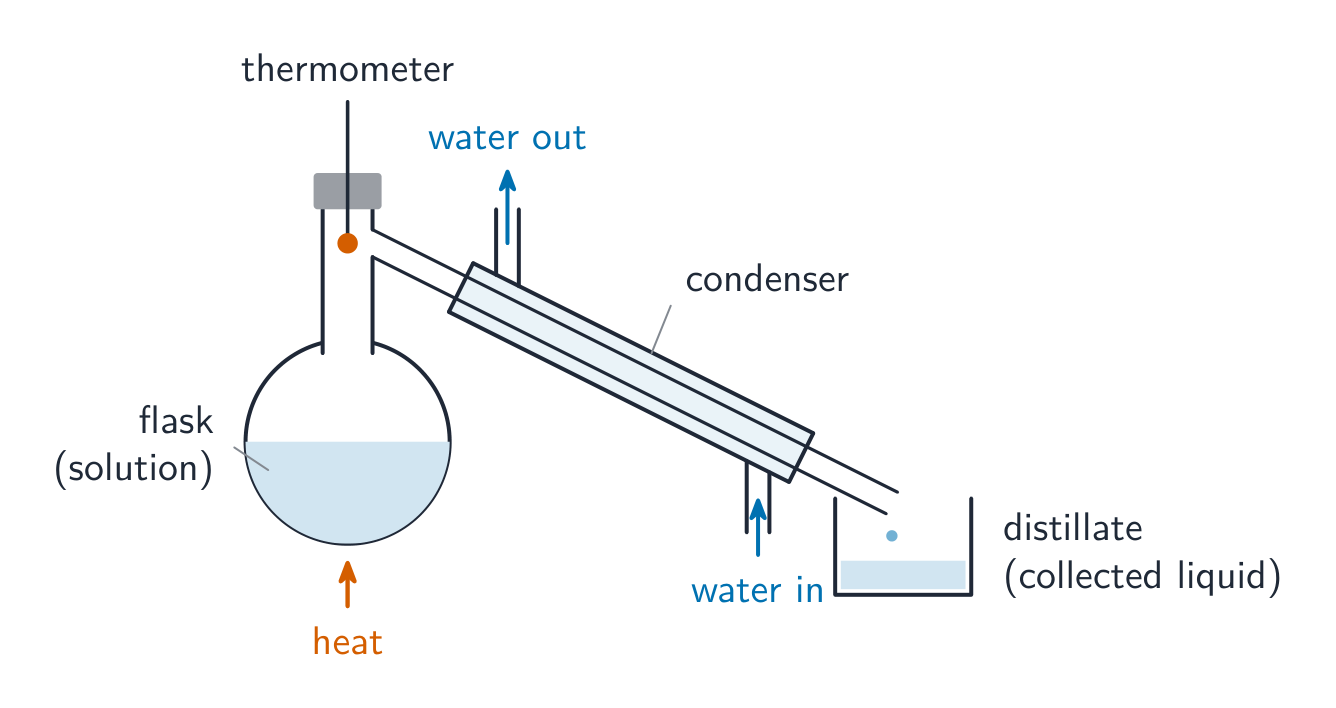
Does the more volatile component necessarily distil as a pure substance first?
Difficulty 1/5 · 100 coins + a small bonus on first completion today
Mixture behaviour differs from boiling pure substances separately.
S1.1: Explain apparatus choices
- Place the thermometer bulb to measure vapour entering the condenser. Cooling water normally enters a condenser jacket at the lower connection and leaves at the upper connection to keep it filled.
- Use suitable school-approved heating and an open vapour path, and do not distil to dryness or heat an improvised sealed vessel. A boiling temperature supports identification but does not alone prove purity.
Why put the thermometer bulb near the vapour exit?
Difficulty 1/5 · 100 coins + a small bonus on first completion today
Connect the instrument position to the actual measured quantity.
S1.1: Use a state model with limits
- In a crystalline solid, close particles vibrate around positions. A liquid remains densely packed while particles rearrange; gas particles are widely separated in a simple model.
- Some solids lack long-range crystalline order. Attractions remain important in liquids; they do not simply disappear on melting. Gases are much more readily compressible because of the large separation.
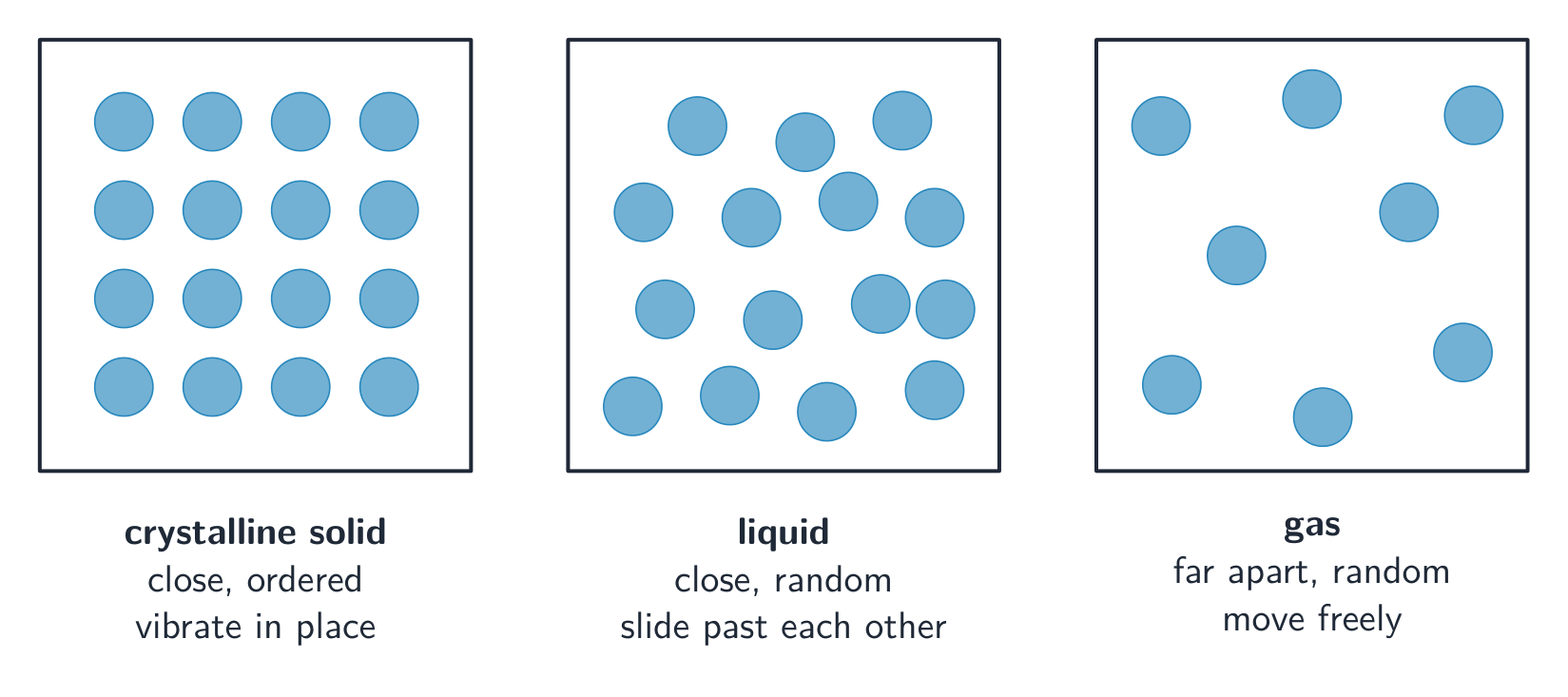
Why is a gas much more compressible than a typical liquid?
Difficulty 1/5 · 100 coins + a small bonus on first completion today
Compressibility follows chiefly from spacing in the simple model.
S1.1: Name all six state changes
- Melting, vaporization and sublimation 升华 take in energy; freezing, condensation and deposition 凝华 release energy under the corresponding conditions. Sublimation is solid→gas and deposition gas→solid.
- For water changing state, molecular identity remains H₂O. Energy changes concern intermolecular organisation; boiling does not split water molecules into hydrogen and oxygen.
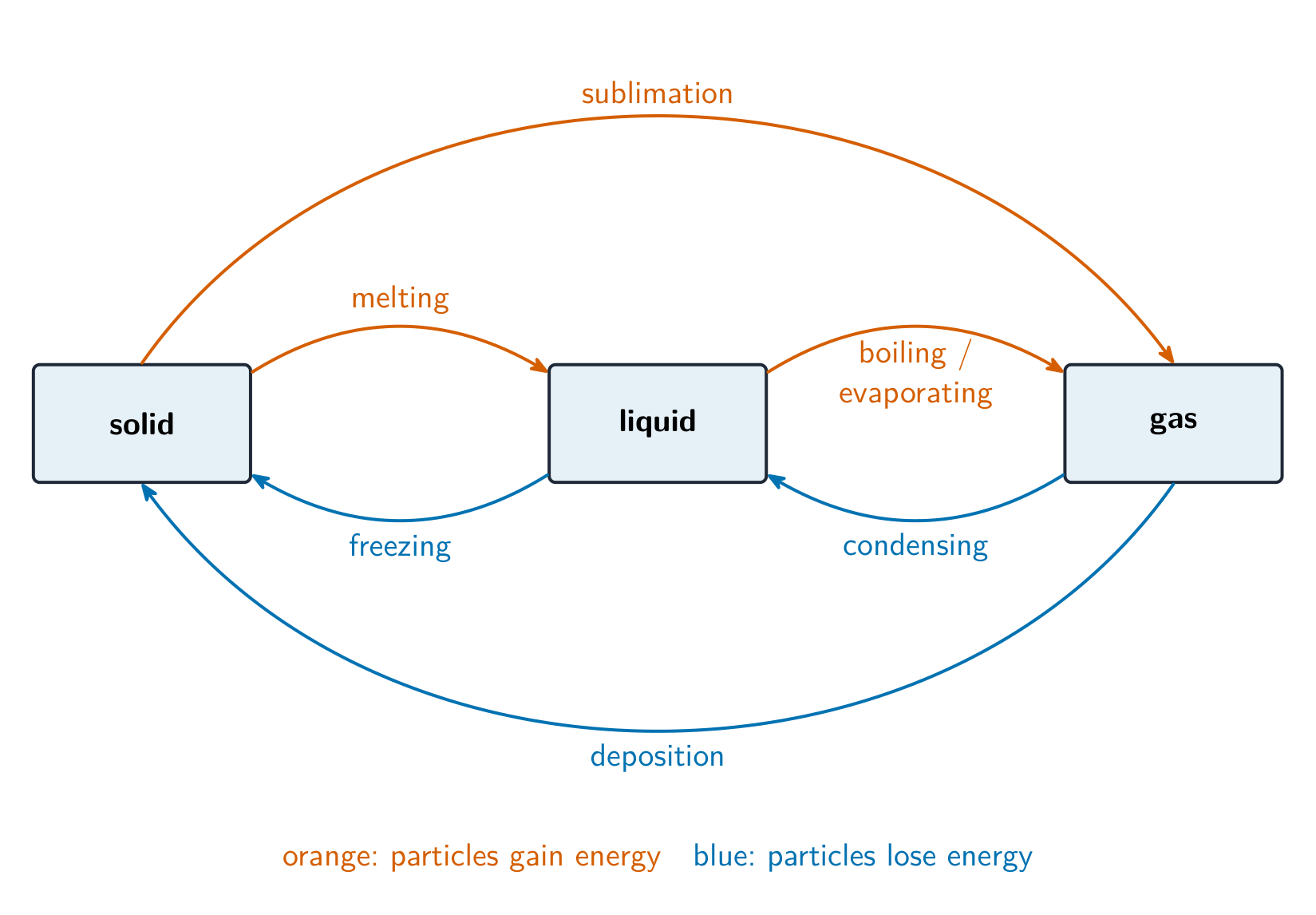
What is the direct gas-to-solid change called?
Difficulty 1/5 · 100 coins + a small bonus on first completion today
Use the initial and final states to select the name.
S1.1: Separate boiling and evaporation
- Evaporation is a surface process over a range of temperatures when sufficiently energetic particles escape. Boiling involves vapour bubbles throughout a liquid when they can persist.
- A pure substance has a defined boiling temperature at specified pressure; changing pressure changes it. A mixture can behave differently from a pure sample, so one observed temperature does not prove one composition.
Does a pure substance have the same boiling temperature at every pressure?
Difficulty 1/5 · 100 coins + a small bonus on first completion today
Conditions are part of the stated physical property.
S1.1: Interpret a heating curve
- On a sloping region, heating raises temperature and average kinetic energy 平均动能 in the simple model. During a near-equilibrium pure-substance phase plateau at fixed pressure, energy changes the phase while temperature stays approximately constant.
- Plateau duration depends on mass, latent energy, power and losses. A schematic’s longer boiling plateau is illustrative, not a universal timing ratio or evidence of a chemical reaction.
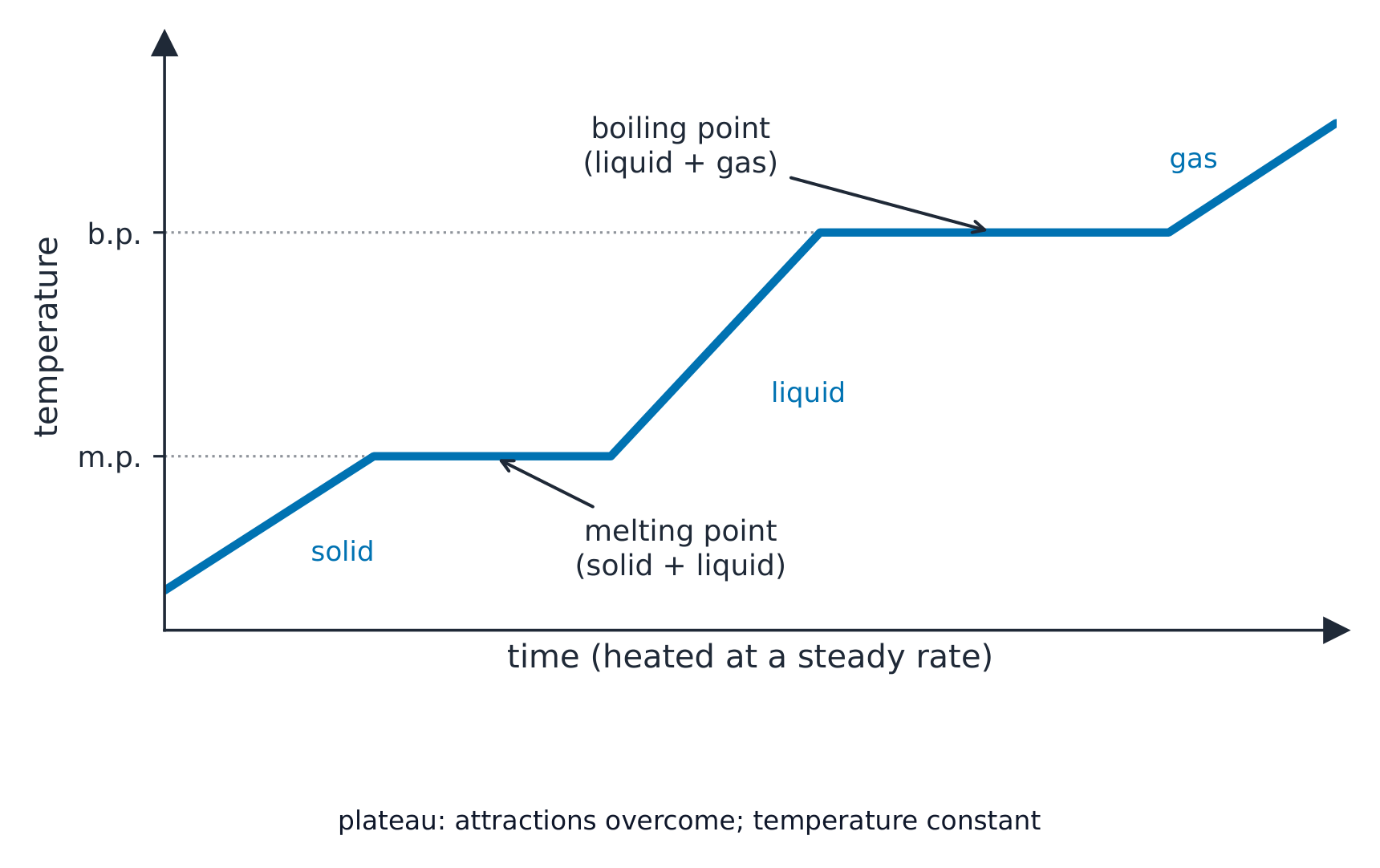
What does a phase plateau represent in this model?
Difficulty 1/5 · 100 coins + a small bonus on first completion today
Temperature and total energy transfer are different quantities.
S1.1: Evaluate a melting-range observation
- A depressed, broadened melting range can be consistent with impurity for a suitable crystalline substance. Compare with a justified reference under appropriate conditions.
- Heating rate, calibration, decomposition and sample conditions may also matter. A sharp range is useful evidence but does not independently prove every possible contaminant absent.
Is one broad melting range conclusive proof of one specific contaminant?
Difficulty 1/5 · 100 coins + a small bonus on first completion today
Keep the conclusion proportionate to the measurement.
S1.1: Use state symbols precisely
- (s), (l) and (g) mean solid, liquid and gas. (aq) means dissolved in water, not a pure liquid substance. H₂O(l)→H₂O(g) retains molecular identity.
- NaCl(s)→Na⁺(aq)+Cl⁻(aq) represents dissolved ions. Aqueous particles are dispersed in a solvent; the formula is not a picture of visible lumps of salt.
Are (aq) and (l) interchangeable?
Difficulty 1/5 · 100 coins + a small bonus on first completion today
Physical state and being dissolved in water convey different information.
S1.1: Connect kelvin and average kinetic energy
- In the course’s kinetic model, higher kelvin temperature relates to higher average kinetic energy. For an ideal gas, mean translational kinetic energy is proportional to T.
- Particles in a sample have a distribution of energies; the same temperature does not give every particle identical speed. Total internal energy is not temperature alone, particularly across a phase change.
Does one temperature mean every particle has exactly the same kinetic energy?
Difficulty 1/5 · 100 coins + a small bonus on first completion today
A mean does not remove variation among particles.
S1.1: Convert an absolute temperature
- The exact numerical conversion is T/K=θ/°C+273.15. A whole-kelvin course estimate may use 273 if the convention is stated.25°C is 298.15 K exactly on that conversion, approximately 298 K.
- Absolute zero is 0 K or−273.15°C. The ordinary classical model here uses non-negative T; it is not a complete account of quantum motion. Write K without a degree sign.
Which unit symbol is correct?
Difficulty 1/5 · 100 coins + a small bonus on first completion today
Kelvin uses K, while Celsius uses °C.
Convert 25°C to kelvin using the exact 273.15 offset.
Difficulty 2/5 · 140 coins + a small bonus on first completion today
25+273.15=298.15 K.
S1.1: Separate temperature change and ratio
- A 1°C temperature interval equals 1 K. However,20→40°C corresponds to 293.15→313.15 K, so the ideal-gas mean-energy ratio is 313.15/293.15=1.068224… .
- The relative rise is about 6.8224%, not 100%. Convert both endpoints for a ratio; do not add 273.15 to an already computed temperature difference.
Does doubling Celsius from 20 to 40 double ideal-gas mean kinetic energy?
Difficulty 1/5 · 100 coins + a small bonus on first completion today
Differences and ratios require different handling of an offset.
Find the percentage rise in ideal-gas mean kinetic energy from 20°C to 40°C, using 273.15.
Difficulty 2/5 · 140 coins + a small bonus on first completion today
Convert both endpoints: T₁ = 20 + 273.15 = 293.15 K and T₂ = 40 + 273.15 = 313.15 K. Mean kinetic energy is proportional to T, so percentage rise = (T₂ − T₁)/T₁ × 100 = 20/293.15 × 100 = 6.822446…%.
S1.1: Keep the fixed conditions visible
- The original gas case remains: for fixed amount and volume, p∝T in the ideal model.90 kPa at 250 K gives 108 kPa at 300 K.
- This pressure relation does not follow from heating alone if amount or volume also changes. The shared lesson’s full ideal-gas objectives belong to unit 05; the matter classification, states and thermal interpretation above complete unit 01.
Why state fixed amount and volume before predicting a pressure ratio?
Difficulty 1/5 · 100 coins + a small bonus on first completion today
Choose a model only after identifying what is held fixed.
S1.5: State the ideal-gas assumptions
- Particles move randomly in straight lines between collisions, have negligible volume relative to the container and exert no intermolecular attractions in the ideal model.
- Collisions conserve total kinetic energy; individual particles can exchange energy. Mean translational kinetic energy is proportional to kelvin T, not identical for every particle.
Does an elastic collision require each particle to retain its own initial energy?
Difficulty 1/5 · 100 coins + a small bonus on first completion today
Distinguish a conserved total from individual contributions.
S1.5: Explain pressure through collisions
- Gas pressure is force per area associated with momentum transfer to walls. Changing amount, temperature or volume changes different parts of the model.
- A tyre pump adds gas; a confined warm sample can change pressure; a syringe can change volume. Container failure also depends on construction and contents. Never heat an improvised sealed container.
Does a pressure change have only one possible cause?
Difficulty 1/5 · 100 coins + a small bonus on first completion today
Identify the state variables before explaining the observation.
S1.5: Fix volume and amount
- For a rigid fixed-amount ideal sample, p is proportional to kelvin T. Cooling 300→250 K from 120 kPa gives 120×250/300=100 kPa absolute.
- A temperature difference of 1°C equals 1 K, but ratios require absolute endpoints. A leak or changing container volume invalidates the simplified fixed-amount/fixed-volume relation.
Which conditions support p₂/p₁=T₂/T₁?
Difficulty 1/5 · 100 coins + a small bonus on first completion today
State what stays fixed rather than memorising an isolated ratio.
S1.5: Fix temperature and amount
- At fixed n,T, p is inversely proportional to V and pV=nRT is constant. Halving volume doubles ideal absolute pressure.
- A p–V curve can be tested with an inverse model. Plotting p against 1/V linearises it, but intercepts, residuals and uncertainty still matter; roughly straight data do not establish every assumption.
At fixed n,T, what follows if volume doubles?
Difficulty 1/5 · 100 coins + a small bonus on first completion today
Use the inverse relation with its stated conditions.
S1.5: Fix pressure and amount
- At fixed p,n, V is proportional to kelvin T. The sample needs a boundary that can change volume while pressure is maintained.
- An ideal V-versus-Celsius line extrapolates to zero near−273.15°C. Real gas 实际气体 may condense before reaching that region; the intercept is a model extrapolation, not a practical route to zero volume.
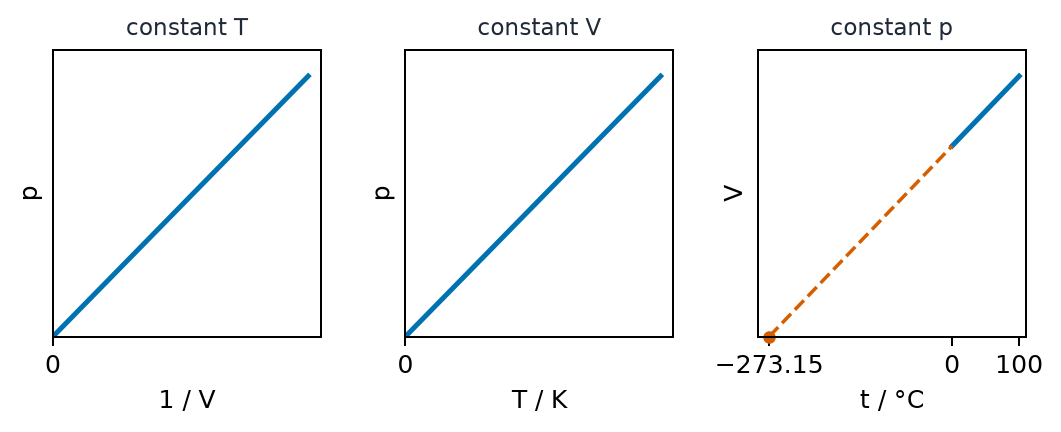
Does a fitted Celsius intercept show a real gas can remain gaseous all the way to 0 K?
Difficulty 1/5 · 100 coins + a small bonus on first completion today
Separate mathematical continuation from a physically attainable state.
S1.5: Use consistent SI quantities
- With R=8.31 J/(K·mol), use absolute p in Pa, V in m³ and T in K.1 kPa=1000 Pa;1 dm³=0.001 m³;1 cm³=10⁻⁶ m³.
- kPa·dm³ is dimensionally a joule, but follow the course’s stated SI calculation route. Mixing kPa with m³ while retaining numerical R=8.31 creates a factor-of 1000 error; convert the final output units afterwards.
What is 180 cm³ in cubic metres?
Difficulty 1/5 · 100 coins + a small bonus on first completion today
Since 1 cm = 0.01 m, 1 cm³ = (0.01)³ m³ = 10⁻⁶ m³. Hence 180 cm³ = 180 × 10⁻⁶ m³ = 1.80 × 10⁻⁴ m³. Cube the length conversion factor for a volume.
S1.5: Convert gauge to absolute pressure
- Invented gauge 50 kPa at ambient 100 kPa means 150 kPa absolute. A rigid fixed sample warming 300→360 K reaches 150×360/300=180 kPa absolute.
- If ambient remains 100 kPa, final gauge pressure is 80 kPa. A gauge reading is a difference from ambient; it is not the pressure referenced to vacuum required in a gas law.
An invented sample has initial gauge pressure 50 kPa while ambient pressure is 100 kPa. Which initial pressure enters the ideal-gas law?
Difficulty 1/5 · 100 coins + a small bonus on first completion today
Gauge pressure is measured relative to ambient pressure. Absolute pressure = gauge + ambient = 50 + 100 = 150 kPa. The ideal-gas pressure is referenced to vacuum, so use 150 kPa, not the 50 kPa gauge difference. If using the SI gas constant with cubic metres, convert this to 150 000 Pa before substituting.
Find final absolute pressure for initial gauge 50 kPa plus ambient 100 kPa, rigid fixed sample warming 300→360 K.
Difficulty 2/5 · 140 coins + a small bonus on first completion today
First find initial absolute pressure: p₁ = gauge + ambient = 50 + 100 = 150 kPa. At fixed amount and volume, p₂ = p₁T₂/T₁ = 150 × 360/300 = 180 kPa absolute.
S1.5: Apply the combined gas law
- At fixed n, p₁V₁/T₁=p₂V₂/T₂. For invented 300 cm³ at 300 K/100 kPa changing to 360 K/150 kPa, SI substitution gives V₂=2.40×10⁻⁴ m³=240 cm³.
- Temperature factor 1.20 competes with pressure factor 1.50, giving volume factor 0.80. The relation needs fixed amount and appropriate ideal behaviour; it does not permit an unnoticed leak or phase change.
A fixed amount of ideal gas warms from 300 to 360 K while absolute pressure rises from 100 to 150 kPa. Why does its volume fall despite warming?
Difficulty 1/5 · 100 coins + a small bonus on first completion today
At fixed amount, V₂/V₁ = (T₂/T₁)(p₁/p₂) = (360/300)(100/150) = 0.80. Warming alone gives factor 1.20, but the pressure rise divides volume by 1.50; together they reduce volume by 20%.
Find final volume in cm³: initial 300 cm³,300 K,100 kPa; final 360 K,150 kPa; fixed amount.
Difficulty 2/5 · 140 coins + a small bonus on first completion today
At fixed amount, p₁V₁/T₁ = p₂V₂/T₂. Rearrange V₂ = V₁(p₁/p₂)(T₂/T₁). Keeping the same pressure and volume units on both sides gives V₂ = 300 × (100/150) × (360/300) = 240 cm³. This is 0.000240 m³ in SI units.
S1.5: Quantify rather than claim cancellation
- The handout’s 250 cm³,20→80°C example uses stated whole-kelvin estimates 293→353 K and pressure 100→150 kPa. Volume becomes 201 cm³ to three significant figures.
- The unrounded factor is (353/293) / 1.50 = 0.803185…, about 19.7% lower volume. Using exact 273.15 endpoints changes the unrounded result slightly, so state the rounding convention.
A fixed amount of ideal gas warms from the stated whole-kelvin estimates 293 to 353 K while absolute pressure rises from 100 to 150 kPa. Do the temperature and pressure factors exactly cancel?
Difficulty 1/5 · 100 coins + a small bonus on first completion today
At fixed amount, V₂/V₁ = (T₂/T₁)(p₁/p₂) = (353/293)(100/150) = 0.803185… . Temperature rises by a factor about 1.205, while pressure rises by 1.50, so the factors do not cancel. The final volume is about 80.3% of the initial volume, a decrease of about 19.7%. For the lesson’s 250 cm³ initial sample, V₂ ≈ 201 cm³ to three significant figures, using the stated whole-kelvin convention.
S1.5: Use a molar volume 摩尔体积 at its conditions
- Equal ideal-gas volumes at the same T,p contain equal numbers of particles. The course booklet molar volume 22.7 dm³/mol belongs to its stated STP, approximately 273 K and 100 kPa.
- For 0.0400 mol at those conditions, volume=0.0400×22.7=0.908 dm³=908 cm³. Amount alone does not determine volume when T or p changes.
Can 22.7 dm³/mol be used at every temperature and pressure?
Difficulty 1/5 · 100 coins + a small bonus on first completion today
Molar volume depends on the thermodynamic conditions.
S1.5: Bound a gas volume ratio
- N₂(g)+3 H₂(g)→2 NH₃(g) gives an ideal stoichiometric volume ratio 1:3:2 at common T,p, if the stated reaction extent is achieved and the substances remain gases.
- A hypothetical 10 cm³ nitrogen with 30 cm³ hydrogen could yield 20 cm³ ammonia for complete conversion. Real equilibrium, limiting reactants and condensation can prevent that outcome; a coefficient is not a guaranteed actual yield.
Does the balanced equation alone guarantee complete ammonia conversion?
Difficulty 1/5 · 100 coins + a small bonus on first completion today
Separate stoichiometric ratios from an actual achieved conversion.
S1.5: Solve for an amount or volume
- Use n=pV/(RT). Invented 0.320 g occupying 180 cm³ at 300 K/100 kPa gives pV=18 J and n=18/(8.31×300)=0.0072202166… mol.
- For 0.500 mol at 298 K/101 kPa, convert p to 101000 Pa: V=nRT/p=0.0122593069… m³, reported 12.3 dm³. Keep intermediate values unrounded.
Why convert 101 kPa to 101000 Pa before using SI R with m³?
Difficulty 1/5 · 100 coins + a small bonus on first completion today
Units determine which numerical substitution is valid.
S1.5: Infer molar mass without over-identifying
- M=m/n=mRT/(pV). Using the invented 0.320 g case and unrounded amount gives M=44.32 g/mol, reported 44.3 g/mol.
- Carbon dioxide or propane could be candidates, but similar molar masses, mixtures and uncertainty prevent unique identification from this number alone. An estimate needs independent chemical evidence.
Does a molar mass near 44 g/mol uniquely identify carbon dioxide?
Difficulty 1/5 · 100 coins + a small bonus on first completion today
A model-derived mass is evidence, not unique chemical identity.
S1.5: Connect density and molar mass
- Substituting n=m/M and ρ=m/V gives ρ=pM/(RT), so M=ρRT/p. Use kg/mol with density in kg/m³ for consistent SI mass units.
- Invented ρ = 1.60 kg/m³,T=300 K,p=100000 Pa gives M=0.039888 kg/mol=39.888 g/mol, reported 39.9 g/mol. This still does not uniquely identify a chemical substance.
How many grams per mole correspond to 0.039888 kg/mol?
Difficulty 1/5 · 100 coins + a small bonus on first completion today
Use 1 kg = 1000 g. Thus 0.039888 kg/mol × 1000 g/kg = 39.888 g/mol. The amount unit remains mol; only the mass prefix changes.
S1.5: Use a supplied dry-gas pressure
- In an invented equal-level collection, supplied total 103 kPa minus water-vapour partial pressure 3 kPa gives dry p=100 kPa. For 200 cm³ at 300 K, n = (100000 × 0.0002) / (8.31 × 300) = 0.00802246… mol.
- Use the supplied or justified vapour pressure at the actual temperature. Unequal liquid levels can need a hydrostatic correction; also check leaks, calibration, purity and temperature. Do not invent missing correction data.
In an invented equal-liquid-level collection, wet-gas total pressure is 103 kPa and the supplied water- vapour partial pressure is 3 kPa. Which pressure represents the dry gas?
Difficulty 1/5 · 100 coins + a small bonus on first completion today
Total pressure = dry-gas partial pressure + water-vapour partial pressure. Hence p(dry gas) = 103 − 3 = 100 kPa. Use this dry-gas pressure when pV = nRT is being used to find the amount of dry gas; 103 kPa includes the water vapour. Equal liquid levels remove a liquid-head pressure difference in this model. Unequal levels would need their own justified correction.
Find dry-gas amount: dry p 100000 Pa,V 0.0002 m³,T 300 K,R 8.31.
Difficulty 2/5 · 140 coins + a small bonus on first completion today
Use pV = nRT, so n = pV/(RT) = (100000 × 0.000200)/(8.31 × 300) = 20/2493 = 0.00802246… mol of dry gas.
S1.5: Interpret a fitted slope
- For p against 1/V at fixed n,T, slope=nRT. Pressure in Pa and reciprocal volume in m⁻³ give slope units Pa·m³=J.
- A supplied 500 Pa·m³ slope at 300 K gives n=500/(8.31×300)=0.2005616… mol. Intercept, residuals, calibration and stability of conditions determine how defensible that estimate is.
For a fixed amount of ideal gas at constant temperature, a graph plots pressure p in Pa against reciprocal volume 1/V in m⁻³. Which equation estimates n from its fitted slope?
Difficulty 1/5 · 100 coins + a small bonus on first completion today
Rearrange pV = nRT to p = (nRT)(1/V). Thus the p-versus-1/V slope is nRT, giving n = slope/(RT). With slope 500 Pa·m³, T = 300 K and R = 8.31 J/(mol·K), n = 500/(8.31 × 300) = 0.20056… mol.
Find n from a p-versus-1/V slope 500 Pa·m³ at 300 K, R=8.31.
Difficulty 2/5 · 140 coins + a small bonus on first completion today
n=500/(8.31×300)=0.2005615724… mol.
S1.5: Compare real and ideal behaviour
- Real gases often approach the ideal model at suitable low pressure and high temperature. At high density, finite particle volume matters; attractions become more important relative to thermal motion at lower temperature.
- These effects compete. Gas identity, temperature, pressure and phase determine the net deviation; not every high-pressure state has the same sign, and stronger attractions alone do not rank every possible gas condition.
Must every real gas show the same deviation at every high pressure?
Difficulty 1/5 · 100 coins + a small bonus on first completion today
State why assumptions may fail without turning a tendency into a universal path.
S1.5: Calculate a deviation ratio
- Z=pV/(nRT) equals 1 in the ideal model. Supplied p=1.20×10⁶ Pa,V=1.00×10⁻³ m³,n=0.500 mol,T=300 K gives pV=1200 J and nRT=1246.5 J.
- Z=1200/1246.5=0.9626955… . Below 1 is consistent with attractions being important under the stated conditions, but does not identify the gas, prove one unique mechanism or eliminate measurement error.
What does Z compare?
Difficulty 1/5 · 100 coins + a small bonus on first completion today
Define the ratio before assigning a physical interpretation.
Find Z for pV=1200 J and nRT=1246.5 J.
Difficulty 2/5 · 140 coins + a small bonus on first completion today
Z=1200/1246.5=0.9626955475… .
S1.5: Read a schematic without inventing data
- The real-gas curve shown is an invented qualitative illustration: a dip below 1 followed by a rise is one possible pattern. It is not measurements of a named gas or a universal route.
- An ideal straight line or low-pressure limit is a model statement. To test a real sample, specify conditions, phase and measurement uncertainty; do not convert a drawn shape into an exact physical threshold.
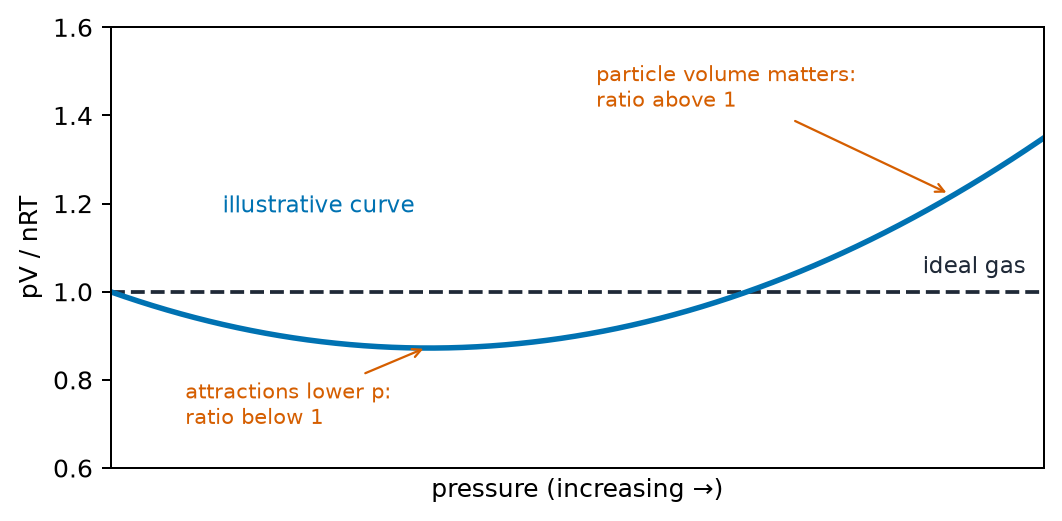
Does a schematic curve establish measured pressure thresholds for every gas?
Difficulty 1/5 · 100 coins + a small bonus on first completion today
Keep model illustration and measured evidence distinct.
S1.5: Detect an amount change despite rising pressure
- An invented rigid sample changes 200→204 kPa while T changes 300→360 K. From pV=nRT, n₂/n₁=(204/200)(300/360)=0.85.
- The model implies 15% less amount despite a 2% pressure rise. A leak is one possible explanation under the assumptions; check calibration, volume, temperature and phase before assigning a cause.
Does a higher final pressure prove the gas amount was unchanged?
Difficulty 1/5 · 100 coins + a small bonus on first completion today
Use all relevant state variables instead of the direction of one reading.
Find percentage of initial amount remaining for rigid ideal sample p 200→204 kPa,T 300→360 K.
Difficulty 2/5 · 140 coins + a small bonus on first completion today
n₂/n₁=(204/200)(300/360)=0.85, so 85% remains under the assumptions.
S1.5: Plan a valid and approved comparison
- Use only approved apparatus and teacher-set temperature/pressure limits. Allow thermal equilibrium, record actual pressure reference and temperature, and check gas tightness and volume stability.
- Vary the intended quantity while documenting the others; collect suitable repeats and inspect model fit. Do not extrapolate real gas to 0 K, heat an improvised sealed vessel or assume a sensor label eliminates calibration uncertainty.
Why wait for thermal equilibrium before linking gas pressure to bath temperature?
Difficulty 1/5 · 100 coins + a small bonus on first completion today
Match the measured bath temperature to the model’s actual gas state.