Climate evidence, energy budgets and policy
Introduced| English | Meaning |
|---|---|
| mitigation/ˌmɪtɪˈɡeɪʃn/ | Action that reduces the causes of climate change, mainly greenhouse gas emissions. |
| adaptation/ˌædæpˈteɪʃn/ | A characteristic that helps an organism survive and reproduce in its environment. |
What would explain this observation?
- One cold day does not disprove a warming climate. Weather describes short-term conditions; climate describes distributions over longer times and regions.
Build the model
- The Earth energy balance includes incoming solar radiation, reflection, absorption and outgoing infrared radiation.
- Greenhouse gases absorb and emit infrared radiation.
- Feedback can alter the response to an initial forcing.
- mitigation 减缓: Actions addressing causes of environmental change.
- adaptation 适应: Actions reducing harm from environmental impacts.

Which action is adaptation to flood risk?
Difficulty 1/5 · 100 coins + a small bonus on first completion today
Adaptation reduces the impact of a risk that remains - moving equipment above flood level does exactly that. Measuring CO2 is monitoring, and ignoring the risk is neither mitigation nor adaptation.
Match each technical term to its precise meaning.
Difficulty 2/5 · 140 coins + a small bonus on first completion today
Use the definitions to distinguish related quantities and processes.
Choose evidence that can test it
- Distinguish mitigation, which addresses drivers, from adaptation, which reduces harm from impacts.
- A policy assessment needs evidence about effectiveness, cost, equity and uncertainty; one criterion is not the entire decision.
In the lab: Compare multi-year data using consistent baselines. State the region, timescale and uncertainty. At HL, connect a management decision to law, economics and ethics rather than treating these lenses as extra definitions only.
Which two habits make the investigation or model in this case more defensible?
Difficulty 2/5 · 140 coins + a small bonus on first completion today
Stating the conditions and assumptions lets others repeat the work exactly, and recording the supporting evidence lets them check the conclusion. Hiding disagreeing results removes the evidence that could challenge a wrong conclusion, and one measurement can never establish a wider claim.
Work from known quantities
- Known: a surface receives 200 power units and reflects 50.
- Absorbed input = incoming-reflected = 200-50 = 150.
- Reflected fraction = 50/200 = 0.25 = 25%.
- A change in reflectivity alters the absorbed budget under this model.
Your turn: Incoming energy is 240 units and reflected energy 72. Find reflected percentage.
Reflection changes the absorbed energy budget
The lesson's 200 incoming power units split into 50 reflected and 150 absorbed. An added illustrative outgoing infrared power of 150 initially balances absorption. Compare the flows as reflectivity changes; this does not predict temperature or a climate trend.
Incoming energy is 240 units and reflected energy 72. Find reflected percentage.
Difficulty 2/5 · 140 coins + a small bonus on first completion today
The result is 30 %. Known: incoming 240 units; reflected 72 units. Use reflected percentage = reflected / incoming x 100. Percentage = 72/240 x 100 = 30%. The absorbed share is 70% under this budget.
Check the conclusion and its limits
- The greenhouse effect is not the same process as ozone depletion.
- A carbon footprint estimate depends on its system boundary.
Not true: One local weather observation establishes a global climate trend. Weather is a short-term local state; climate is the long-term statistical pattern. One cold day in one city cannot confirm or refute a global trend built from decades of worldwide records.
- The Earth energy balance includes incoming solar radiation, reflection, absorption and outgoing infrared radiation.
- Distinguish mitigation, which addresses drivers, from adaptation, which reduces harm from impacts.
- Watch for: the greenhouse effect is not the same process as ozone depletion.
Weather is a short-term local state; climate is the long-term statistical pattern.
Difficulty 1/5 · 100 coins + a small bonus on first completion today
True. Weather is a short-term local state; climate is the long-term statistical pattern. One cold day in one city cannot confirm or refute a global trend built from decades of worldwide records.
Actions addressing causes of environmental change: write the technical term.
Difficulty 1/5 · 100 coins + a small bonus on first completion today
mitigation means Actions addressing causes of environmental change.
Write from a reflected share of 14 percent
- Incoming energy is 200 units and reflected energy is 28 units.
- Find the reflected percentage. One local weather observation is not a climate trend.
Incoming energy is 200 units and reflected energy is 28 units. What percentage is reflected, and why does one local weather observation not establish a climate trend?
Reflected percentage = reflected energy/incoming energy × 100 = 28/200 × 100 = 14%. One local weather observation gives a short-term state; a climate trend needs comparable records over longer periods and regions.
The SL written surface receives 200 energy units and reflects 28. What percentage is reflected?
Difficulty 1/5 · 100 coins + a small bonus on first completion today
28 divided by 200 is 0.14, so 14 percent is reflected. Other options — 30 percent (the lesson case of 72 units from 240); 28 units (the reflected energy).
Compare climate records using a stated baseline
- Weather is a short-term atmospheric state; climate describes distributions over longer periods and regions. Compare consistent locations, seasons, methods and uncertainty. An invented temperature anomaly rising from +0.4 to +1.0 degrees Celsius changes by +0.6 degrees relative to the stated reference; these are not the absolute temperatures.
- A percentage calculated from a Celsius anomaly can be misleading because the reference zero is chosen. Ice-core carbon dioxide and reconstructed temperature can correlate while feedbacks and common drivers also operate. Correlation alone does not determine the whole causal direction; independent physical evidence and other observations support the greenhouse mechanism. One cold or hot local day does not settle a global trend.
An invented temperature anomaly changes from +0.4 to +1.0 degrees Celsius relative to the same reference. Find the change in degrees Celsius.
Difficulty 2/5 · 140 coins + a small bonus on first completion today
1.0 − 0.4 = +0.6 degrees. The anomaly is a difference from a reference, not an absolute temperature or a universal percentage warming.
Connect human emissions with active carbon stores and removal
- Fossil-fuel burning transfers carbon from geological stores to the active atmosphere–ocean–biosphere system. Deforestation can release stored carbon and reduce later uptake. Atmospheric carbon dioxide can increase even while vegetation and oceans absorb some emissions, because sinks need not remove the full added amount.
- Human-associated methane sources include fossil-fuel leaks, anaerobic decomposition in landfills or flooded rice fields, and microbial digestion in ruminants. Emission rate and atmospheric concentration are different: concentration also depends on removal. Neither gas comes from only one activity, and a continuing sink does not imply that human additions have no effect.
Separate infrared transfer from surface reflectivity
- Greenhouse gases absorb and emit infrared radiation at relevant wavelengths, changing radiative transfer and energy balance. They do not form a solid roof or reflect all outgoing radiation. The natural greenhouse effect and its enhancement are related; ozone depletion is a separate process.
- In an invented surface budget, incoming 240 power units minus reflected 72 gives absorbed input 168 and a reflected share of 30%. Another surface receiving 180 and reflecting 36 absorbs 144 and reflects 20%; the separate SL written case receives 200 and reflects 28, giving 172 absorbed and 14% reflected. State the case and consistent energy/power units; this simplified reflection budget does not determine the whole planet's temperature.
Close each reinforcing feedback through its physical mechanism
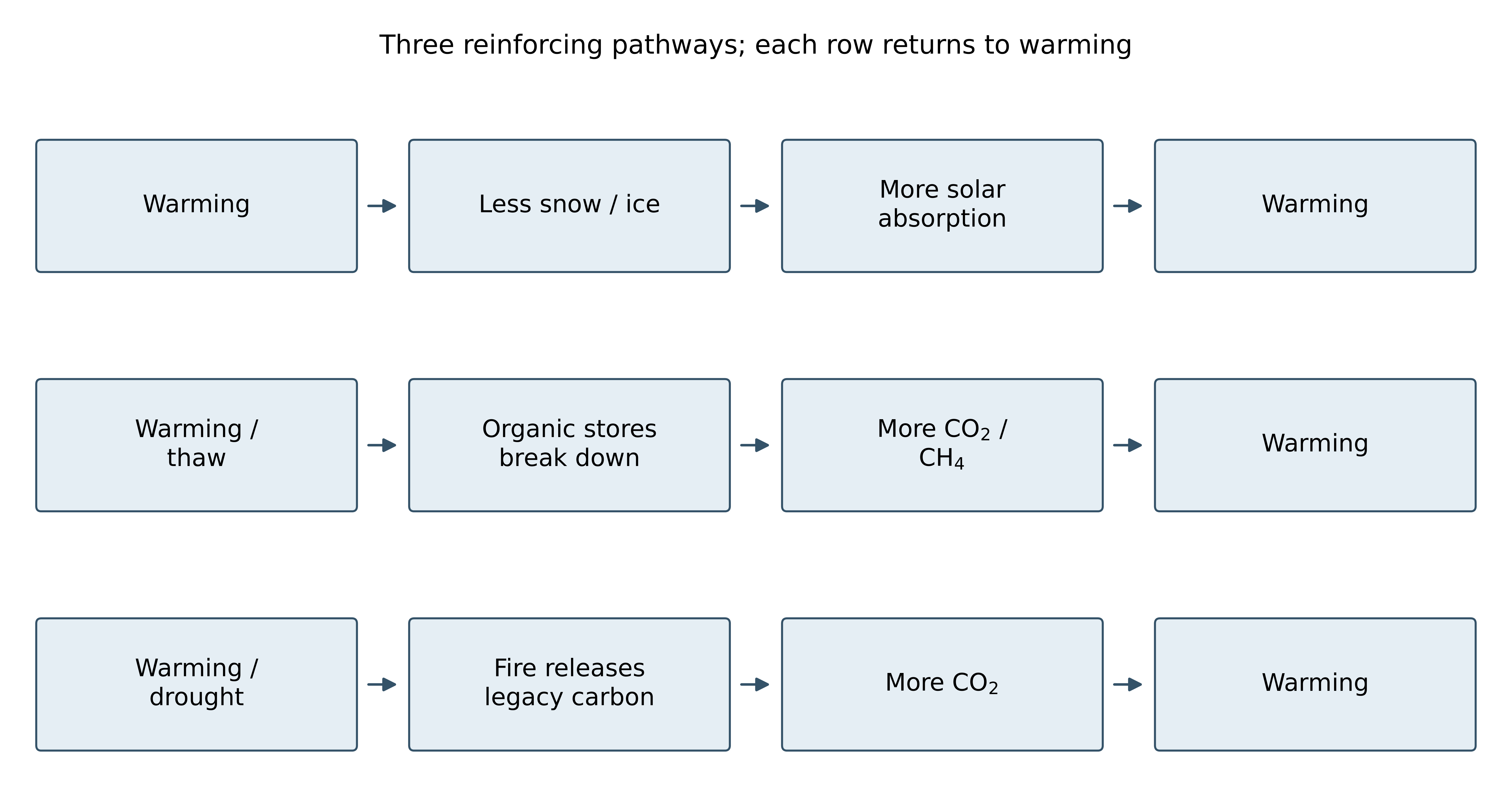
- Warming can remove bright snow/ice, expose a darker surface, increase solar absorption and promote further warming. Thaw can expose frozen organic material to decomposition: aerobic pathways release carbon dioxide, while waterlogged low-oxygen conditions can support methane production. The gas need not all have been pre-made inside ice.
- Peat drying, drought and fire can release stored carbon and reduce later uptake, reinforcing warming. Rates still depend on moisture, oxygen, substrate and organism limits. Carbon-rich deep water reaching the surface can release carbon dioxide, while warming affects solubility; circulation and biology also matter. Local release does not establish that the entire ocean is a net source.
Distinguish a boreal carbon stock from its current net balance
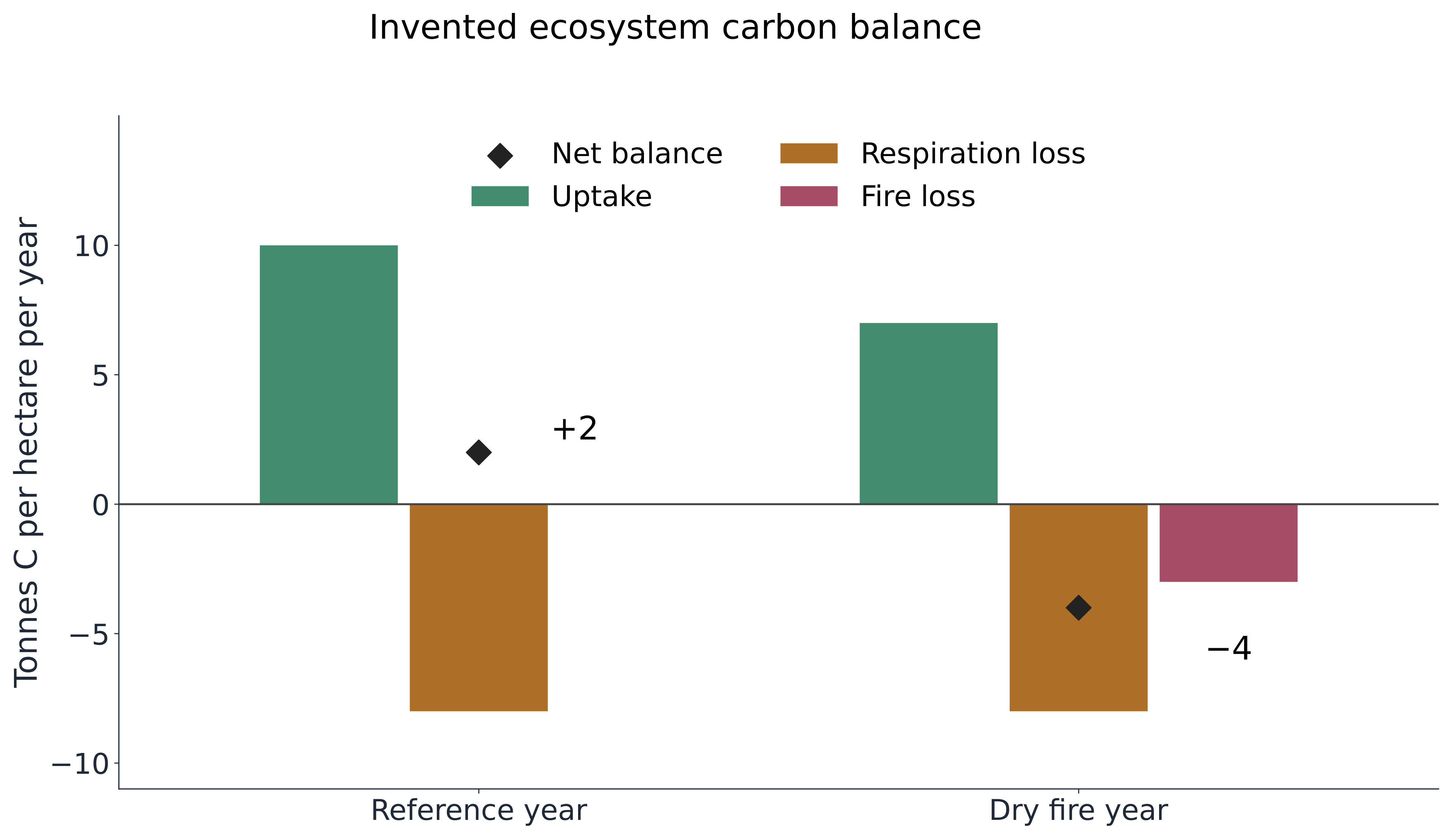
- In an invented hectare, annual carbon uptake 10 tonnes C and respiration 8 give net retention +2 tonnes C with no fire. A dry fire year with uptake 7, respiration 8 and combustion 3 gives −4 tonnes C: a net source for that boundary and year. Even without fire, uptake 7 minus respiration 8 would be a loss of one tonne C.
- A large existing stock does not make a forest a current sink, and tonnes C are not tonnes carbon dioxide. Walker and colleagues' research summary describes radiocarbon evidence for legacy-soil-carbon combustion in vulnerable Canadian forest conditions. It supports a loss mechanism, not one universal tipping age for every boreal forest. Repeated measurements are needed before calling a one-year loss permanent collapse.
An invented hectare takes up 1,200 kg C annually, loses 900 kg C through respiration and 450 kg C through fire. Calculate net ecosystem carbon retention in kg C for that year.
Difficulty 2/5 · 140 coins + a small bonus on first completion today
1,200 − 900 − 450 = −150 kg C. Negative retention means a net source for the defined year/boundary, not proof of permanent collapse or a quantity in kg CO2.
Explain polar habitat loss through season, location and life stage
- Landfast sea ice is attached to a coast or fixed feature; drifting sea ice moves, and both differ from a land-based glacier. Emperor penguins commonly breed on stable Antarctic sea ice. Early breakup can remove the platform before chicks have waterproof plumage. Fretwell and colleagues' 2023 satellite study reported evidence of breeding failure at four of five studied Bellingshausen Sea colonies in 2022, not every colony in Antarctica.
- Arctic walruses use ice as resting platforms near shallow feeding grounds. Retreat beyond suitable shelf habitat can increase travel or crowd coastal haulouts, where young animals can be vulnerable during disturbance. Walruses feed on benthic organisms rather than eating ice. Habitat function depends on position, season and persistence, not just one annual ice-area total.
Connect ocean mixing with nutrient-limited primary production
- Photosynthesis needs light and nutrients. Sunlit surface water can become nutrient-depleted, while mixing and upwelling supply nutrient-rich deeper water. Warmer surface layers can strengthen stratification and reduce vertical exchange. Winds, salinity and currents also affect delivery; warmth does not create nitrate by itself.
- If nutrient supply limits producers, reduced delivery can lower production and food-web energy input. In an invented comparison, production falls from 500 to 400 units per square metre per year, a 20% reduction. An assumed transfer fraction of 0.10 gives 50 then 40 corresponding units at the next level. This is a conditional model, not a universal efficiency or a direct forecast of fish catch at every coast.
An invented primary-production comparison changes from 500 to 400 units per square metre per year. Calculate percentage decrease relative to 500.
Difficulty 2/5 · 140 coins + a small bonus on first completion today
(500 − 400)/500 × 100 = 20%. An assumed 10% trophic transfer would give 50 then 40 corresponding units, not an unconditional fish-catch forecast.
Distinguish range movement from unlimited habitat escape
- Establishment at a cooler leading edge and loss at a warmer trailing edge can shift a range poleward or upslope. Dispersal, soil, partners, competition and barriers constrain movement; individuals do not need to walk uphill for a population's boundary to change. Survey effort, season and detection must be comparable in resurveys.
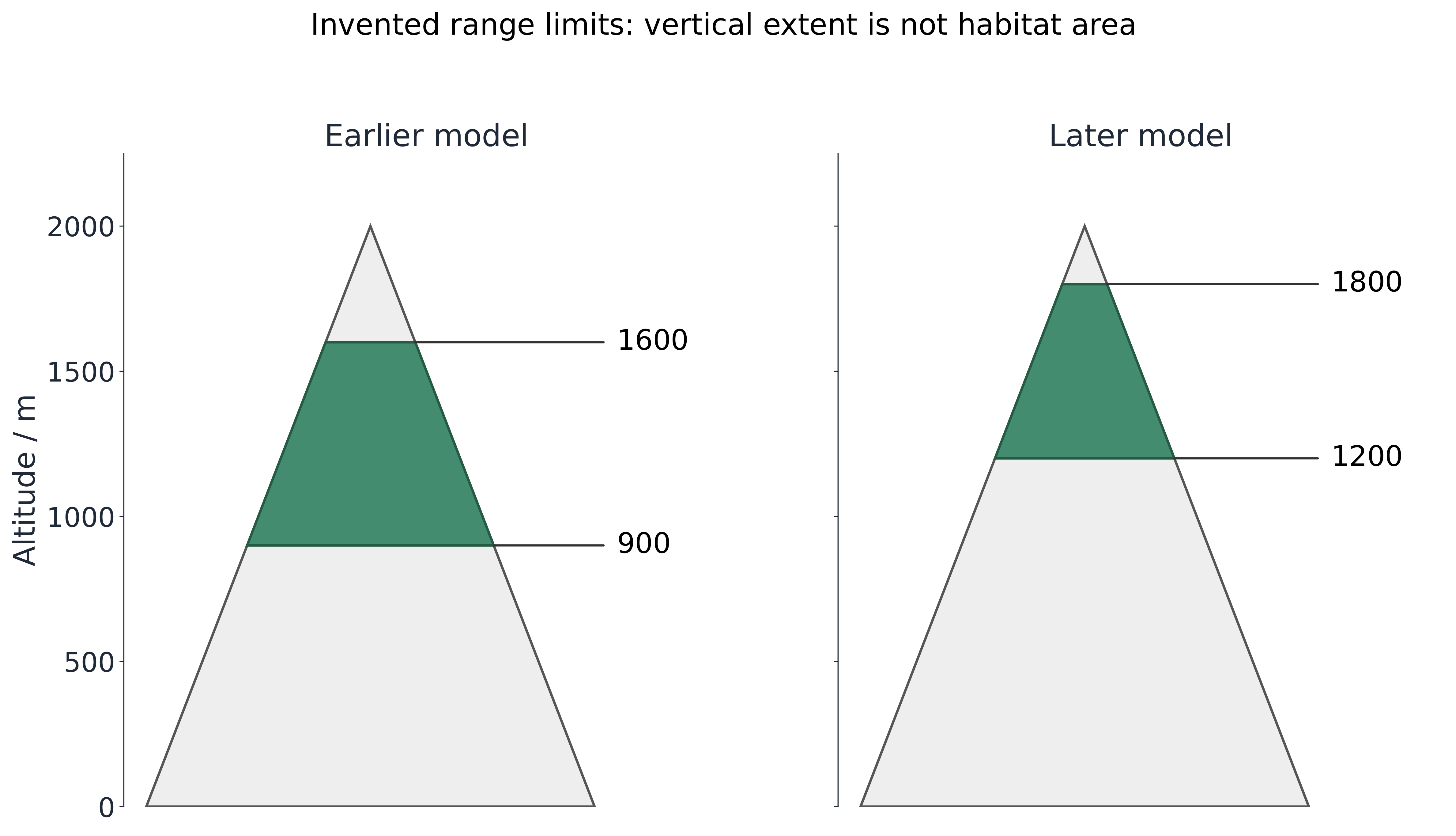
- In the invented mountain model, limits move from 900–1,600 m to 1,200–1,800 m. The lower edge rises 300 m and upper edge 200 m, shrinking vertical extent from 700 to 600 m, about 14.3%. Vertical extent is not habitat area, especially near a summit. Real species, including different tree life stages, can show varied responses; a distributional shift alone is not proof of allele-frequency evolution.
An invented mountain range changes from limits 900–1,600 m to 1,200–1,800 m. Find the percentage decrease in vertical extent relative to its initial extent.
Difficulty 2/5 · 140 coins + a small bonus on first completion today
Initial extent 700 m; later 600 m. The decrease is 100/700 × 100 ≈ 14.3%. Vertical extent is not habitat area.
Separate coral bleaching from reduced calcification
- Reef-building corals are animals associated with photosynthetic symbionts supplying much of their nutrition. Heat stress can disrupt the association, reducing symbionts or pigments and revealing the pale skeleton: bleaching. A bleached coral is stressed but not necessarily dead; prolonged or repeated stress can impair recovery and cause mortality.
- Carbon dioxide uptake also increases seawater hydrogen ions and can reduce carbonate availability, making calcium-carbonate construction harder. As NOAA explains, acidification concerns falling pH, not necessarily pH below seven. This chemistry differs from heat-induced bleaching. Lost coral structure can affect shelter, food and reproduction throughout the reef; local pollution or disease can compound stress.
Which explanation correctly separates coral bleaching from ocean acidification?
Difficulty 1/5 · 100 coins + a small bonus on first completion today
Bleached corals can survive and recover under suitable conditions. Acidification is a pH decline, with reduced carbonate availability potentially affecting calcium-carbonate structures.
Keep climate adaptation distinct from mitigation and genetic adaptation
- Mitigation addresses drivers, such as fossil-fuel emissions or durable carbon uptake. Climate adaptation reduces harm, for example reconnecting suitable habitats or adjusting water management. One intervention can contribute to both, but reducing flood damage does not automatically lower greenhouse-gas concentration.
- In evolution, adaptation refers to inherited features associated with success; in climate policy, adaptation can be a practical response that requires no genetic change. Likewise, acclimatization within one organism and range movement are not automatically evolution. Name the meaning in context rather than treating every useful response as newly inherited adaptation.
Which action most directly illustrates climate adaptation rather than a demonstrated reduction in the causes of warming?
Difficulty 1/5 · 100 coins + a small bonus on first completion today
Climate adaptation reduces impacts; mitigation addresses drivers. A project can do both, but impact reduction alone does not establish reduced greenhouse-gas concentration or genetic evolution.
Assess sequestration through net storage, baseline and permanence
- Afforestation establishes forest on land not recently forested; regeneration restores tree cover through recovery. Net carbon retention depends on growth, soil disturbance, respiration, harvest, later fire and what would otherwise happen. Planting one seedling does not make its carbon permanent. Compare native regeneration and non-native plantations over equivalent boundaries and timescales, including water use, habitat and reflectivity.
- Rewetting peat-forming wetlands can slow aerobic decomposition and support organic accumulation when production exceeds loss. Methane emissions can also change, so stored carbon and total climate effects need separate accounting. Tropical, temperate and boreal peat systems need not have identical rates. A stock estimate alone does not establish annual additional removal or a zero-emission outcome.
Compare policy claims using several explicit criteria
- Effectiveness, cost, equity and uncertainty address different questions. Include construction, maintenance, land-use change, displaced emissions and later releases where relevant to the chosen boundary. A cheap project can have little net benefit if it merely shifts emissions elsewhere; a large gross uptake can conceal a small additional net gain.
- Compare measured or modelled outcomes against an explicit baseline, giving the timescale and uncertainty. Legal requirements, economics and ethical priorities can influence choices, but a decision needs evidence linking the intervention to its intended outcome. A single cost or photograph cannot establish the full comparison.
Link a climate driver to an ecological consequence and its limits
- Trace the relevant physical change through habitat, nutrients, physiology or interactions to a biological outcome. Distinguish mechanisms such as sea-ice platform loss, stratification, coral heat stress and seawater chemistry rather than writing one generic warming arrow. Name the region, life stage and evidence used.
- In numerical work, use consistent carbon mass, proper starting denominators and the actual system boundary. Separate stocks, net fluxes, percentage points and differences from an anomaly baseline. Explain one alternative influence, one measurement limitation and what further evidence would strengthen a claim about persistence, recovery or causation.
Explain two different routes from climate-related change to a biological outcome, then evaluate a carbon-sequestration or adaptation claim. Include a calculation or measurement limit.
A causal pathway and a defined comparison support a claim more strongly than one generic warming arrow or gross uptake figure.