Cell division: count nuclei and chromosomes carefully
Introduced| English | Meaning |
|---|---|
| chromatid/ˈkrəʊmətɪd/ | One of the two copies of a replicated chromosome before they separate. |
| mitotic index/maɪˈtɒtɪk ˈɪndeks/ | Fraction of scored cells undergoing mitosis. |
What would explain this observation?
- A root-tip image contains cells at different stages of mitosis. A snapshot can estimate the fraction of cells dividing, but it does not time one observed cell directly.
Build the model
- DNA replication occurs before mitosis.
- Mitosis separates sister chromatids 染色单体, preserving chromosome number in daughter nuclei.
- Meiosis includes homologous chromosome separation and normally halves the chromosome number while generating variation.
- mitotic index 有丝分裂指数: Fraction of scored cells undergoing mitosis.
- chromatid: One copy of a replicated chromosome before separation.

What happens to DNA amount during replication before mitosis?
Difficulty 1/5 · 100 coins + a small bonus on first completion today
Replication copies every DNA molecule, so the DNA amount doubles before mitosis while each chromosome still counts as one (two sister chromatids joined at a centromere). The DNA never disappears or halves during replication.
Match each technical term to its precise meaning.
Difficulty 2/5 · 140 coins + a small bonus on first completion today
Use the definitions to distinguish related quantities and processes.
Choose evidence that can test it
- Count chromosomes by centromeres under the stated convention.
- DNA amount and chromosome number are different quantities.
- Crossing over and independent assortment contribute to meiotic variation.
In the lab: Use a prepared root-tip slide or a labelled image. Define a counting rule and field selection before counting. Distinguish dividing cells from damaged or ambiguous cells and report exclusions.
Which two habits make the investigation or model in this case more defensible?
Difficulty 2/5 · 140 coins + a small bonus on first completion today
Stating the conditions and assumptions lets others repeat the work exactly, and recording the supporting evidence lets them check the conclusion. Hiding disagreeing results removes the evidence that could challenge a wrong conclusion, and one measurement can never establish a wider claim.
Work from known quantities
- Known: 25 dividing cells among 200 scored cells.
- Mitotic index = 25/200 = 0.125, or 12.5%.
- Estimating phase duration from this proportion requires assumptions about a steady, representative cell population.
Your turn: 18 of 120 scored cells are dividing. Calculate mitotic index as a percentage.
Count dividing cells against all scored cells
25 dividing cells among 200 scored cells gives 25/200 = 0.125 = 12.5%. Change the dividing and non-dividing counts and distinguish a snapshot proportion from a direct measurement of time.
18 of 120 scored cells are dividing. Calculate mitotic index as a percentage.
Difficulty 2/5 · 140 coins + a small bonus on first completion today
The result is 15 %. Known: 18 dividing cells among 120 scored. Use mitotic index = dividing / total x 100. Index = 18/120 x 100 = 15%. Reading phase durations from this assumes a steady, representative population.
Check the conclusion and its limits
- Replication doubles DNA amount without immediately doubling the chromosome count.
- Meiosis does not simply produce two identical diploid cells.
Not true: DNA replication immediately doubles chromosome number under the centromere convention. Under the centromere convention a chromosome with two sister chromatids still counts as one chromosome. Replication doubles DNA content; only sister-chromatid separation later doubles the chromosome count.
- DNA replication occurs before mitosis.
- Count chromosomes by centromeres under the stated convention.
- Watch for: replication doubles DNA amount without immediately doubling the chromosome count.
DNA replication immediately doubles chromosome number under the centromere convention.
Difficulty 1/5 · 100 coins + a small bonus on first completion today
Under the centromere convention a chromosome with two sister chromatids still counts as one chromosome. Replication doubles DNA content; only sister-chromatid separation later doubles the chromosome count.
Fraction of scored cells undergoing mitosis: write the technical term.
Difficulty 1/5 · 100 coins + a small bonus on first completion today
mitotic index means Fraction of scored cells undergoing mitosis.
Write from a mitotic index of 12 percent
- 9 of 75 scored cells are dividing.
- Find the mitotic index. Under the centromere convention, replication does not immediately double the chromosome number.
9 of 75 scored cells are dividing. What is the mitotic index as a percentage, and why does DNA replication not immediately double the chromosome number?
Mitotic index = dividing cells/all scored cells × 100 = 9/75 × 100 = 12%. A duplicated chromosome with attached sisters still counts as one under the centromere convention; DNA replication doubles DNA amount before sister separation changes chromosome count.
The SL written case has 9 dividing cells among 75 scored. Find mitotic index as a percentage.
Difficulty 1/5 · 100 coins + a small bonus on first completion today
9 divided by 75 is 0.12, so the mitotic index is 12 percent. Other options — 15 percent (the lesson example's result for 18 of 120 cells); 9 (the number of dividing cells).
Distinguish nuclear division from separating the whole cell
- New cells arise from existing cells through division, supporting unicellular reproduction, growth and tissue replacement. In nucleated eukaryotes, nuclear division distributes genetic material; cytokinesis separates cytoplasm. These processes usually cooperate but can overlap in timing or occur separately, leaving a multinucleate cell.
- Mitosis maintains chromosome number in daughter nuclei under the normal model; meiosis reduces chromosome-set number in a sexual life cycle. Neither process means a whole daughter cell appears spontaneously from non-living matter. State the required nuclear outcome before treating every division as identical.
Compare cytokinesis mechanisms and unequal cytoplasmic shares
- Animal cytokinesis uses an actin–myosin contractile ring and an inward cleavage furrow. Plant cells instead assemble vesicles into a cell plate that grows outward and builds separating membranes and wall. A rigid plant wall does not pinch inward by the same animal mechanism.
- Equal chromosome distribution need not mean equal cytoplasm: oogenesis retains most cytoplasm in the egg lineage, while polar bodies receive little, and budding yeast forms a smaller bud. Daughter cells also need appropriate organelles and cytoplasmic components. Receiving nuclear DNA alone does not supply all the structures needed for continued cell function.
Count chromosome sets separately from DNA copies
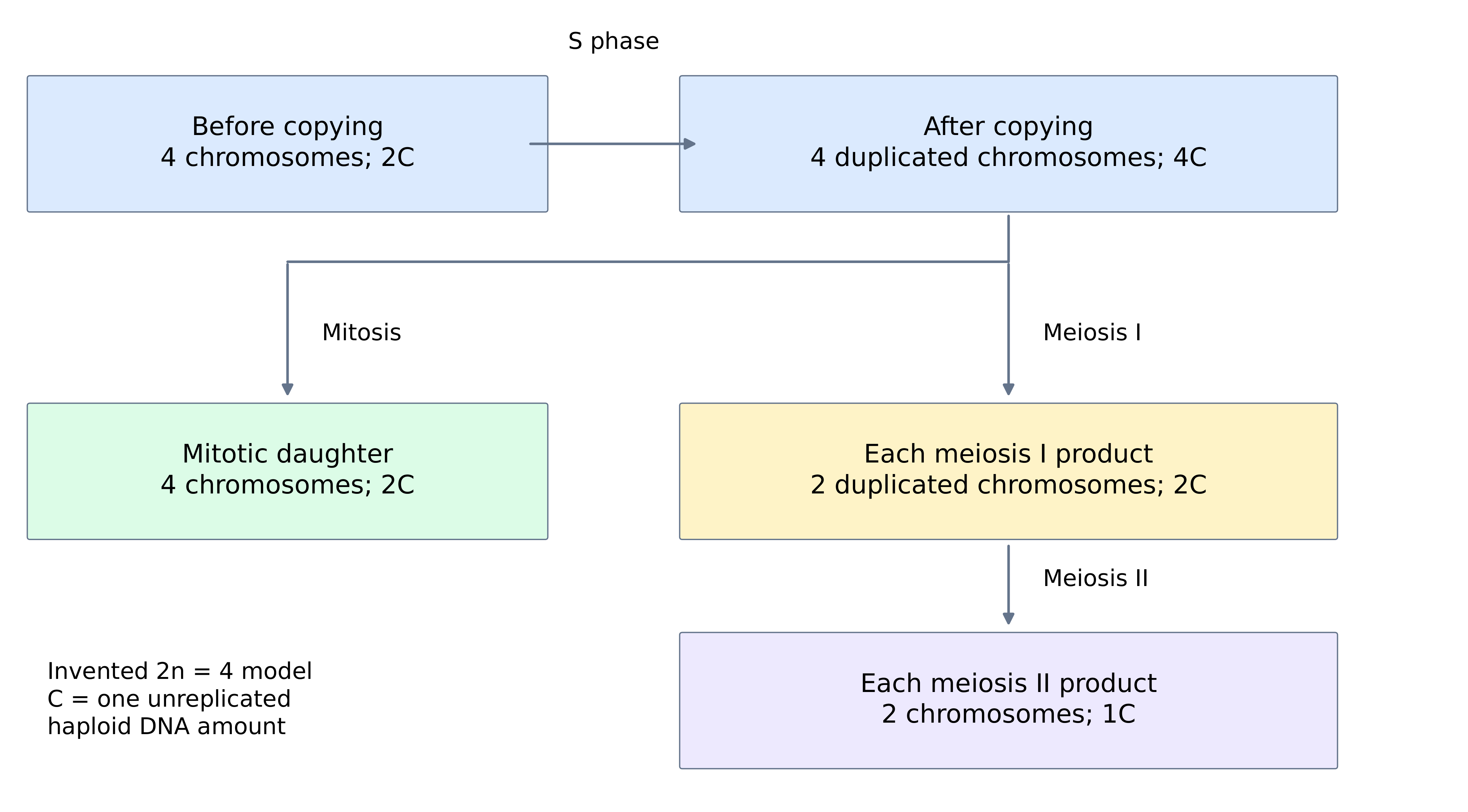
- Homologues are corresponding maternal and paternal chromosomes; sisters are the copied chromatids of one replicated chromosome. Under the stated convention, an attached pair of sisters still counts as one chromosome. Replication doubles DNA amount, without immediately doubling chromosome number or ploidy.
- In an invented species with 2n = 4, a cell goes from four chromosomes and 2C DNA before replication to four duplicated chromosomes and 4C after it. There are then eight chromatids and eight DNA molecules. C measures DNA amount in an unreplicated haploid set; it is not itself a chromosome count.
Explain chromosome movement through mitosis
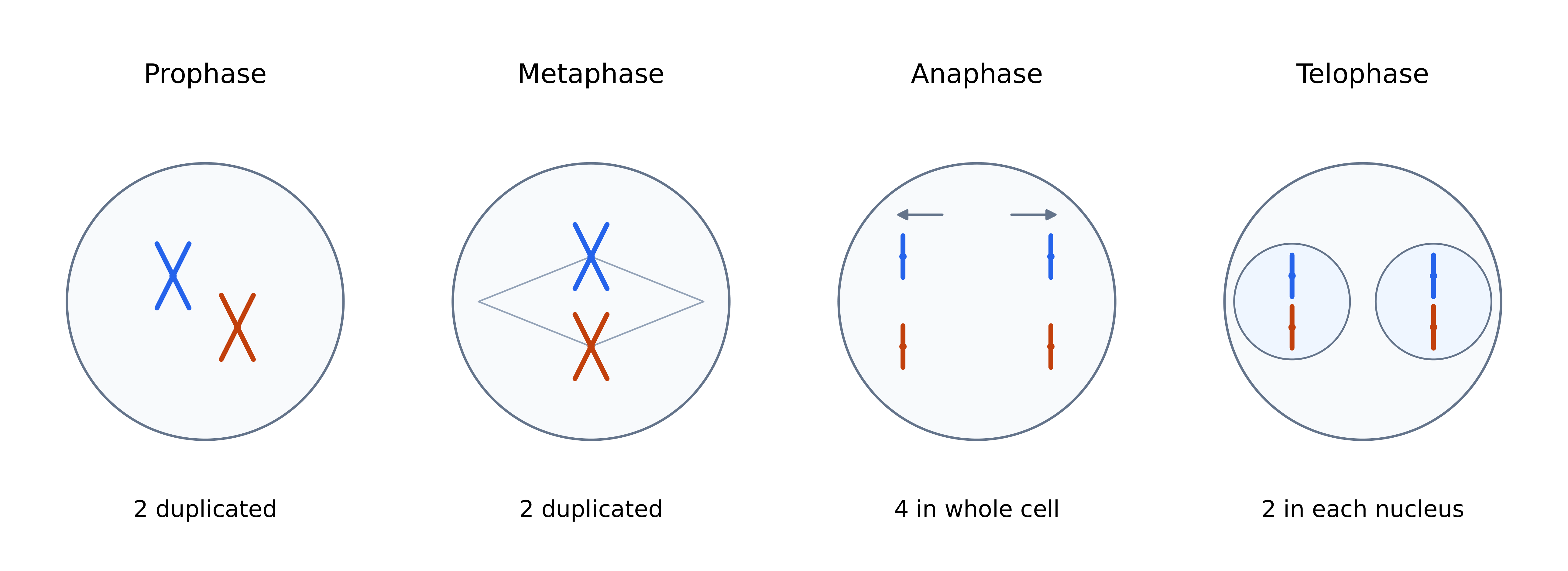
- Prophase includes chromosome condensation and spindle development, with nuclear-envelope breakdown allowing spindle access. Histone-associated packaging changes DNA arrangement rather than making extra copies. At metaphase, duplicated chromosomes align individually, with sister attachments towards opposite poles.
- In anaphase, sisters separate and each becomes a daughter chromosome; telophase forms daughter nuclei as chromosomes become less condensed. Microtubules, motors and changes in microtubule length contribute to movement. In the 2n = 4 model, the still-undivided anaphase cell has eight daughter chromosomes in total, while each future daughter nucleus receives four.
Identify phases from chromosome arrangement
- An equatorial arrangement of individual duplicated chromosomes supports metaphase; separating sister groups support anaphase; forming daughter nuclei support telophase. Paired homologues at an equator instead suggest metaphase I. An X represents two sisters of a duplicated chromosome, not automatically a homologous pair.
- Use prepared root-tip slides or supplied micrographs and record the arrangement supporting each identification. Start at low magnification, then examine clearly bounded cells. Keep uncertain or damaged cells recorded separately rather than guessing from round shape or dark staining alone. Interphase is active and is not one of the four mitotic phases.
Separate homologues first and sisters second in meiosis
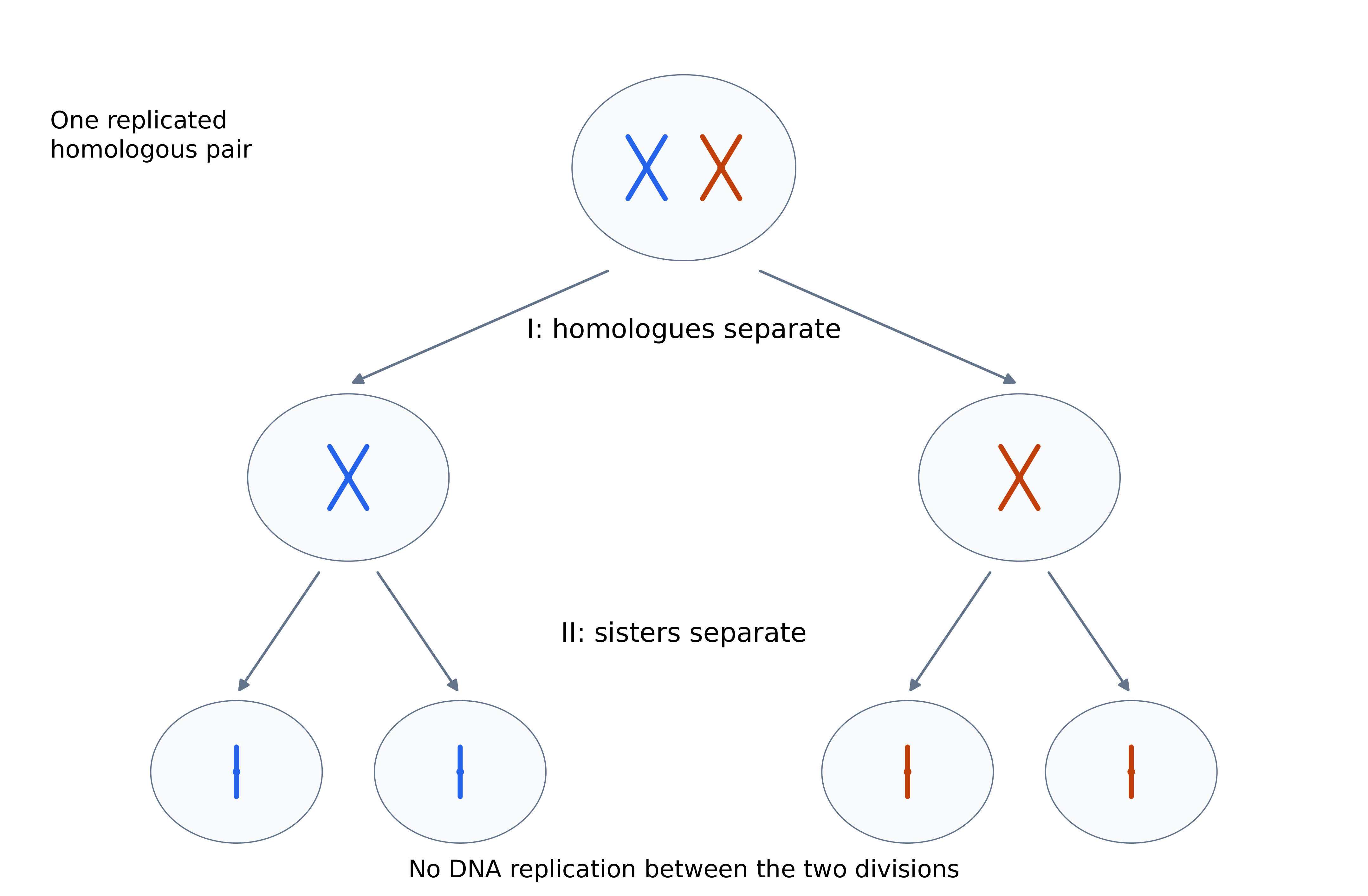
- Replication before meiosis I forms sisters; homologues then pair as bivalents, each containing two homologues and four chromatids. At metaphase I, bivalents align; anaphase I separates homologues while sisters remain attached. The resulting nuclei are haploid despite their duplicated chromosomes.
- Meiosis II separates sisters without another intervening DNA-replication round. One diploid nucleus normally gives four haploid nuclei. Cytokinesis can be unequal, so four nuclear products do not necessarily mean four equal functional gametes. Reduction and later fertilization prevent chromosome-set number doubling every sexual generation.
Apply the count convention to a different invented species
- Let 2n = 6 and unreplicated diploid nuclear DNA amount be 6 pg. After replication there are six duplicated chromosomes, twelve chromatids/DNA molecules and 12 pg. In whole-cell mitotic anaphase there are twelve daughter chromosomes; each normal daughter nucleus subsequently has six and 6 pg.
- After meiosis I, each of two products instead has three duplicated chromosomes and 6 pg; after meiosis II, each of four has three unduplicated chromosomes and 3 pg. Half the chromosome sets does not mean half an incomplete gene collection. Always label one product, one nucleus or the entire still-undivided cell before giving a number.
In an invented species with 2n = 6, a diploid cell completes DNA replication but its sister chromatids remain attached. How many nuclear DNA molecules are present in that cell?
Difficulty 2/5 · 140 coins + a small bonus on first completion today
Six duplicated chromosomes contain twelve sister chromatids, each containing one DNA molecule: twelve molecules. The attached-chromosome count remains six.
Distinguish crossing over from independent orientation
- In prophase I, non-sister chromatids of homologues can exchange corresponding regions, making new combinations within chromosomes. At metaphase I, different bivalents can orient independently, making different combinations of whole maternal and paternal homologues. These are different mechanisms; gametes need not have an exactly equal maternal/paternal chromosome split.
- Ignoring crossing over, n independent pairs permit 2 to the power n whole-chromosome combinations across possible meiotic products: four pairs permit sixteen. One meiosis still produces four nuclei, not sixteen. Mutation creates new alleles; meiotic reshuffling and fertilization combine existing variants in new ways.
An invented species has four independently orienting homologous pairs. Ignoring crossing over, calculate possible whole-chromosome combinations across meiotic products.
Difficulty 2/5 · 140 coins + a small bonus on first completion today
2⁴ = 16 possible combinations across products of many divisions. One meiosis still yields four nuclei; the count of possible types is different.
Model non-disjunction at the division where it occurs
- Failure of one homologous pair to separate in meiosis I, followed by normal meiosis II, gives two products with an extra chromosome and two lacking one in the specified model. If I is normal but one II division fails to separate sisters, there are two usual-number products, one with an extra and one lacking a chromosome.
- A human gamete with two chromosome-21 copies can join one with a single copy, giving full trisomy 21 and a total of 47 chromosomes. NHGRI distinguishes full trisomy, mosaic and translocation forms, so that simple count does not describe every case of Down syndrome. A segregation error differs from a single-base substitution.
In the specified model, meiosis I is normal but only one of the two meiosis II divisions has non-disjunction of one chromosome. Which four-product pattern follows?
Difficulty 1/5 · 100 coins + a small bonus on first completion today
The normal meiosis-II division gives two usual products, while the affected division gives an extra and a missing chromosome. The last option instead describes the stated meiosis-I-error model followed by normal II.
Put all scored cells in the mitotic-index denominator
- In an invented sample, 160 interphase, 20 prophase, eight metaphase, seven anaphase and five telophase cells total 200. Mitotic phases contain forty cells, giving index 0.20, or 20%. Interphase belongs in the denominator, while all four mitotic phases belong in the numerator.
- Selecting only a particularly active field can bias the index. Preselect representative fields, use one boundary/ambiguity rule, record exclusions and include independent biological samples. A larger nucleus or darker stain does not itself identify division. Compare equivalent tissue regions and scoring methods before attributing a difference to treatment.
An invented representative sample contains 24 mitotic cells among 160 total scored cells, including interphase. Find mitotic index as a percentage.
Difficulty 2/5 · 140 coins + a small bonus on first completion today
24/160 × 100 = 15%. The denominator is all scored cells, not only the dividing cells or one selected mitotic phase.
Interpret an index as a snapshot rather than a direct stopwatch
- A phase fraction can approximate its fraction of cycle time only in a suitable representative asynchronous population with steady cycling and comparable survival. If 20% are mitotic and cycle time is fifteen hours, estimated mitotic duration is three hours under that model.
- Synchronization, non-cycling cells, selective cell loss or a drug arresting mitosis can break the inference. A high index may mean slow exit from mitosis rather than faster production of daughters. A snapshot population fraction does not directly time the particular cell pictured; state the assumption and the alternative explanation.
Explain division with a labelled boundary and a causal sequence
- Track replication, pairing, alignment, separation and cytokinesis in order. Name sister versus homologue, chromosome versus DNA molecule, and whole-cell versus per-product counts. Use chromosome arrangement to identify a phase rather than assuming every central line is the same process.
- For variation, distinguish allele origin from reshuffling and possible types from the number of products in one division. For an index, show numerator and denominator and qualify any duration estimate. Nuclear distribution, cytoplasmic partition and new biomass growth are related but different outcomes.
A student says replication immediately doubles ploidy, each meiosis makes sixteen nuclei when n = 4, and a high mitotic index proves rapid tissue growth. Evaluate each statement and specify useful observations.
Division explanations require both the counted entity and the biological process; a snapshot alone does not establish a rate.