Osmosis and a fair potato experiment
Introduced| English | Meaning |
|---|---|
| osmosis/ɒzˈməʊsɪs/ | The net movement of water across a partially permeable membrane towards a higher solute concentration. |
| control variable/kənˈtrəʊl ˈveərɪəbl/ | A factor kept constant or otherwise accounted for so its effect does not distort an investigation. |
What would explain this observation?
- A potato cylinder gains mass in one solution and loses mass in another. Its mass change provides evidence about movement of water, rather than movement of potato tissue.
Build the model
- Osmosis 渗透作用 is the net movement of water through a partially permeable membrane from a more dilute solution to a more concentrated solution.
- Dissolved solutes can change the direction of net water movement.
- osmosis: Net water movement through a partially permeable membrane.
- control variable 控制变量: A factor kept constant for a fair comparison.

Water crosses; solute stays
At equal pressure, water moves toward the more concentrated ideal solution; this membrane retains solute.
Why blot all samples before the final weighing?
Difficulty 1/5 · 100 coins + a small bonus on first completion today
Blotting removes solution clinging to the surface, which is not water that entered the tissue. Doing it the same way for every cylinder keeps the comparison fair; blotting cannot stop molecular movement and is not meant to equalise masses.
Match each technical term to its precise meaning.
Difficulty 2/5 · 140 coins + a small bonus on first completion today
Use the definitions to distinguish related quantities and processes.
Choose evidence that can test it
- Use percentage change to compare samples with different initial masses.
- A zero percentage change estimates a solution concentration with no net water movement.
- This is an estimate from a trend, not proof that water molecules stop moving.
In the lab: Use equal-length cylinders from similar tissue, fixed solution volume, temperature and immersion time. Blot each cylinder in the same way before weighing. Repeat each concentration and plot mean percentage change against concentration.
Which two habits make the investigation or model in this case more defensible?
Difficulty 2/5 · 140 coins + a small bonus on first completion today
Stating the conditions and assumptions lets others repeat the work exactly, and recording the supporting evidence lets them check the conclusion. Hiding disagreeing results removes the evidence that could challenge a wrong conclusion, and one measurement can never establish a wider claim.
Work from known quantities
- Known: initial mass 2.50 g; final mass 2.75 g.
- Use percentage change = (final - initial) / initial × 100.
- Percentage change = (2.75 - 2.50) / 2.50 × 100 = +10%.
- A positive value means net water entry.
- Interpolate the concentration where the plotted trend crosses zero.
Your turn: A 4.00 g cylinder ends at 3.60 g. Find percentage mass change.
A 4.00 g cylinder ends at 3.60 g. Find percentage mass change.
Difficulty 2/5 · 140 coins + a small bonus on first completion today
The result is -10 %. Known: initial mass 4.00 g; final mass 3.60 g. Use percentage change = (final - initial) / initial x 100. Percentage change = (3.60 - 4.00) / 4.00 x 100 = -10%. The negative sign means a net loss of water from the tissue.
Check the conclusion and its limits
- Blotting removes surface solution.
- Weighing a wet cylinder without blotting adds liquid that did not enter the cells.
- Repeats reduce random variation but do not correct a miscalibrated balance.
Not true: At zero net water movement no water molecules cross the membrane. Zero NET movement means water molecules cross the membrane in both directions at equal rates. Molecules never stop moving; only the net transfer is zero.
- Osmosis is the net movement of water through a partially permeable membrane from a more dilute solution to a more concentrated solution.
- Use percentage change to compare samples with different initial masses.
- Watch for: blotting removes surface solution.
At zero net water movement no water molecules cross the membrane.
Difficulty 1/5 · 100 coins + a small bonus on first completion today
Zero NET movement means water molecules cross the membrane in both directions at equal rates. Molecules never stop moving; only the net transfer is zero.
Net water movement through a partially permeable membrane: write the technical term.
Difficulty 1/5 · 100 coins + a small bonus on first completion today
osmosis means Net water movement through a partially permeable membrane.
Write from a loss of 5 percent
- A 5.00 g cylinder ends at 4.75 g.
- Find the percentage mass change. Zero net water movement is not zero movement.
A 5.00 g cylinder ends at 4.75 g. What is the percentage mass change, and what does a zero net change mean about water molecules?
Percentage mass change = (final − initial) / initial × 100 = (4.75 − 5.00)/5.00 × 100 = −5%. The negative sign means a loss. Net zero is a balance of two continuing water flows under the tissue model.
The SL written case changes from 5.00 g to 4.75 g. What is its percentage mass change?
Difficulty 1/5 · 100 coins + a small bonus on first completion today
Mass change = 4.75 − 5.00 = −0.25 g. Percentage change = −0.25/5.00 × 100 = −5%, so the cylinder loses 5% of its initial mass.
Explain a two-sided selectively permeable boundary
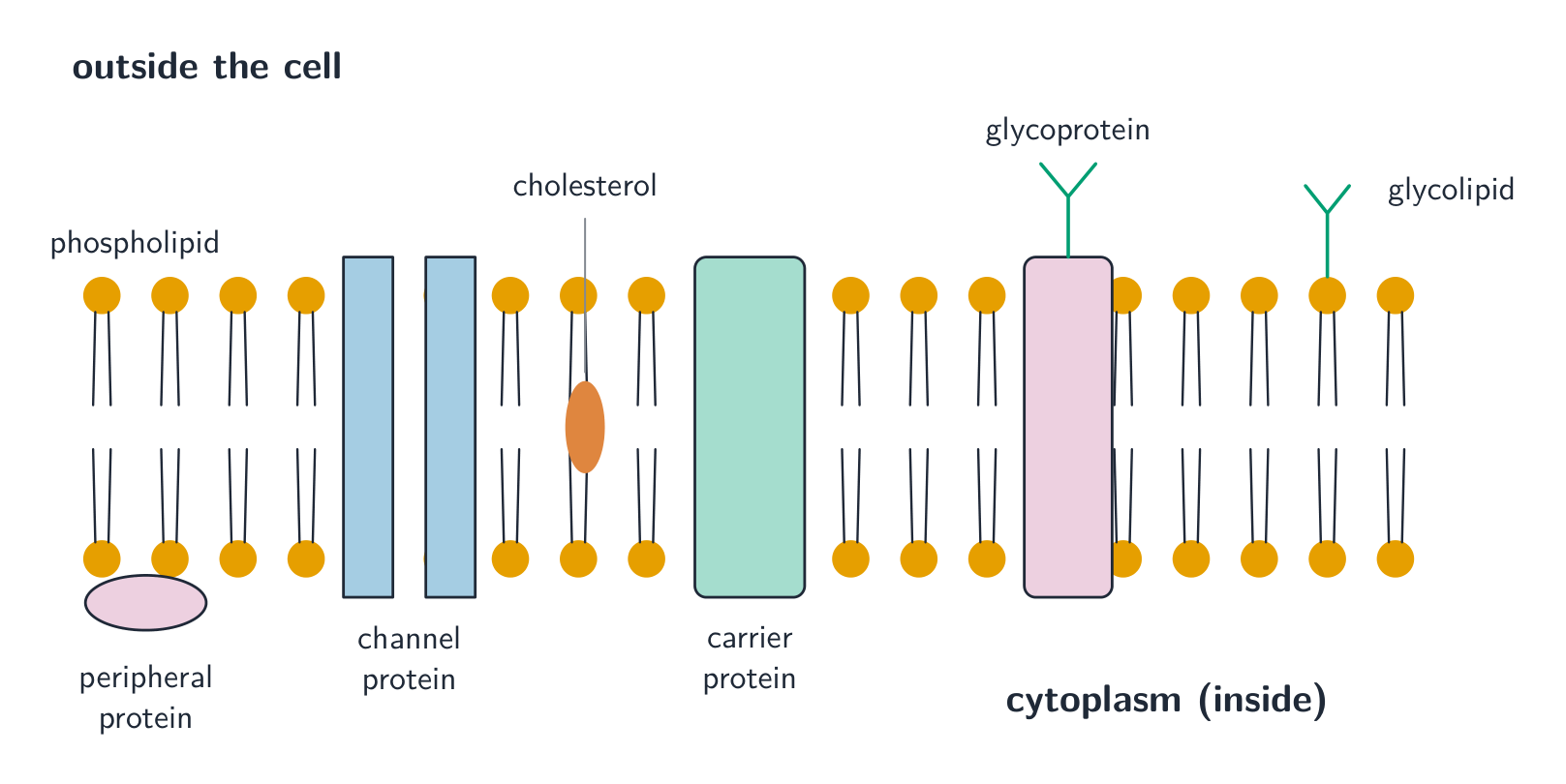
- Phospholipid heads face water outside and inside a cell, while hydrophobic tails form the bilayer interior. This interior restricts many ions and large polar molecules, but small non-polar molecules such as oxygen cross more readily. A barrier can be selectively permeable without being completely impermeable.
- A cell wall is separate from the plasma membrane. Membranes can close around compartments and contain proteins with different functions. Do not identify a channel, receptor or pump merely from a rectangular cartoon: use its position, binding, transported particles and energy coupling as evidence.
Read the fluid mosaic model
- Many lipids and proteins move within the membrane plane: this is fluidity. The mosaic includes different components distributed through the membrane. Integral proteins are embedded; transmembrane proteins span it. Peripheral proteins attach at a surface. Attachments can restrict movement, so not every protein drifts freely everywhere.
- In a labelled model, show both aqueous sides, heads outward, tails inward, integral and peripheral proteins, external carbohydrate branches and cholesterol in an animal membrane. Keep a channel's hydrophilic pore clear. Recognition, transport and adhesion are different possible roles, rather than every protein doing all of them.
Describe net diffusion without stopping molecules
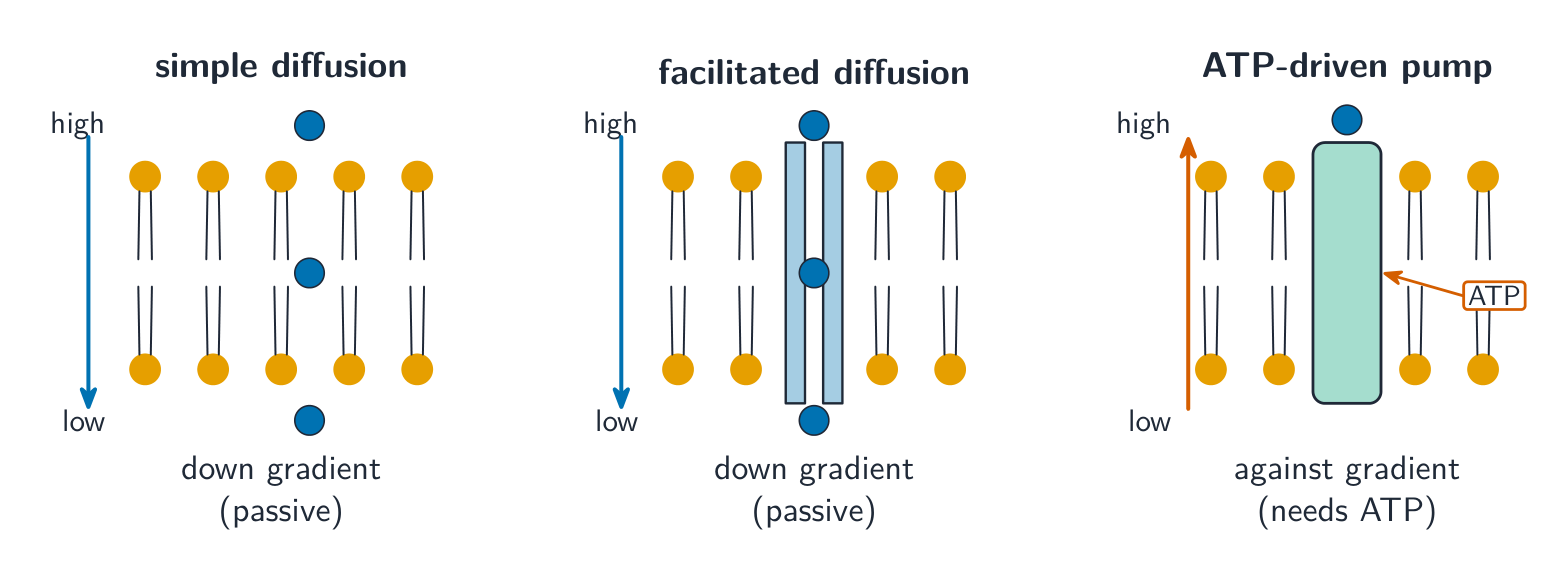
- Random movement occurs in both directions. With a concentration difference and a permeable route, more particles cross from the higher-concentration side, producing net diffusion downhill. At equilibrium, crossings continue but balance. Reversing an oxygen gradient reverses its net diffusion direction under otherwise comparable conditions.
- Simple diffusion through the bilayer needs neither a transport protein nor direct ATP for each crossing. Rate depends on permeability, concentration gradient, area, distance and temperature. A large gradient cannot force a particle through a completely impermeable barrier; the available route matters as well as the difference between sides.
Distinguish a channel from a pump
- An open selective channel provides a hydrophilic route for facilitated diffusion. It does not automatically admit every smaller particle or use ATP for every crossing. Uncharged solutes move down their concentration gradients; an ion's net movement depends on both concentration and electrical effects, together its electrochemical gradient.
- A facilitated-diffusion carrier binds a solute and changes conformation instead of providing an open pore. Some other carriers couple transport to an energy source, so “carrier” does not mean “active”. Identify the net direction and energy coupling, not just the presence of a membrane protein.
An ion crosses an open selective protein channel. Which statement is justified?
Difficulty 1/5 · 100 coins + a small bonus on first completion today
A channel creates a selective route. Both concentration and electrical effects matter for ions, whereas an energy-coupled pump has a different mechanism.
State the conditions for the osmosis prediction
- Osmosis is net water movement through a selectively permeable membrane in response to a water-potential difference. The earlier dilute-to-concentrated solution model assumes equal pressure and a solute that cannot cross. Pressure can oppose that tendency, so “toward more solute” is not a complete rule for every system.
- Aquaporins provide channels for rapid water movement; they do not pump water using ATP. Water continues crossing both ways even at zero net transfer. A plant cell wall can resist expansion and allow pressure to build, whereas an animal cell has no equivalent wall. Tissue mass change does not directly show every molecular crossing.
When does the simple dilute-to-concentrated prediction for net water movement apply most directly?
Difficulty 1/5 · 100 coins + a small bonus on first completion today
The simple prediction has conditions. Water-potential differences can also include pressure effects, and no net movement does not mean no molecular crossings.
Explain why a constant concentration can cost energy
- Active transport couples movement to an energy source and can move a substance against its gradient. An ATP-driven pump binds specific particles and changes conformation through an energy-coupled cycle. It is not simply an open channel allowing particles to fall downhill.
- Continuing inward and outward transport can balance while average concentration stays constant. ATP can still be consumed to maintain an unequal distribution against leaks. Conversely, seeing a solute enter through a protein down a gradient alone does not establish active transport. The energy source and full transport pathway need investigation.
Keep recognition and attachment distinct
- Glycoproteins have carbohydrate linked to protein; glycolipids have carbohydrate linked to lipid. Their carbohydrate chains face the extracellular surface of the plasma membrane. This asymmetry provides exposed recognition features that can bind particular molecules rather than a written label a cell reads.
- Adhesion is attachment between cells or to surrounding material; recognition is selective interaction with a feature. A molecule can contribute to these without transporting ions. The two membrane faces differ in components and surroundings, so label outside and cytoplasm instead of drawing an interchangeable pair of surfaces.
Make the potato comparison fair
- Use comparable tissue, equal cylinder dimensions, fixed immersion time, temperature and solution volume, and accurately prepared concentrations. Measure each cylinder before and after, blotting consistently to remove surface liquid. A wet surface adds mass without showing that water entered cells.
- Use independent cylinders at each concentration and report their variation. Reweighing the same cylinder many times is not the same as biological replication. A systematic calibration or solution-preparation error can bias every repeat. Interpret short-term mass changes mainly as water transfer only when tissue remains sufficiently intact and major solute uptake or tissue loss is unlikely.
Use the initial mass as the denominator
- Percentage mass change is $(\text{final}-\text{initial})/\text{initial}\times100$. A change from 2.50 g to 2.75 g is +10%; 4.00 g to 3.60 g is −10%. Signs describe net gain or loss. Dividing by final mass answers a different question.
- Invented A gains 0.25 g from 2.50 g, while B gains 0.40 g from 8.00 g. A gains 10% and B only 5%, despite B gaining more grams. Percentage change permits a proportional comparison, but does not remove every difference in tissue condition, shape or exposed surface area.
An invented cylinder starts at 6.00 g and ends at 5.40 g. Give the signed percentage mass change.
Difficulty 2/5 · 140 coins + a small bonus on first completion today
(5.40 − 6.00)/6.00 × 100 = −10%. Use initial mass in the denominator and retain the negative sign for loss.
Interpolate the zero crossing with its assumptions
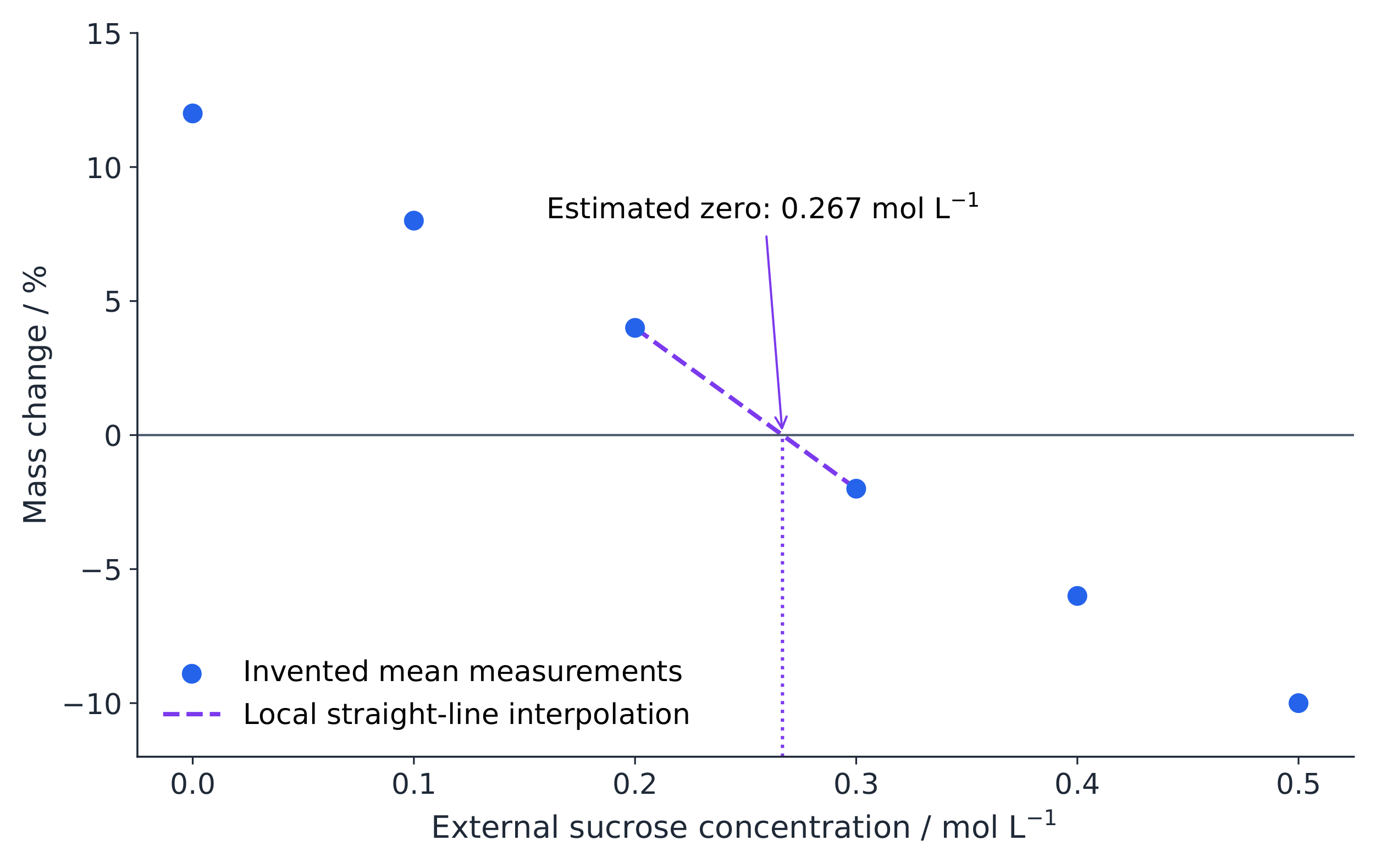
- Invented comparable means are +4% at 0.20 mol per litre and −2% at 0.30 mol per litre. A local straight-line approximation places zero $4/(4+2)=2/3$ of the interval from 0.20: $0.20+(2/3)(0.10)=0.267$ mol per litre, to three significant figures.
- This estimates an external concentration with no net mass change during the observation period. It does not prove all cells have that exact solute concentration or that water movement stopped. Pressure, tissue differences and measurement uncertainty matter. More concentrations near the crossing and independent repeats can improve the estimate.
Invented mean mass changes are +6% at 0.10 mol per litre and −2% at 0.30 mol per litre. Assuming a local linear trend, estimate the zero-change concentration.
Difficulty 2/5 · 140 coins + a small bonus on first completion today
The fraction from the positive endpoint is 6/(6 + 2) = 3/4. Thus 0.10 + (3/4)(0.30 − 0.10) = 0.25 mol per litre. This is an estimated external no-net-change condition, not an exact concentration in every cell.
Choose evidence that distinguishes mechanisms
- Suppose an uncharged solute enters through a protein while its external concentration is higher. Facilitated diffusion is consistent with that observation; so is a more complex energy-coupled pathway. Measure transport under controlled gradients and investigate coupling rather than calling any protein-mediated entry active transport.
- ATP depletion can damage other cell processes, so a changed uptake rate alone does not identify the transporter as a direct ATPase. Consider viability, gradient maintenance and alternate routes. Distinguish an observation from its proposed mechanism, and use controls that address competing explanations.
Link the route to the transported substance
- For oxygen entering down a gradient, explain passage through the bilayer. For an ion moving downhill through an open selective channel, explain facilitated diffusion and electrical as well as concentration effects. For a pump moving uphill, state the energy coupling. For water, state membrane permeability and the water-potential difference.
- A strong answer names the substance, route, driving conditions and net direction. Avoid saying that every particle enters, that a closed channel removes the gradient, or that a steady concentration means no transport occurs. The membrane controls routes; it does not cancel random molecular movement.
Plan a potato-cylinder investigation of net water movement across membranes. Explain how you would compare unequal starting masses and interpret a zero crossing.
Good design links the measured mass response to a constrained water-movement model and reports variation and limitations.