Gas exchange: maintaining diffusion gradients
Introduced| English | Meaning |
|---|---|
| ventilation/ˌventɪˈleɪʃn/ | The movement of air into and out of the lungs, which maintains concentration gradients for gas exchange. |
| perfusion/pəˈfjuːʒn/ | The flow of blood through the vessels of a tissue or organ. |
What would explain this observation?
- An exchange surface can be very thin yet fail to deliver enough oxygen when ventilation 通气 or blood flow falls.
Build the model
- Gas exchange occurs by diffusion across a surface.
- Large area, short diffusion distance and maintained concentration gradients support transfer.
- Ventilation refreshes the external medium; perfusion 灌注 carries gases to and from the exchange surface.
- ventilation: Movement of air or water over an exchange surface.
- perfusion: Blood flow through tissue or an exchange surface.

What maintains an oxygen gradient across the lung exchange surface?
Difficulty 1/5 · 100 coins + a small bonus on first completion today
Ventilation refreshes alveolar air and blood flow carries oxygen away, so both sides of the surface keep the partial-pressure gradient steep. Stopping blood flow would let equilibration flatten it, and a longer path would slow diffusion.
Match each technical term to its precise meaning.
Difficulty 2/5 · 140 coins + a small bonus on first completion today
Use the definitions to distinguish related quantities and processes.
Choose evidence that can test it
- Distinguish movement of the whole medium from diffusion across the membrane.
- Ventilation and perfusion work together, while haemoglobin helps transport oxygen in blood.
- A change in breathing rate alone does not measure oxygen uptake.
In the lab: Use an approved model or published respiratory data. Compare exchange surface area, diffusion path and flow. For human demonstrations use voluntary resting measurements; do not induce breathlessness or hyperventilation.
Which two habits make the investigation or model in this case more defensible?
Difficulty 2/5 · 140 coins + a small bonus on first completion today
Stating the conditions and assumptions lets others repeat the work exactly, and recording the supporting evidence lets them check the conclusion. Hiding disagreeing results removes the evidence that could challenge a wrong conclusion, and one measurement can never establish a wider claim.
Work from known quantities
- Known: tidal volume is 0.50 L and breathing rate is 12 breaths/min.
- Minute ventilation = 0.50 × 12 = 6.0 L/min.
- This includes dead-space ventilation and is not identical to alveolar ventilation.
Your turn: Tidal volume is 0.60 L and breathing rate is 10 breaths/min. Find minute ventilation.
Same air flow, different fresh-air delivery
Start with 0.50 L × 12 = 6.0 L/min. Separate dead-space air from fresh air reaching alveoli, and compare shallow rapid breaths with deeper slower breaths.
Tidal volume is 0.60 L and breathing rate is 10 breaths/min. Find minute ventilation.
Difficulty 2/5 · 140 coins + a small bonus on first completion today
The result is 6 L/min. Known: tidal volume 0.60 L; breathing rate 10 breaths per minute. Use minute ventilation = tidal volume x rate. Ventilation = 0.60 x 10 = 6 litres per minute. Alveolar ventilation is lower once dead space is subtracted.
Check the conclusion and its limits
- Air entering the lungs is not all exchanged with blood.
- Oxygen and carbon dioxide diffuse in opposite net directions because their own gradients differ.
Not true: Minute ventilation directly equals oxygen uptake. Ventilation moves air into and out of the lungs; oxygen uptake measures oxygen transferred into the blood. Some moved air stays in the conducting airways and does not exchange gases with blood. Oxygen uptake also depends on diffusion and blood flow, so total ventilation is not the same quantity as oxygen uptake. Avoid treating all dead space as air that never enters alveoli: ventilated regions can also exchange little when blood flow is inadequate.
- Gas exchange occurs by diffusion across a surface.
- Distinguish movement of the whole medium from diffusion across the membrane.
- Watch for: air entering the lungs is not all exchanged with blood.
Ventilation moves air into and out of the lungs; oxygen uptake measures oxygen transferred into the blood.
Difficulty 1/5 · 100 coins + a small bonus on first completion today
True. Ventilation moves air into and out of the lungs; oxygen uptake measures oxygen transferred into the blood. Some moved air stays in the conducting airways and does not exchange gases with blood. Oxygen uptake also depends on diffusion and blood flow, so total ventilation is not the same quantity as oxygen uptake. Avoid treating all dead space as air that never enters alveoli: ventilated regions can also exchange little when blood flow is inadequate.
Movement of air or water over an exchange surface: write the technical term.
Difficulty 1/5 · 100 coins + a small bonus on first completion today
ventilation means Movement of air or water over an exchange surface.
Write from a minute ventilation of 12 litres per minute
- Tidal volume is 0.80 L and the breathing rate is 15 breaths per minute.
- Find minute ventilation. It includes dead space.
Tidal volume is 0.80 L and breathing rate is 15 breaths per minute. What is the minute ventilation, and why is it not the same as alveolar ventilation?
0.80 times 15 is 12. Dead-space air is moved but does not all meet the exchange surface.
The HL written case has 0.80 L at 15 breaths per minute. What is minute ventilation?
Difficulty 1/5 · 100 coins + a small bonus on first completion today
0.80 times 15 is 12 litres per minute, and dead space is still included.
Connect exchange-surface properties to diffusion
- Large multicellular organisms have internal cells far from the exterior and, for similar shapes, less surface area per unit volume. Specialized exchange surfaces and transport help meet those constraints. Large area supports many simultaneous crossings; a thin permeable barrier shortens the diffusion path; a moist lining lets gases dissolve before crossing membranes.
- A thin water layer helps, while a thick fluid layer adds distance. Gases cross by diffusion, not because an alveolus pumps oxygen with ATP. Plants respire as well as photosynthesize: net carbon dioxide uptake in light can coexist with respiration releasing carbon dioxide. State the process and conditions rather than assigning one gas direction permanently to every plant.
Use a proportional model with controlled conditions
- For the same gas and barrier, a simple transfer model makes rate proportional to area times concentration difference, divided by diffusion distance. If area triples and distance increases by a factor of 1.5 while the gradient remains fixed, relative rate is $3/1.5=2$: twice the initial value.
- Increasing area while thickening the barrier can therefore have opposing effects. State which factors are held constant; permeability, temperature and functioning surface area can change in living tissues. The model compares constraints rather than predicting a complete lung's numerical performance from area alone.
In the stated proportional model, exchange area triples and diffusion distance is multiplied by 1.5, with gradient and permeability fixed. Find the new transfer rate as a multiple of the original.
Difficulty 2/5 · 140 coins + a small bonus on first completion today
Relative rate = 3/1.5 = 2. This comparison assumes the same gas, barrier properties and maintained gradient; it is not a complete numerical prediction of a living lung.
Renew both sides of the exchange surface
- Ventilation moves bulk air or water over a surface; perfusion supplies blood flow through it. Diffusion transfers gases across the barrier down their own gradients. In alveoli, oxygen partial pressure is normally higher in fresh alveolar air than incoming blood; carbon dioxide generally has the opposite gradient. Compare the same gas across the surface.
- In an invented sealed model, equal fixed-volume compartments contain the same solvent at the same temperature. Oxygen concentration falls from 100 to 70 outside while rising from 40 to 70 inside, in arbitrary concentration units. Equal amounts in unequal volumes would not imply equal concentrations. The gradient disappears and net transfer stops, although crossings continue. Renewing the outside medium and supplying fresh lower-oxygen fluid inside can restore net entry. Thin walls alone cannot maintain gradients indefinitely without renewal or other processes.
Trace air and identify the actual thin barrier
- Air passes through trachea, bronchi and smaller bronchioles toward alveolar regions. Branching distributes air, and many alveoli provide a large total area. Thin type I pneumocytes and adjacent capillary walls support a short air-to-blood diffusion path; bronchioles are not the main thin exchange surface.
- Type II cells supply surfactant that lowers surface tension and stabilizes the moist lining. It neither supplies oxygen nor creates its gradient. Loss of area, barrier thickening, poor ventilation or poor blood flow can each limit exchange. A high breathing rate alone cannot distinguish these causes or establish oxygen uptake.
Follow muscle action through volume to pressure
- During inspiration, diaphragm contraction flattens it and external intercostal activity raises the ribs. Thoracic and lung volumes increase; alveolar pressure falls slightly below atmospheric pressure during inflow. Air follows that pressure difference rather than being pulled in by a contracting alveolar muscle.
- Quiet expiration is largely passive: inspiratory muscles relax and elastic recoil reduces volume, raising pressure during outflow. Forced expiration recruits additional muscle activity. The diaphragm does not contract upward during quiet expiration. The NHLBI breathing explanation connects muscle action and recoil; airflow can reach zero while air remains in the lungs.
Read lung volumes as differences on a trace
- In an invented reference trace, normal expiration is 1.2 L and normal inspiration 1.7 L, giving tidal volume 0.5 L. Maximum inspiration is 4.2 L and maximum expiration 0.2 L. Inspiratory reserve is 2.5 L; expiratory reserve is 1.0 L; vital capacity is $2.5+0.5+1.0=4.0$ L.
- The trace's zero is arbitrary. A simple spirometer measures moved air, not residual air remaining after maximal expiration, so these differences do not establish total lung capacity. Read several regular breaths with calibrated axes. Repeated breaths from one person do not become independent people or establish a population reference range.
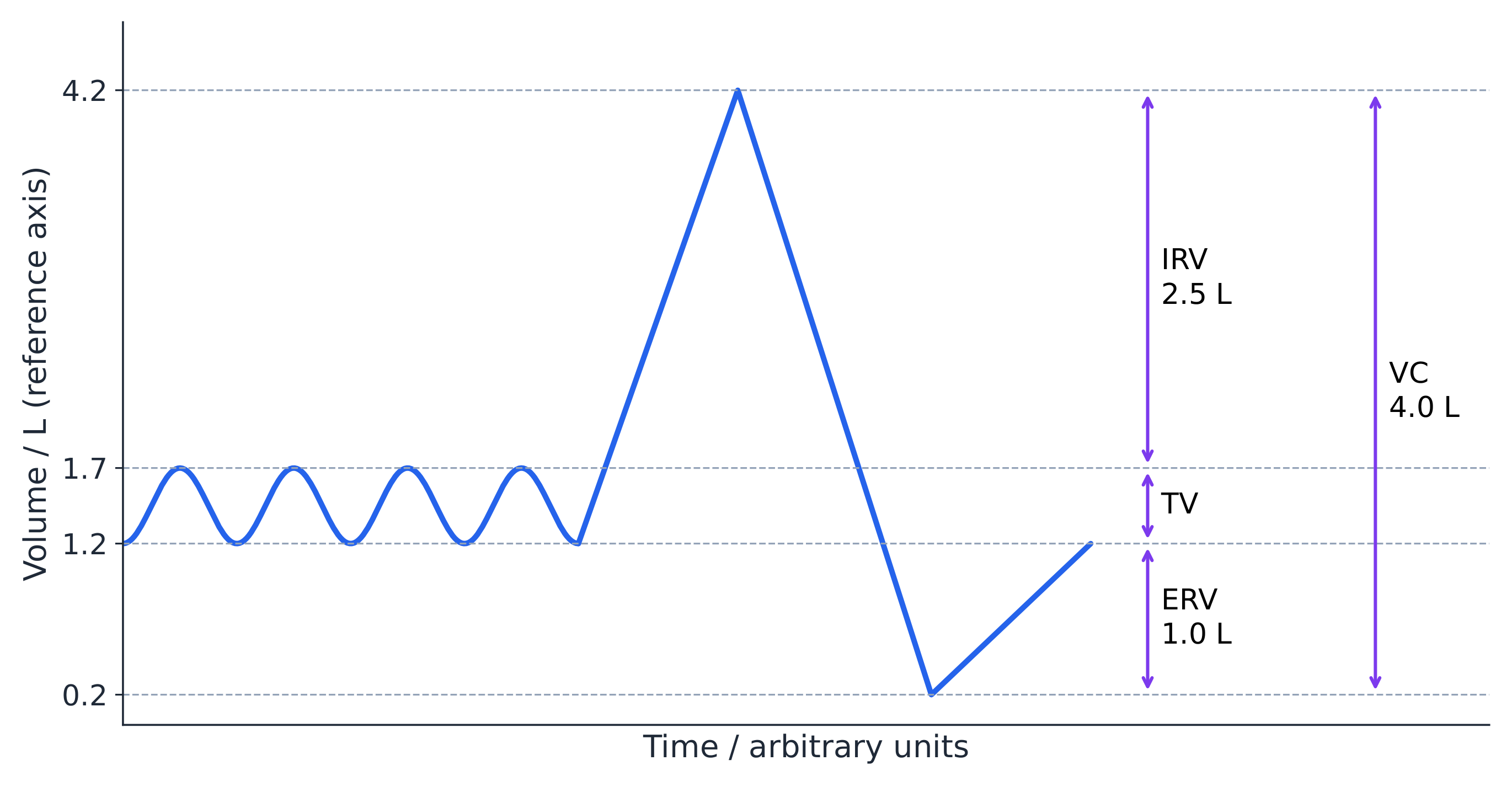
An invented lung trace has maximum inspiration at 4.2 L and maximum expiration at 0.2 L on an arbitrary reference axis. Find vital capacity.
Difficulty 2/5 · 140 coins + a small bonus on first completion today
Vital capacity = 4.2 − 0.2 = 4.0 L. The arbitrary zero and simple moved-air trace do not reveal residual volume or total lung capacity.
Separate moved air from alveolar air and oxygen uptake
- Minute ventilation equals tidal volume times breaths per minute. Invented 0.50 L breaths at 12 per minute give 6.0 L per minute. With an assumed dead space of 0.15 L per breath, estimated alveolar ventilation is $(0.50-0.15)(12)=4.2$ L per minute, not 6.0.
- A different model pattern, 0.30 L at 20 breaths per minute, also moves 6.0 L per minute but gives only $(0.30-0.15)(20)=3.0$ L per minute at the alveoli. Neither value equals oxygen uptake: that depends on gas composition and transfer into blood. These are invented models for comparison, not breathing instructions or clinical reference values.
An invented model has 0.50 L per breath, 12 breaths per minute and fixed dead space 0.15 L per breath. Find estimated alveolar ventilation.
Difficulty 2/5 · 140 coins + a small bonus on first completion today
(0.50 − 0.15) × 12 = 4.2 L per minute. Minute ventilation is 6.0 L per minute including dead space. Neither is automatically oxygen uptake into blood.
Trace gases through a representative dicot leaf
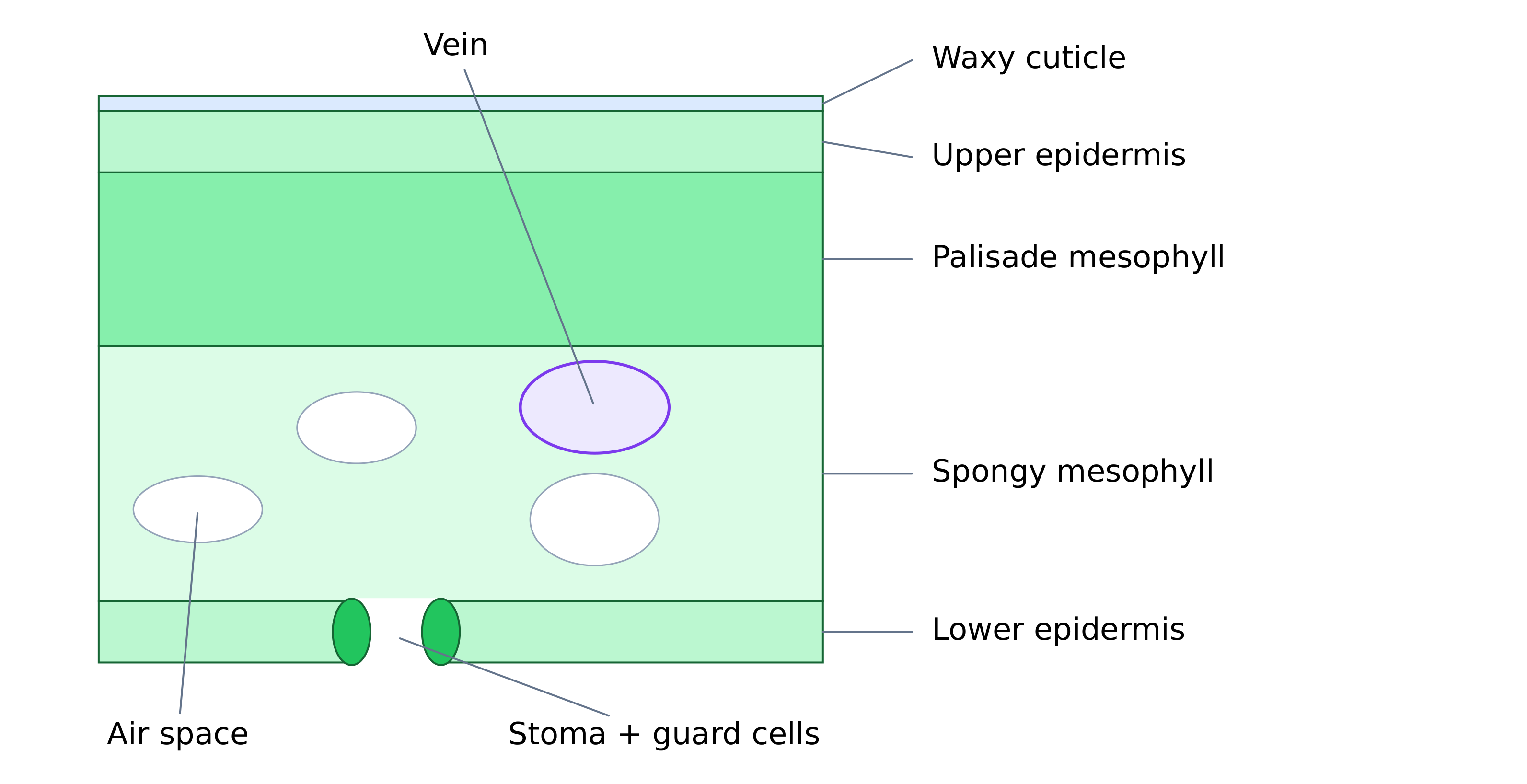
- A typical terrestrial dicot section has an upper cuticle and epidermis, palisade mesophyll, spongy mesophyll with connected air spaces, and a lower epidermis with stomata and guard cells. Vein xylem supplies water while phloem carries assimilates. This arrangement varies among species and environments rather than describing every leaf.
- Carbon dioxide can pass through a stoma and air spaces, dissolve at a moist mesophyll wall and enter a photosynthesizing cell. The cuticle limits uncontrolled water loss but restricts direct epidermal exchange. In a low-power tissue plan, draw regions and relative thicknesses, not every organelle or a guessed pattern of individual cells.
Explain carbon entry and water loss together
- Water evaporates from moist mesophyll surfaces and vapour diffuses outward through open stomata when conditions favour loss. Opening pores also permits carbon dioxide entry. Transpiration is not simply photosynthesis consuming water, and guard cells regulate aperture rather than leaving every pore permanently open.
- At a stated leaf temperature, higher external humidity usually reduces the vapour gradient; wind can remove a humid boundary layer. Temperature and light can increase evaporative demand or promote opening, but water stress can close stomata. Explain the physical driver and the plant response; a warmer or brighter treatment does not guarantee more measured water loss.
Measure uptake without calling it a direct loss count
- In an invented potometer comparison, corrected uptake is 0.20 mL in 10 minutes in still air and 0.35 mL in 10 minutes in moving air. Rates are 0.020 and 0.035 mL per minute; the increase is $(0.035-0.020)/0.020\times100=75\%$.
- Uptake approximates transpiration under suitable conditions, but is not a direct count of every molecule leaving the leaf. Check leaks, allow equilibration and control leaf area, temperature, light and water supply. Repeat with independent plants where appropriate. Uptake alone cannot establish that stomatal aperture changed or identify every cause.
Divide stomatal counts by the sampled area
- Invented equal fields of 0.20 square millimetres contain 32, 36, 28 and 40 stomata. Total count is 136 over 0.80 square millimetres, giving 170 stomata per square millimetre. The equivalent average count is 34 per field, divided by 0.20. Count each pore once, not its two guard cells as two stomata.
- For a circular field of diameter 0.50 mm, radius is 0.25 mm and area is $\pi(0.25)^2\approx0.196$ square millimetres. A count of 35 then gives about 178 stomata per square millimetre. Halve diameter before squaring; doubling diameter quadruples area rather than doubling it.
Four invented fields each have area 0.20 square millimetres and counts 32, 36, 28 and 40 stomata. Find pooled density per square millimetre.
Difficulty 2/5 · 140 coins + a small bonus on first completion today
Total count = 136; sampled area = 4 × 0.20 = 0.80 square millimetres. Density = 136/0.80 = 170 per square millimetre. Count pores, not both guard cells separately.
Build a fair plant-exchange comparison
- Calibrate image area, use one boundary-counting rule and select fields without favouring crowded patches. Record leaf side, position and developmental stage. Fields within one leaf estimate its local variation; independent plants provide different biological replication. For unequal areas, divide pooled counts by pooled area rather than averaging unweighted field counts.
- Density measures pores per area, not current photosynthesis or transpiration rate. Opening, pore size, humidity, temperature and metabolism also matter. Combine structural measurements with controlled functional evidence before claiming that one leaf currently exchanges gases faster. State the sampled population and the limits of the measurement.
A class finds greater stomatal density on one leaf and claims it must have faster current transpiration. Explain what further evidence and controls are needed.
Structural capacity and current function require different evidence. Control both physical gradients and plant responses before inferring a causal mechanism.
AHL: Read site saturation and cooperative binding
- A haemoglobin tetramer has four haem groups, each binding one oxygen molecule reversibly. Binding changes conformation and favours further binding, producing a sigmoidal dissociation curve. The horizontal axis is oxygen partial pressure; the vertical axis is the percentage of available binding sites occupied, not oxygen percentage in air or an uptake rate.
- At the same oxygen pressure, a left-shifted curve has greater saturation and affinity in the comparison region. With invented equal capacities of 150 oxygen units, 80% saturation means 120 bound units and 60% means 90. Greater affinity is not automatically better tissue delivery: blood must also unload oxygen. A sample average does not require identical occupancy of every tetramer.
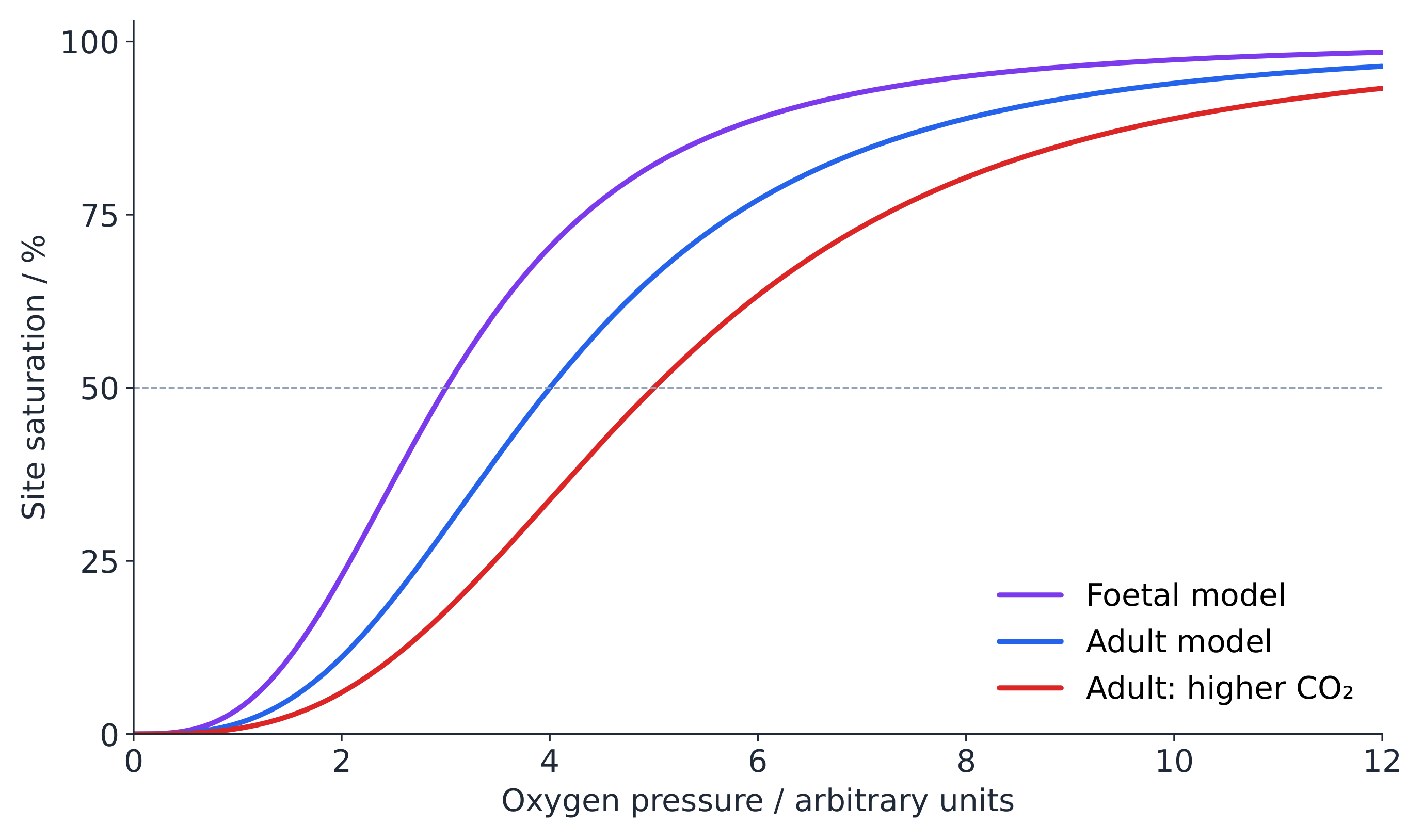
AHL: An invented sample has binding capacity 150 oxygen units and site saturation 80%. How many units are bound?
Difficulty 2/5 · 140 coins + a small bonus on first completion today
0.80 × 150 = 120 units. Saturation describes the fraction of sites occupied across the sample, not the oxygen percentage in air or an identical occupancy for every tetramer.
AHL: Explain foetal loading across separate circulations
- Adult haemoglobin A has two alpha and two beta chains; foetal haemoglobin has two alpha and two gamma chains. Under physiological red-cell conditions, foetal haemoglobin has higher oxygen affinity, helping loading across the placental barrier at lower oxygen partial pressures. Maternal and foetal blood normally remain in separate circulations rather than forming one mixed blood pool.
- Different allosteric interactions, including weaker binding of 2,3-bisphosphoglycerate by foetal haemoglobin, contribute to this affinity difference. Do not generalize it to every purified-protein solution. In an invented equal-capacity comparison of 200 oxygen units, 50% and 70% saturation give 100 and 140 bound units; that is a model difference, not a universal real placental transfer.
AHL: Which statement links foetal haemoglobin to placental oxygen transfer correctly?
Difficulty 1/5 · 100 coins + a small bonus on first completion today
Different globin subunits and allosteric interactions contribute to affinity. Placental transfer still requires gradients, perfusion and a diffusion pathway; affinity is not an unconditional measure of tissue delivery.
AHL: Calculate unloading before comparing Bohr shifts
- Higher carbon dioxide and accompanying hydrogen-ion conditions reduce haemoglobin oxygen affinity, shifting the curve right. At the same tissue oxygen pressure, lower saturation favours unloading. Carbon dioxide acts through acid–base conditions and distinct globin sites; do not confuse it with carbon monoxide competing at haem or with ATP-driven oxygen pumping.
- In an invented equal-capacity model starting at 96% saturation, blood leaves at 72% under lower carbon dioxide and 54% under higher carbon dioxide. Unloading is 24 versus 42 percentage points of capacity: 18 points more and $42/24=1.75$ times as much. Compare equal starting saturation and capacity, and account separately for any changed blood flow.
AHL: Equal-capacity samples start at 96% saturation. At the same tissue oxygen pressure, one leaves at 72% and the other at 54%. Find the second sample’s oxygen unloading as a multiple of the first.
Difficulty 2/5 · 140 coins + a small bonus on first completion today
Unloading is 96 − 72 = 24 versus 96 − 54 = 42 percentage points of equal capacity. Ratio = 42/24 = 1.75. The difference is 18 percentage points, a different quantity; higher-carbon-dioxide conditions can promote the right shift.