Your learning plan · Continue · Review →
本 + Noun (this / our / one's own)
IntroducedYour saved position stays in this browser. Resuming does not complete the lesson or answer its questions.
 2:18
HSK 6 Grammar 4: 本 + 名词, 词 + 性
The school office announces a Friday closure in a stiff official voice, speaking as the school itself: 本校本周五停课一天。 A classmate forwards the same news casually…
English explanations + Mandarin examples · captions follow the spoken text
In this lesson
This shop, our school
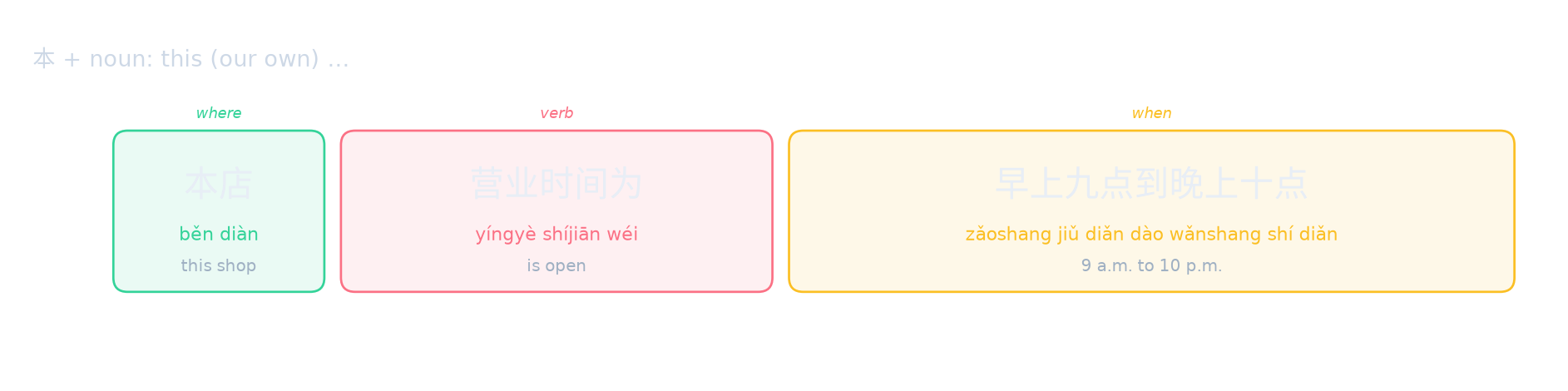
- A notice at a shop door announces new opening hours.
- 本店time of business营业时间for / (wéi) to be为early morning早上九点to / arrive / (result: get)到evening晚上十点。 — "This shop's opening hours are 9 a.m. to 10 p.m."
- Goal: say "this / our / one's own" in formal Chinese with this (formal) / originally / (measure: books)本 + noun (this week本周, this (formal) / originally / (measure: books)本company公司, the person themself本人).
this (formal) / originally / (measure: books)本 + noun = this / our (formal)
- this (formal) / originally / (measure: books)本 refers to the speaker's own place or organisation in formal notices: 本店 (this shop), 本校 (this school), this (formal) / originally / (measure: books)本company公司 (our company).
- With time words it means "this, the current": this week本周 (this week), this month本月, 本次.
this Friday本周五power cut停电。
Complete the notice: “This shop is closed on Mondays.” ____店周一休息。
Difficulty 1/5 · 100 coins + a small bonus on first completion today
本店 = this shop (formal).
One's own
- the person themself本人 = I myself, the person concerned: requires需要the person themself本人to sign签字 — "Requires the signature of the person themselves."
- local本地 = local: native person (of a country)本地人, local本地dish (of food); vegetable菜.
requires需要the person themself本人to sign签字。
Match each word to its meaning.
Difficulty 2/5 · 140 coins + a small bonus on first completion today
本 + noun = this / our / one's own.
Formal register
- 本店 / 本校 belong to notices and announcements; in conversation, say we / us我们shop店 / we / us我们school学校.
- this (formal) / originally / (measure: books)本 + noun needs no (modifier / structural particle)的 or measure word: this (formal) / originally / (measure: books)本company公司, not 本个company公司.
- this (formal) / originally / (measure: books)本 goes straight onto the noun, with no measure word: ✓ this (formal) / originally / (measure: books)本company公司(modifier / structural particle)的staff员工 — "our company's staff"; ✗ 本个company公司.
Which suits casual conversation?
Difficulty 1/5 · 100 coins + a small bonus on first completion today
In speech, 我们学校 is natural.
this (formal) / originally / (measure: books)本 the measure word
- this (formal) / originally / (measure: books)本 is also the measure word for books: one / a一this (formal) / originally / (measure: books)本book书.
- Before an organisation or time word, it means "this / our".
I我bought买了a一本book书。
In 一本书, 本 means “this”.
Difficulty 1/5 · 100 coins + a small bonus on first completion today
Here it is the measure word for books.
Recap
- this (formal) / originally / (measure: books)本 + noun = this / our / one's own (formal): 本店, 本校, this week本周, the person themself本人, local本地.
- Speech prefers we / us我们…; this (formal) / originally / (measure: books)本 is also the book measure word.
Read the full reference: HSK 6 grammar — Nouns.
A notice at a shop door announces new opening hours. Close the examples. Say a Mandarin response, then write it in Chinese. Explain briefly in English what the lesson’s pattern adds. Compare with the model, then change one detail and try again.
This is supported productive practice. Compare meaning and structure; your answer need not copy the model. A partner or teacher must hear the spoken response to comment on pronunciation.
What went wrong? Only the site team sees this.