Sensation, perception and psychophysics
Introduced 6:20
Sensation, perception and psychophysics
On the morning of 22 October 1850, Gustav Fechner, a physicist in Leipzig, lay in bed thinking about how the mind and the physical world are related. He…
English narration · English and 中文 subtitles you can switch
In this lesson
| English | Meaning |
|---|---|
| just-noticeable difference/dʒʌst ˈnəʊtɪsəbl ˈdɪfrəns/ | The smallest change in a stimulus that can be discriminated under a stated procedure. |
| transduction/trænsˈdʌkʃn/ | Conversion of physical stimulus energy into neural signals. |
| categorical perception/ˌkætɪˈɡɒrɪkl pəˈsepʃn/ | A pattern of discrimination that is stronger across category boundaries than within them for comparable physical differences. |
Why does the same added weight become harder to notice?
- Adding a small weight to a light bag can be noticeable, while the same addition to a heavy bag is missed. The just-noticeable difference 最小可觉差 depends on the starting intensity, not just the added amount.
- Sensation concerns detecting stimulation; perception concerns organising and interpreting it. A detection response also depends on the decision the observer is willing to make.
Separate absolute and difference thresholds
- An absolute threshold is the stimulus level detected on a specified proportion of trials, often 50%. A difference threshold is the change required for discrimination under the stated procedure; neither is a perfectly sharp boundary that applies to every trial.
- Weber's law approximates $\Delta I/I=k$ over an appropriate range: the noticeable change grows with the baseline. Fechner's law proposes a roughly logarithmic relation between physical and perceived intensity, rather than an unlimited linear increase.
Suppose $k=0.03$ for a weight-discrimination task in the range tested. At a baseline of 200 g, the predicted JND is $0.03\times200=6$ g. At 600 g it is 18 g. The predicted ratio stays constant; the added number of grams does not.
Weber fraction 0.05. Smallest detectable increase from 400 g, in g?
Difficulty 2/5 · 140 coins + a small bonus on first completion today
Weber's law: ΔI = k × I = 0.05 × 400 g = 20 g. The just-noticeable difference grows in proportion to the starting intensity.
A light of 60 units has a JND of 3 units. What JND is expected at 300 units?
Difficulty 2/5 · 140 coins + a small bonus on first completion today
The Weber fraction is 3 / 60 = 0.05. At 300 units the JND is 0.05 × 300 = 15 units.
A study defines a faint tone threshold as the intensity detected on half of its trials. Which threshold is being operationalised?
Difficulty 1/5 · 100 coins + a small bonus on first completion today
The criterion concerns detecting a stimulus level, not discriminating a change from a baseline.
Sensitivity and response criterion answer different questions
- Signal detection separates sensitivity, often summarised by $d'$, from the criterion for reporting a signal. A hit is “yes” on a signal trial; a false alarm is “yes” on a noise-only trial. Misses and correct rejections complete the outcome table.
- A reward for reporting signals may encourage a more liberal criterion, increasing both hits and false alarms. More hits alone do not establish higher sensitivity; the response pattern and the model used to estimate sensitivity matter.

Compare hits with false alarms before interpreting a change in detection performance.
A reward manipulation does not logically guarantee that sensitivity stays unchanged: attention, effort or learning could also change. The distinction is between what a criterion shift can explain and what the observations actually establish.
A higher hit rate always means better sensitivity.
Difficulty 1/5 · 100 coins + a small bonus on first completion today
A more liberal response criterion can increase hits and false alarms. A hit-rate increase alone does not establish improved sensitivity.
Distinguish converting energy from adapting to it
- Transduction 换能 converts physical stimulation into neural signals: photoreceptors respond to light, and hair cells respond to mechanical stimulation in hearing. Rods support dim-light vision; cones support colour and fine detail in suitable light.
- Sensory adaptation reduces response to continuing stimulation. Dark adaptation is an increase in visual sensitivity after entering darkness, with different contributions from cones and rods over time; it is not an instantaneous switch or a single universal duration.
Converting light or sound energy into neural signals is called ____.
Difficulty 1/5 · 100 coins + a small bonus on first completion today
Sensory receptors convert physical stimulation into neural signals. Adaptation is a change in response over continued exposure, not the conversion itself.
Identify the cue that groups stationary elements
- Proximity groups elements that are near one another; similarity groups elements with shared features such as colour. These cues can cooperate or conflict, so name the feature described in the question.
- Closure favours a complete figure despite gaps; good continuation favours smooth paths through intersections. Filling a gap is different from following the smooth continuation of a line.
Which grouping principle?
Distinguish distance, shared appearance, gap completion and smooth continuation.
Seeing a circle with a small gap as a complete circle illustrates
Difficulty 1/5 · 100 coins + a small bonus on first completion today
Closure is the Gestalt tendency to perceive incomplete figures as whole by filling in missing parts. Proximity and similarity group separate items; common fate groups items moving together.
Shared movement is a different grouping cue
- Common fate groups elements moving together, even when they are not the nearest neighbours or do not share a colour. A set of birds changing direction together illustrates a movement cue, not merely proximity.
- Compare a still image with a moving display. Position alone can support proximity, whereas coordinated movement supplies evidence for common fate; do not infer movement from a static cluster unless the scenario specifies it.
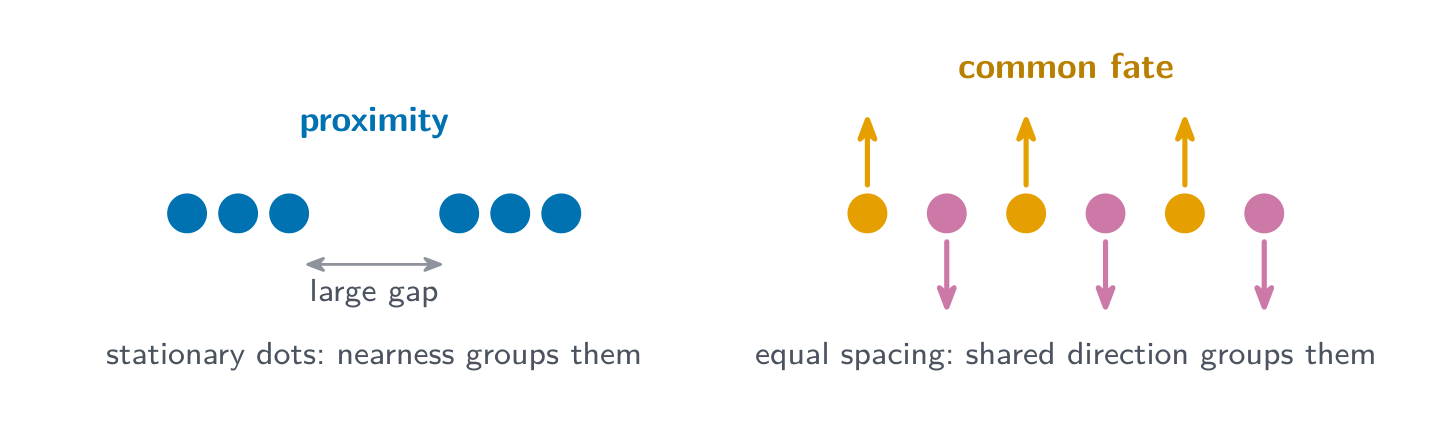
Arrows indicate movement in the right-hand example. All dots use the same colour so colour does not explain that grouping.
Motion or distance?
Distinguish common fate from proximity using the cue specified.
Equally spaced identical dots separate into two sets moving in different directions. Which cue best explains grouping by those sets?
Difficulty 1/5 · 100 coins + a small bonus on first completion today
Equal spacing and appearance do not separate the sets; shared motion does.
Combine sensory evidence with context
- Bottom-up processing builds from sensory features; top-down processing uses expectations and context. Recognising a blurred word from its sentence context uses top-down information alongside the visual input.
- Categorical perception 范畴知觉 means that equal physical differences can be discriminated differently around category boundaries. For speech, a change crossing a phoneme boundary may be easier to distinguish than an equal change within one category; within-category differences are not necessarily impossible to hear.
Categorical perception means that every difference within a phoneme category is impossible to hear.
Difficulty 1/5 · 100 coins + a small bonus on first completion today
Discrimination can be better across category boundaries than within them for equal physical changes; this is not an absolute inability to detect all within-category variation.
Match each description to the most direct concept.
Difficulty 2/5 · 140 coins + a small bonus on first completion today
Separate conversion, adaptation, contextual interpretation and grouping.
Explain a change in reports without inventing a cause
- An observer reports more faint alarms after rewards change, but also reports more alarms on noise-only trials. The physical stimuli are otherwise matched.
- Explain one plausible criterion account, then state why the hit increase alone does not prove improved sensitivity. Separately identify which information would support a grouping explanation based on movement.
After rewards change, an observer reports more signals on both signal and noise-only trials. Give a plausible criterion account and explain what cannot be concluded from the higher hit rate alone.
A more liberal response criterion means the observer is more willing to say a signal is present. This can increase both hits and false alarms. The higher hit rate alone does not prove improved sensitivity, nor does the reward change guarantee unchanged sensitivity; compare the full response pattern and relevant model assumptions.
Keep the distinctions separate
-
Weber's JND prediction uses a fraction of the baseline within the applicable range.
-
Signal-detection outcomes distinguish reporting bias from sensory sensitivity; a higher hit rate alone is insufficient.
-
Transduction, adaptation, grouping and contextual interpretation describe different aspects of perception, not one compulsory linear sequence.
-
Proximity concerns distance; common fate concerns coordinated motion. Categorical perception changes discrimination around category boundaries.
-
just-noticeable difference: The smallest change in a stimulus that can be discriminated under a stated procedure.
-
transduction: Conversion of physical stimulus energy into neural signals.
-
categorical perception: A pattern of discrimination that is stronger across category boundaries than within them for comparable physical differences.
A static display has red and blue dots mixed within each of two close spatial clusters. Predict two possible grouping cues, then state what new information would be needed to support common fate.
Nearness within each cluster supports proximity; shared colour across positions supports similarity. The cues may compete. To support common fate, the display or scenario must provide coordinated movement, not just position or colour.
What went wrong? Only the site team sees this.