Radiation attenuation, laser gain and cavity modes
Introduced 5:54
Radiation attenuation, laser gain and cavity modes
On 16 May 1960 Theodore Maiman, at Hughes Research Laboratories in California, fired a bright flash lamp around a small rod of pink ruby with silvered ends. A…
English narration · English and 中文 subtitles you can switch
In this lesson
| English | Meaning |
|---|---|
| attenuation/əˌtenjuːˈeɪʃn/ | A reduction in a wave or beam's intensity as it travels through a medium. |
| half-value layer/hɑːf ˈvæljuː ˈleɪə/ | |
| population inversion/ˌpɒpjʊˈleɪʃn ɪnˈvɜːʃn/ | More atoms per state in an upper level than in a lower one. |
| Bragg peak/bræɡ piːk/ |
Range or no range
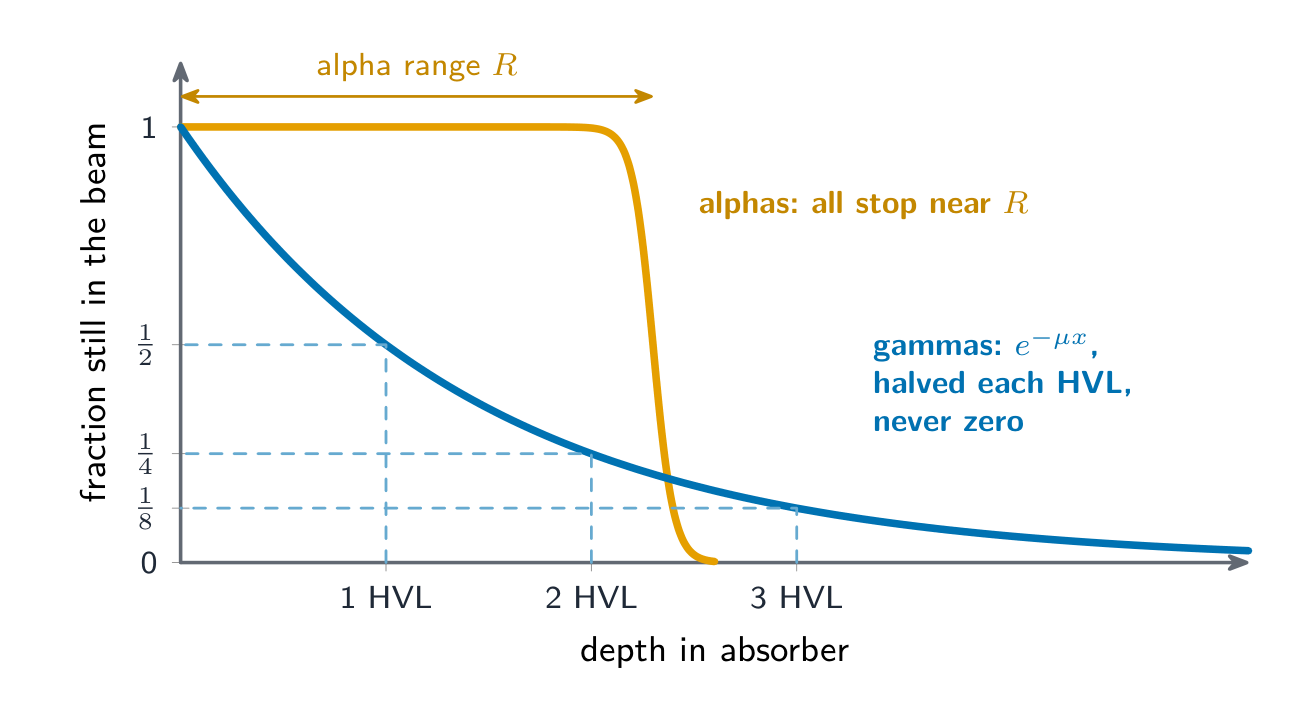
- Alpha particles stop within a few centimetres of air. Gamma rays never have a definite stopping depth: some always get through.
- GRE radiation and laser questions test charged-particle range, exponential attenuation 衰减, stimulated emission and cavity modes.
Charged particles: range
- Heavy charged particles lose energy in many small collisions: under a constant loss rate, range $= E_0/(dE/dx)$. A 5 MeV particle losing 2 MeV/cm stops after 2.5 cm.
- Energy loss per length rises as the particle slows (the Bragg peak 布拉格峰 at the end of the track), and grows as $z^2$ of the particle's charge: an alpha loses energy four times as fast as a proton at the same speed. Electrons straggle and radiate, so their range is fuzzier.
An 8 MeV particle loses a constant 2 MeV/cm. Range in cm?
Difficulty 2/5 · 140 coins + a small bonus on first completion today
With a constant energy loss of 2 MeV per cm, 8 MeV lasts $8/2 = 4$ cm.
At the same speed, an alpha particle (charge $2e$) loses energy per centimetre, compared with a proton,
Difficulty 1/5 · 100 coins + a small bonus on first completion today
Stopping power goes as $z^2$ of the moving charge: $2^2 = 4$.
Photons: exponential attenuation
- $I = I_0e^{-\mu x}$ (narrow beam); half-value layer 半值层 $\ln2/\mu$. $\mu = 0.2$/cm: HVL 3.47 cm; after 10 cm, $e^{-2} \approx 0.135$.
- Recorded counts also include detector efficiency: $\mu x = \ln4$, $\varepsilon = 0.25$ gives $\tfrac14 \times \tfrac14 = \tfrac1{16}$. Broad beams transmit more (build-up).
Range or exponential?
Match the radiation type to its penetration law.
Half-value layer for $\mu = 0.5$/cm, in cm (three decimal places)?
Difficulty 2/5 · 140 coins + a small bonus on first completion today
The half-value layer satisfies $e^{-\mu x} = 1/2$, so $x = \ln2/\mu = 0.693/0.5 = 1.386$ cm.
Three half-value layers transmit
Difficulty 1/5 · 100 coins + a small bonus on first completion today
Each half-value layer halves the intensity: $(1/2)^3 = 1/8$.
A shield has HVL 2 cm. Thickness (cm) to reduce a narrow gamma beam to 1/32?
Difficulty 2/5 · 140 coins + a small bonus on first completion today
$1/32 = (1/2)^5$: five half-value layers, $5 \times 2 = 10$ cm.
Stimulated emission and inversion
- A stimulated photon copies the stimulating one in frequency, direction and phase. Net gain needs population inversion 粒子数反转 $N_2/g_2 > N_1/g_1$.
- Thermal equilibrium never inverts a two-level system ($N_2/N_1 = e^{-\Delta E/kT} < 1$), and pumping two levels can at best equalise them; lasers pump a third level that drops quickly into a long-lived (metastable) upper laser level.
A two-level system in thermal equilibrium at positive temperature can have population inversion.
Difficulty 1/5 · 100 coins + a small bonus on first completion today
Boltzmann factors always favour the lower level.
Cavity modes
- Standing waves fit the mirrors: $L = m\lambda/2$, so $\nu_m = \dfrac{mc}{2L}$ with spacing $\dfrac{c}{2L}$: 30 cm gives 500 MHz. Gain must beat round-trip losses.
- The number of modes that lase is the gain bandwidth divided by the spacing: a 1.5 GHz gain curve in a 30 cm cavity supports about 3.
A 25 cm cavity: $c/2L = 3\times10^8/0.5 = 600$ MHz between neighbouring modes.
Mode spacing of a 1.5 m laser cavity in MHz?
Difficulty 2/5 · 140 coins + a small bonus on first completion today
Longitudinal modes are spaced by $c/2L = 3\times10^8/3 = 10^8$ Hz, which is 100 MHz.
A 15 cm cavity with a 3 GHz gain bandwidth. About how many longitudinal modes lase?
Difficulty 2/5 · 140 coins + a small bonus on first completion today
Spacing $c/2L = 3\times10^8/0.3 = 1$ GHz; $3/1 = 3$ modes.
Worked GRE question: shielding a source
1.0 cm of lead cuts a narrow gamma beam to 1/4 of its intensity. To cut it to 1/64, the total thickness of lead needed is
- (A) 2 cm
- (B) 3 cm
- (C) 4 cm
- (D) 6 cm
- (E) 16 cm
Fast route. $1/64 = (1/4)^3$: each centimetre multiplies by $\tfrac14$, so 3 cm. Answer (B).
Traps. (E) scales the thickness with $1/I$ (linear thinking). (D) counts six half-value layers ($1/64 = (1/2)^6$) but treats 1 cm as one of them; it is two.
Worked GRE question: which modes lase?
A laser cavity 50 cm long has a gain medium whose gain exceeds losses over a band 1.2 GHz wide. The number of longitudinal modes that can lase is about
- (A) 1
- (B) 2
- (C) 4
- (D) 8
- (E) 12
Fast route. Spacing $c/2L = 3\times10^8/1.0 = 300$ MHz; $1.2\text{ GHz}/300\text{ MHz} = 4$. Answer (C).
Traps. (B) uses $c/L$ for the spacing. (D) halves the spacing a second time ($c/4L$).
Common errors
- Giving gamma rays a range. Attenuation is exponential; only a fraction is stopped per layer.
- Halving per HVL but adding thicknesses linearly. Fractions multiply.
- Inversion as $N_2 > N_1$ when degeneracies differ. Compare $N_2/g_2$ with $N_1/g_1$.
- Mode spacing $c/L$. It is $c/2L$: the round trip is $2L$.
Recap
- Charged particles: a range. Photons: $e^{-\mu x}$, HVL $\ln2/\mu$.
- Lasing needs inversion; equilibrium two-level systems cannot provide it.
- Mode spacing $c/2L$; lasing modes = gain bandwidth / spacing.
- attenuation: The gradual loss of beam intensity as it passes through matter.
- half-value layer: The thickness that halves a beam's intensity, $\ln 2/\mu$.
- population inversion: More atoms per state in an upper level than in a lower one.
What went wrong? Only the site team sees this.