Solid-state, nuclear and particle models
Introduced| English | Meaning |
|---|---|
| binding energy/ˈbaɪndɪŋ ˈenədʒi/ | The energy required to separate a bound system into specified free constituents. |
| band gap/bænd ɡæp/ | band gap |
| half-life/hɑːf laɪf/ | The time for the number of undecayed nuclei in a radioactive sample to halve. |
Electrons are not the same as carriers
- Pure silicon has $14$ electrons per atom yet barely conducts. Add one phosphorus atom per million and conductivity jumps — because of available states, not more electrons.
- GRE condensed-matter, nuclear and particle questions test bands, Fermi–Dirac occupancy, decay laws, binding energy 结合能 and conservation rules.
Bands and doping
- A full band carries no net current. Metals have partly filled bands; insulators a large gap; semiconductors a small band gap 带隙 ($\sim$1 eV).
- Donors (P, As in Si) add electrons: n-type. Acceptors (B, Al) add holes: p-type.
Doping silicon with phosphorus makes it p-type.
Difficulty 1/5 · 100 coins + a small bonus on first completion today
Phosphorus is a donor (n-type).
Fermi–Dirac occupancy
- $f(E) = \dfrac{1}{e^{(E - \mu)/kT} + 1}$. At $T = 0$: a step, 1 below $\mu$, 0 above. At $E = \mu$, $f = \tfrac12$ at any temperature.
- Heating smears only a band of width $\sim kT$ around $\mu$.
Fermi–Dirac occupancy at $E - \mu = kT$, to three decimal places?
Difficulty 2/5 · 140 coins + a small bonus on first completion today
The Fermi–Dirac occupancy is $1/(e^{(E-\mu)/kT} + 1) = 1/(e + 1) = 0.269$.
Radioactive decay
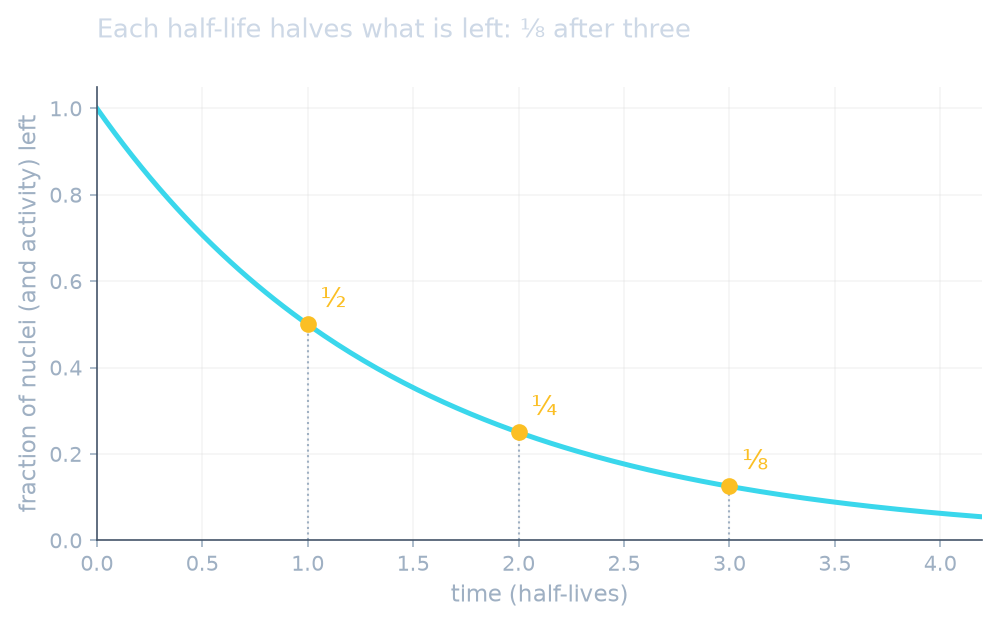
- $N = N_0e^{-\lambda t}$, activity $A = \lambda N$, $t_{1/2} = \dfrac{\ln 2}{\lambda}$. Each half-life 半衰期 halves $N$: after $k$ half-lives, $N/N_0 = 2^{-k}$, and so is $A/A_0$.
- Activity counts decays per second (Bq); $N$ counts nuclei.
What fraction of the nuclei remains after 5 half-lives? Give a decimal.
Difficulty 2/5 · 140 coins + a small bonus on first completion today
Each half-life halves what remains: after five, $(1/2)^5 = 1/32 = 0.03125$.
Binding and conservation
- Binding energy $= \Delta m\,c^2$ with $1\text{ u}\,c^2 = 931.5$ MeV. Stability follows binding energy per nucleon, peaking near iron.
- Conserve charge, energy, momentum, baryon number and each lepton number. β⁻ decay is $n \to p + e^- + \bar\nu_e$: the antineutrino explains the continuous electron spectrum.
A mass defect of 0.010 u gives $0.010 \times 931.5 \approx 9.3$ MeV. After three half-lives, $\tfrac18$ of the nuclei — and $\tfrac18$ of the activity — remain.
Allowed process?
Check charge, baryon and lepton number in reactions.
A mass defect of 0.020 u corresponds to what binding energy in MeV (one decimal place)?
Difficulty 2/5 · 140 coins + a small bonus on first completion today
One atomic mass unit is equivalent to 931.5 MeV, so $0.020 \times 931.5 = 18.6$ MeV.
Which is a complete β⁻ decay of a free neutron?
Difficulty 1/5 · 100 coins + a small bonus on first completion today
Charge and lepton number balance.
Recap
- Conduction needs empty states near the Fermi level; doping supplies carriers.
- $f(\mu) = \tfrac12$; $T = 0$ is a step.
- $2^{-k}$ after $k$ half-lives; 931.5 MeV per u; check every conservation law.