Waves and optics
Introduced| English | Meaning |
|---|---|
| coherent/kəʊˈhɪərənt/ | Having a fixed phase relationship over time. |
| path difference/pæθ ˈdɪfrəns/ | The difference in distance travelled by two waves to the same point. |
| diffraction/dɪˈfrækʃn/ | The spreading or redistribution of waves as they pass an edge or aperture. |
Two bright waves, darkness
- Two equal coherent 相干的 beams, each of intensity $I_0$, meet. Depending on their phase difference the result is anywhere from $4I_0$ to $0$.
- GRE optics tests superposition, path and phase, double slits and gratings, single-slit diffraction, thin films, and lenses.
Add amplitudes, then square
- Intensity $\propto$ amplitude$^2$. Two equal waves with phase difference $\varphi$: $I = 2I_0(1 + \cos\varphi) = 4I_0\cos^2(\varphi/2)$.
- In phase: amplitude $2A$, intensity $4I_0$. Out of phase ($\varphi = \pi$): zero. Adding intensities would always give $2I_0$, which is true only for incoherent light.
Two equal coherent waves (each $I_0$) meet with $\varphi = \pi/2$. Intensity in units of $I_0$?
Difficulty 2/5 · 140 coins + a small bonus on first completion today
Two equal waves give $I = 2I_0(1 + \cos\varphi)$. With $\varphi = \pi/2$, $\cos\varphi = 0$, so $I = 2I_0$: the intensities simply add.
For coherent waves, the total intensity includes an interference term that depends on the phase difference.
Difficulty 1/5 · 100 coins + a small bonus on first completion today
True. Amplitudes add, so I = I₁ + I₂ + 2√(I₁I₂) cos φ; only for incoherent waves do the intensities simply add.
Path difference 程差, double slits and gratings
- $\varphi = 2\pi\Delta/\lambda$. Double slit: bright fringes at $d\sin\theta = m\lambda$; on a distant screen the spacing is $\Delta y = \lambda L/d$. A grating with $N$ slits has the same bright angles, but the peaks are much sharper (intensity $\propto N^2$), which is why gratings separate close wavelengths.
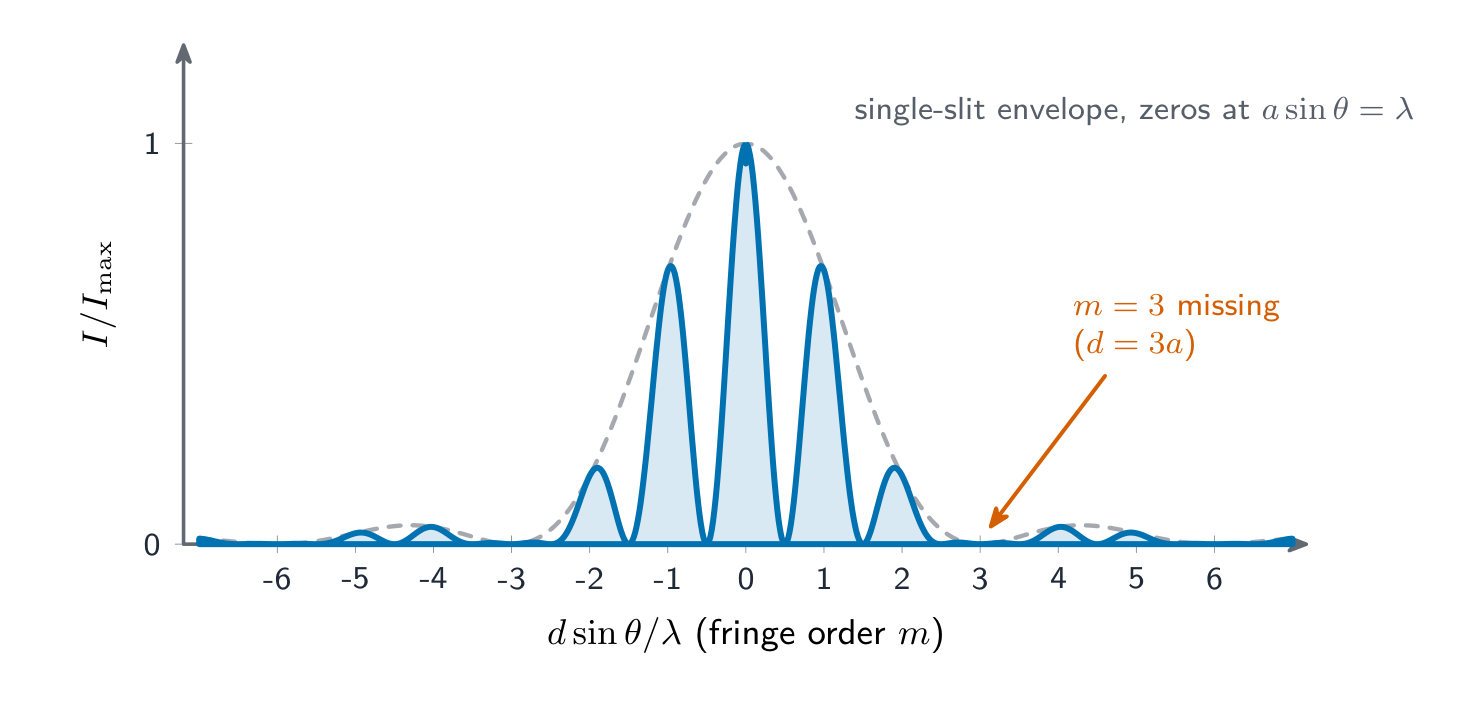
- Real slits have a width $a$, so the fringes sit under a single-slit envelope. A fringe that falls on an envelope zero is missing: with $d = 3a$, orders $m = \pm3, \pm6, \dots$ vanish.
$\lambda = 600$ nm, $d = 0.30$ mm, $L = 2.0$ m: $\Delta y = \dfrac{600\times10^{-9} \times 2}{3\times10^{-4}} = 4$ mm.
Bright or dark?
Use path difference to predict interference.
A path difference of $\lambda/4$ gives a phase difference of
Difficulty 1/5 · 100 coins + a small bonus on first completion today
A whole wavelength of path is $2\pi$ of phase, so a quarter wavelength is $2\pi/4 = \pi/2$.
λ = 500 nm, slit separation 0.25 mm, screen 1.5 m away. Fringe spacing in mm?
Difficulty 2/5 · 140 coins + a small bonus on first completion today
$500\times10^{-9} \times 1.5 / 2.5\times10^{-4}$ m.
A grating has 500 lines per mm. Angle of the first-order maximum for 600 nm light, in degrees (one decimal place)?
Difficulty 2/5 · 140 coins + a small bonus on first completion today
$d = 2\ \mu$m, $\sin\theta = 0.6/2 = 0.30$, $\theta = 17.5°$.
Single-slit diffraction 衍射
- Minima at $a\sin\theta = m\lambda$, $m = \pm1, \pm2, \dots$, never $m = 0$, which is the bright centre. The central maximum is twice as wide as the others: $2\lambda L/a$ on a screen.
- A narrower slit spreads the light more. A circular aperture of diameter $D$ gives a first dark ring at $\sin\theta = 1.22\lambda/D$, the resolution limit of telescopes and eyes.
A 0.10 mm slit, λ = 500 nm, screen 1.0 m away. Width of the central maximum in mm?
Difficulty 2/5 · 140 coins + a small bonus on first completion today
$2\lambda L/a = 2 \times 5$ mm.
Thin films
- Light reflected from the top and bottom of a film of thickness $t$ and index $n$ has extra path $2nt$ (near-normal light). Reflection from a higher-index medium adds a half-wave ($\pi$) flip; from a lower-index one, none.
- Count the flips. One flip (soap film in air): bright reflection when $2nt = (m + \tfrac12)\lambda$. Zero or two flips (coating on glass, $n_{\text{air}} < n_{\text{film}} < n_{\text{glass}}$): bright when $2nt = m\lambda$, dark when $2nt = (m + \tfrac12)\lambda$. A quarter-wave coating, $t = \lambda/4n$, cancels reflection.
A soap film ($n = 1.33$) in air looks bright in reflection at 532 nm. Minimum thickness in nm?
Difficulty 2/5 · 140 coins + a small bonus on first completion today
One flip (top surface only), so bright when $2nt = \lambda/2$: $t = \dfrac{532}{4 \times 1.33} = 100$ nm.
Rays: lenses and mirrors
- Geometric optics works when apertures are much larger than $\lambda$. Thin lens or mirror: $\dfrac1f = \dfrac1{d_o} + \dfrac1{d_i}$, magnification $M = -d_i/d_o$, with real images at $d_i > 0$.
- An object at $2f$ gives a real, inverted image at $2f$ ($M = -1$). An object inside $f$ of a converging lens gives a virtual, upright, magnified image: the magnifying glass.
An object is 30 cm from a converging lens of focal length 20 cm. Image distance in cm?
Difficulty 2/5 · 140 coins + a small bonus on first completion today
$1/d_i = 1/20 - 1/30 = 1/60$: real image at 60 cm, inverted, magnification $-2$.
Worked GRE question: the antireflection coating
A glass lens ($n = 1.50$) is coated with a film of $n = 1.38$ to cancel reflection of 552 nm light at normal incidence. The minimum film thickness is
- (A) 50 nm
- (B) 100 nm
- (C) 138 nm
- (D) 200 nm
- (E) 276 nm
Fast route. Both reflections are from a higher index, so both flip: no net flip. Cancel with $2nt = \lambda/2$: $t = \dfrac{\lambda}{4n} = \dfrac{552}{4 \times 1.38} = 100$ nm. Answer (B).
Traps. (C) forgets the index ($\lambda/4$). (D) uses $2nt = \lambda$, the condition for strong reflection. (E) is $\lambda/2$.
Worked GRE question: missing fringes
In a double-slit experiment the slit separation is 4 times the slit width. Which bright fringe is the first to be missing?
- (A) $m = 1$
- (B) $m = 2$
- (C) $m = 3$
- (D) $m = 4$
- (E) none is missing
Fast route. Bright fringes at $d\sin\theta = m\lambda$; the envelope's first zero at $a\sin\theta = \lambda$. They coincide when $m = d/a = 4$. Answer (D). So 7 bright fringes ($m = -3 \dots 3$) lie inside the central envelope.
Traps. (A) confuses the first envelope zero with the first fringe. (E) ignores the slit width.
Common errors
- Adding intensities for coherent light. Add amplitudes, then square.
- Using $m = 0$ in the single-slit minimum condition. That is the bright centre.
- Forgetting reflection flips or the film index. Count flips; the wavelength in the film is $\lambda/n$.
- Sign of $d_i$. A negative image distance means a virtual image.
Recap
- Coherent waves: add amplitudes, then square; $\varphi = 2\pi\Delta/\lambda$.
- Double slit or grating maxima $d\sin\theta = m\lambda$; fringe spacing $\lambda L/d$; order $m = d/a$ missing.
- Single-slit minima $a\sin\theta = m\lambda$ with $m \neq 0$; circular aperture $1.22\lambda/D$.
- Thin film: path $2nt$, plus a $\pi$ flip at each reflection from a higher index; quarter-wave coating $t = \lambda/4n$.
- $1/f = 1/d_o + 1/d_i$, $M = -d_i/d_o$.
- coherent: Having a fixed phase relationship over time.
- path difference: The difference in distance travelled by two waves to the same point.
- diffraction: The spreading of waves through an opening or around an edge.