Real analysis and topology
Introduced| English | Meaning |
|---|---|
| compact/kəmˈpækt/ | Describing a space in which every open cover admits a finite subcover. |
| Cauchy sequence | A sequence whose later terms are arbitrarily close to each other. |
| uniform continuity/ˈjuːnɪfɔːm kɒntɪˈnjuːɪti/ | A form of continuity with one input-distance bound for the whole domain at each output tolerance. |
Bounded but no maximum
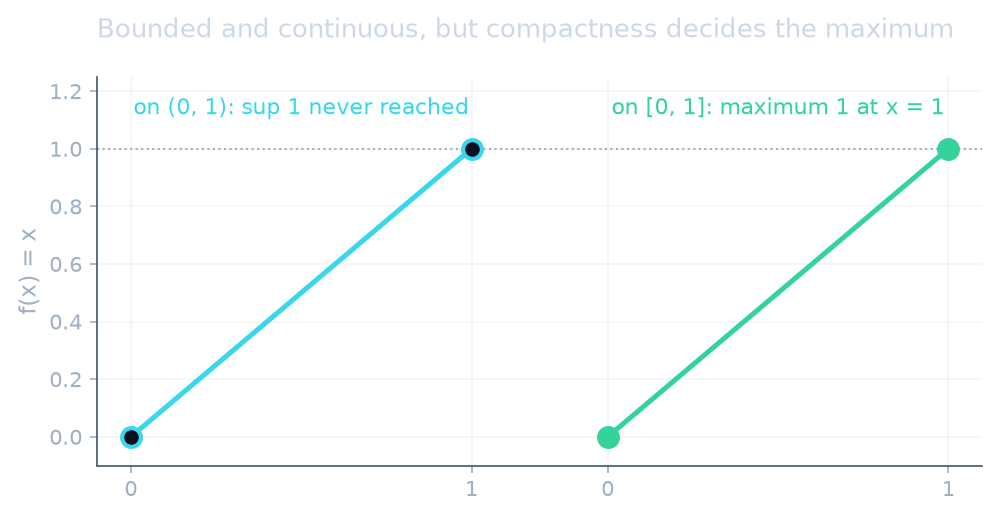
- A design search permits settings $0<x<1$ and scores them with $f(x)=x$. The score approaches $1$ but never reaches it: the supremum is $1$, but there is no maximum. On $[0,1]$, the value $1$ is attained. A supremum is the least upper bound; a maximum must also belong to the set of values.
- Analysis asks which hypotheses make a conclusion certain: a compact 紧致的 domain, continuity, connectedness or completeness. Compactness will provide an extrema guarantee, but a particular function can attain extrema even when its domain is not compact.
What is the supremum of $\{1 - 1/n : n \ge 1\}$?
Difficulty 2/5 · 140 coins + a small bonus on first completion today
The values increase to 1 without reaching it.
Name the space and its distance
- A metric $d$ is a nonnegative distance with symmetry, a triangle inequality and $d(x,y)=0$ exactly when $x=y$. An open ball of radius $r>0$ about $a$ consists of points with $d(x,a)<r$. On the real line, the usual metric is $d(x,y)=|x-y|$.
- Open and closed sets are relative to an ambient space. A subset is closed when its complement is open in that space. For $K=[0,1]\cap\mathbb Q$, the set $K$ is closed in $\mathbb Q$: its complement consists of rational points below zero or above one. It is not closed as a subset of $\mathbb R$.
Do late terms approach one another?
- In a metric space, $x_n\to x$ means that for every $\varepsilon>0$, some integer $N$ makes $d(x_n,x)<\varepsilon$ whenever $n\ge N$. Convergence names a target point $x$ in the space; finitely many early terms do not affect the limit.
- A Cauchy sequence 柯西序列 is a sequence whose later terms are arbitrarily close to each other. Precisely, for every $\varepsilon>0$, some $N$ makes $d(x_m,x_n)<\varepsilon$ for all $m,n\ge N$. This condition compares terms with each other without first specifying a limit.
A Cauchy sequence can find a hole
- A metric space is complete if every Cauchy sequence converges to a point in that space. In $(0,1)$ with usual distance, $x_n=1/(n+1)$ for $n\ge1$ is Cauchy: late terms are all close to zero and to each other. Its real limit is zero, which is outside the space, so $(0,1)$ is not complete.
- A closed subset of a complete metric space is complete. Thus $[0,1]$ is complete because $\mathbb R$ is complete. By contrast, rational decimal truncations of $\alpha=\sqrt2/2$ form a Cauchy sequence in $\mathbb Q$ but have no rational limit. Completeness depends on which points the space contains.
Which metric space (usual distance) is complete?
Difficulty 1/5 · 100 coins + a small bonus on first completion today
The closed interval is a closed subset of the complete real line. The other spaces omit limits of some Cauchy sequences under their stated usual distances.
For $x_n=1/(n+1)$ in $(0,1)$, give a tail-distance bound proving the Cauchy property. Why does the sequence still fail to converge in this space?
For $m,n\ge N$, both terms lie between zero and $1/(N+1)$, so $|x_m-x_n|<1/(N+1)$. Choose N with $1/(N+1)<\varepsilon$. Its unique real limit is zero, which is not in the domain, so it has no limit in the space (0,1).
A function limit and continuity at a point
- Take $f:D\to\mathbb R$, where $D\subseteq X$ and $X$ has metric $d$. A limit $L$ at an accumulation point $a\in X$ of $D$ requires: for every $\varepsilon>0$, choose $\delta>0$ so that domain points with $0<d(x,a)<\delta$ satisfy $|f(x)-L|<\varepsilon$. Continuity at a domain point $a$ uses $L=f(a)$ and allows $d(x,a)=0$ too.
- The input bound may depend on the chosen point $a$ and tolerance $\varepsilon$. For $f(x)=1/x$ on $(0,1)$, restricting $|x-a|<a/2$ ensures $x>a/2$. Then $|1/x-1/a|\le2|x-a|/a^2$; choosing $\delta=\min(a/2,\varepsilon a^2/2)$ proves continuity at that fixed $a$.
One input bound across the domain
- Uniform continuity 一致连续 is a form of continuity with one input-distance bound for the whole domain at each output tolerance. For every $\varepsilon>0$, choose a single $\delta>0$ so that all domain pairs with $d(x,y)<\delta$ satisfy $|f(x)-f(y)|<\varepsilon$. The choice can depend on $\varepsilon$, but not on the pair.
- Uniform continuity implies continuity at every domain point. The converse fails. The identity function on all of $\mathbb R$ is uniformly continuous: choose $\delta=\varepsilon$. Its unbounded domain and range do not prevent this; uniform continuity is about controlling changes, not bounding values.
If, for each $\varepsilon>0$, one $\delta>0$ controls all domain pairs, the function is ____ continuous.
Difficulty 1/5 · 100 coins + a small bonus on first completion today
Uniformly continuous. Delta may depend on the chosen output tolerance but not on the pair of domain points.
The identity map $f(x)=x$ on $\mathbb R$ is uniformly continuous even though its range is unbounded.
Difficulty 1/5 · 100 coins + a small bonus on first completion today
True. For every $\varepsilon>0$, choosing $\delta=\varepsilon$ controls all pairs because $|f(x)-f(y)|=|x-y|$.
Work through a failure of uniformity
- For $f(x)=1/x$ on $(0,1)$, take $x_n=1/(n+1)$ and $y_n=1/(n+2)$ with $n\ge1$. Their input gap is $1/((n+1)(n+2))$, tending to zero. Their output gap is always $|(n+1)-(n+2)|=1$.
- Fix $\varepsilon=1/2$. Whatever positive $\delta$ is proposed, a sufficiently large $n$ gives an input gap below $\delta$ while the output gap is still $1$. This defeats a single bound valid for all pairs, although continuity at every fixed positive point remains true.

Which condition is being used?
Distinguish what is fixed and what must be controlled.
For $f(x)=1/x$, $x_n=1/(n+1)$ and $y_n=1/(n+2)$, what is $|f(x_2)-f(y_2)|$?
Difficulty 2/5 · 140 coins + a small bonus on first completion today
The two inputs are 1/3 and 1/4; the outputs are 3 and 4. Their distance is 1.
Use the displayed pairs for $1/x$ to refute uniform continuity on $(0,1)$. State a fixed output tolerance and explain why every proposed input bound fails.
Fix $\varepsilon=1/2$. Given any $\delta>0$, choose n large enough that $1/((n+1)(n+2))<\delta$. Both inputs lie in (0,1), but their output distance equals 1, which exceeds the fixed tolerance. The same construction defeats every delta; allowing delta to depend on the pair would change the definition.
Compactness: covers and sequences
- A space is compact if every open cover has a finite subcover. An open cover is a collection of open sets whose union contains the space; a subcover selects some of those same sets and still covers it. The original cover may be infinite: only a finite selection is required to suffice.
- In metric spaces, an equivalent test says that every sequence has a subsequence converging to a point in the space. A finite set is compact, but compact spaces need not be finite. For example, every sequence in $[0,1]$ has a convergent subsequence with its limit still in $[0,1]$.
Heine–Borel needs its ambient space
- For subsets of $\mathbb R^n$ with Euclidean distance, compactness is equivalent to being closed and bounded. For $\{1/n:n\ge1\}$, the missing limit point zero prevents closedness in $\mathbb R$; adding zero gives a closed bounded, hence compact, set. The real line is closed in itself but unbounded, so it is not compact.
- Closed and bounded is insufficient in a general metric space. The earlier set $K=[0,1]\cap\mathbb Q$ is closed and bounded in $\mathbb Q$. Yet its rational truncations approaching $\alpha=\sqrt2/2$ have no subsequence converging inside $K$: every subsequence has that same irrational real limit. The sequential compactness test therefore fails.
Compact subsets of ℝ
Apply Heine–Borel to subsets of the real line.
Which subset of $\mathbb R$ is compact?
Difficulty 1/5 · 100 coins + a small bonus on first completion today
As a subset of the real line with usual distance, the set containing zero and all 1/n is closed and bounded. Including its only accumulation point is essential.
Why does $K=[0,1]\cap\mathbb Q$ not contradict Heine–Borel in Euclidean space?
Difficulty 1/5 · 100 coins + a small bonus on first completion today
Heine–Borel for subsets of the real line requires closedness in the real line. Irrational limits such as $\sqrt2/2$ show that K is not closed there.
What continuity on a compact domain gives
- A continuous real-valued function on a nonempty compact space attains a maximum and a minimum. A continuous map from a compact metric space to a metric space is also uniformly continuous. These are sufficient hypotheses, not necessary conditions for a particular function to have those properties.
- On $(0,1)$, the identity is bounded and uniformly continuous but does not attain its extreme bounds; $1/x$ is continuous but unbounded and not uniformly continuous. A constant function on that same noncompact domain attains both its maximum and minimum. The domain alone does not decide every function's behaviour.
Every continuous function on $(0, 1)$ is bounded.
Difficulty 1/5 · 100 coins + a small bonus on first completion today
False: 1/x is continuous on the open unit interval and becomes arbitrarily large near zero. Failure of a theorem’s hypotheses alone would not prove unboundedness; this explicit counterexample does.
Critique: “If a continuous real function has a maximum, its domain must be compact.” Give a counterexample and explain what the extreme value theorem actually guarantees.
The constant function f(x)=0 on (0,1) is continuous and attains its maximum and minimum 0, although the domain is not compact. The theorem gives a sufficient condition: every continuous real function on a nonempty compact space attains extrema. It does not turn one function’s success into a necessary condition on its domain.
Connectedness prevents gaps in a real range
- A space is connected if it cannot be separated into two disjoint, nonempty sets that are open relative to the space and whose union is the space. Real intervals are connected. The set $[-2,-1]\cup[1,2]$ is disconnected: its negative and positive parts give such a separation.
- Continuous images of connected spaces are connected. Therefore a continuous real-valued function on an interval takes every value between two of its values, giving the intermediate value theorem. Connectedness does not imply boundedness or compactness: $\mathbb R$ is connected and unbounded.
A continuous real function on $[0,1]$ satisfies $f(0)=-2$ and $f(1)=3$. Which conclusion is guaranteed?
Difficulty 1/5 · 100 coins + a small bonus on first completion today
The intermediate value theorem gives at least one zero between the endpoint values. It does not guarantee uniqueness, monotonicity or differentiability.
Keep metric and topological claims separate
- A compact metric space is complete, but completeness alone does not imply compactness: the real line is complete and not compact. A proof about Cauchy sequences uses a specified distance; a compactness proof must keep its cover or subsequence conditions in view.
- A homeomorphism is a continuous bijection with a continuous inverse. It preserves compactness and connectedness, but need not preserve completeness for the chosen metrics. For example, $(0,1)$ is homeomorphic to $\mathbb R$ via $h(x)=\tan(\pi(x-1/2))$, although only the latter is complete with its usual distance.
With usual distance, which space is complete and connected but not compact?
Difficulty 1/5 · 100 coins + a small bonus on first completion today
The real line is complete and connected. Its unboundedness prevents compactness. The closed unit interval is compact; the open interval and the rationals are not complete.
Match a conclusion to its hypotheses
- compact: Describing a space in which every open cover admits a finite subcover.
- Quantifiers matter: continuity fixes a point; uniform continuity controls all domain pairs at each tolerance; the Cauchy condition controls all sufficiently late pairs of terms.
- Name the ambient space and metric. Separate compactness, completeness and connectedness, then justify each claimed implication or disprove it with a valid counterexample.
Explain why $K=[0,1]\cap\mathbb Q$, with usual distance, is closed and bounded in Q but neither complete nor compact. Use rational approximations to $\sqrt2/2$.
Its complement in Q is relatively open, so K is closed in Q; all its points are between 0 and 1. Rational decimal truncations of the irrational number alpha=sqrt(2)/2 lie in K and converge in R to alpha. They are Cauchy, but cannot converge in K, proving incompleteness. Every subsequence also has real limit alpha, so none converges inside K, violating the metric-space sequential compactness criterion.