Data analysis: spread, weighted averages and conditional probability
Introduced| English | Meaning |
|---|---|
| weighted average/ˈweɪtɪd ˈævrɪdʒ/ | weighted average |
| overlap/ˌəʊvəˈlæp/ | The items that belong to two groups at the same time. |
The average that needs weights
- Class A (20 students) averaged 70; class B (30 students) averaged 80. What is the average of all 50 students? Not 75 — the larger class counts more.
- GRE data analysis tests averages, spread, distributions and probability with the right reference group.
Weighted averages 加权平均
- Total ÷ count: $\dfrac{20 \times 70 + 30 \times 80}{50} = \dfrac{1400 + 2400}{50} = 76$.
- The combined average lies between the two, closer to the larger group.
10 students averaged 60 and 30 students averaged 80. What is the overall average?
Difficulty 2/5 · 140 coins + a small bonus on first completion today
$(600 + 2400) \div 40 = 75$.
A combined average lies closer to the average of the ____ group.
Difficulty 1/5 · 100 coins + a small bonus on first completion today
It carries more weight.
Spread and distribution
- Range, interquartile range and standard deviation measure spread. Adding a constant to every value leaves them unchanged; multiplying scales them.
- In a normal distribution, about 68% lies within 1 SD and 95% within 2 SD of the mean.
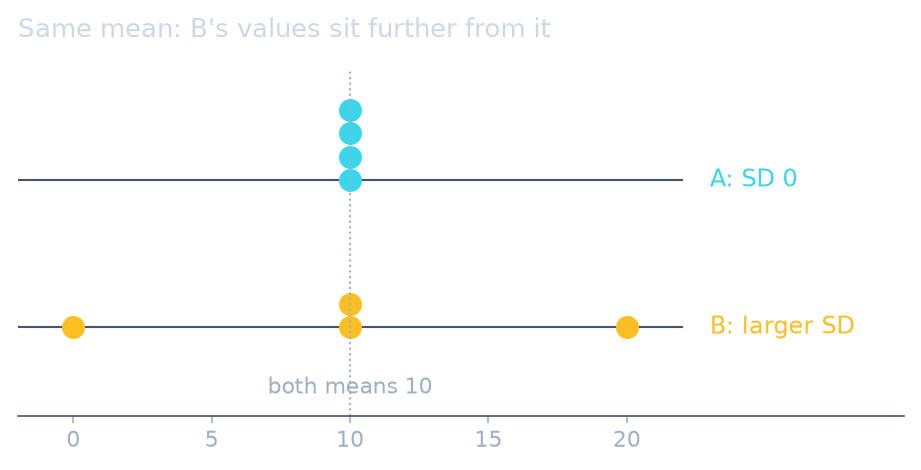
Data A: 10, 10, 10, 10. Data B: 0, 10, 10, 20. Same mean (10); B has the larger standard deviation because its values are further from the mean.
Adding 10 to every value in a data set leaves its standard deviation unchanged.
Difficulty 1/5 · 100 coins + a small bonus on first completion today
True. Shifting all values moves the mean by 10 but does not change how spread out they are.
Probability with overlaps 重叠部分
- $P(A \text{ or } B) = P(A) + P(B) - P(A \text{ and } B)$. Of 100 students, 60 study French, 50 Spanish, 20 both: French or Spanish $= 90$.
- Conditional: "Of those who study Spanish, what fraction also study French?" $= \tfrac{20}{50}$ — the reference total is 50.
Which total?
Choose the correct reference total for a probability.
Of 200 people, 120 like tea, 90 like coffee and 40 like both. How many like tea or coffee?
Difficulty 2/5 · 140 coins + a small bonus on first completion today
$120 + 90 - 40 = 170$.
Same group: of those who like coffee, what fraction also like tea?
Difficulty 1/5 · 100 coins + a small bonus on first completion today
The reference total is the 90 coffee drinkers.
Common traps
- Averaging averages without weights.
- Using the grand total instead of the conditioning group.
Recap
- Weighted average = total ÷ count; it sits nearer the larger group.
- Subtract the overlap for "or"; divide by the conditioning group for "given".
- overlap: The items that belong to two groups at the same time.