Algebra: domains, systems, inequalities and functions
Introduced| English | Meaning |
|---|---|
| domain/dəˈmeɪn/ | The set of input values for which a function is defined. |
| elimination/ɪˌlɪmɪˈneɪʃn/ | Solving simultaneous equations by combining them to remove one of the unknowns. |
A candidate can fail the original question
- A learner solves $\dfrac{x^2-4}{x-2}=4$ by cancelling to get $x+2=4$, then reports $x=2$. But the original denominator is zero at that value, so the proposed answer is not allowed.
- The domain 定义域 is the set of allowed inputs. This lesson works with real numbers unless a task gives a narrower set. Record restrictions before changing an expression, then test candidates in the original conditions.
Record denominator and root restrictions
- A denominator must be nonzero. For $\dfrac{1}{x-2}$, exclude $x=2$. A real square root needs a nonnegative input: $\sqrt{x+6}$ requires $x\ge-6$.
- Restrictions combine. For $\dfrac{\sqrt{x+6}}{x-2}$, first require $x\ge-6$, then exclude 2. Both restrictions apply at once; every part must be defined.
Cancel factors while keeping the hole
- Factor $x^2-4=(x-2)(x+2)$. Cancelling $x-2$ is valid only when $x\ne2$. Within that domain the original equation becomes $x+2=4$.
- Its only candidate is 2, which is excluded, so there is no solution. On the graph, the line would meet the level 4 exactly at the missing point. Simplifying the formula does not fill that hole.

Over the real numbers, how many solutions does $\dfrac{x^2-9}{x-3}=6$ have?
Difficulty 1/5 · 100 coins + a small bonus on first completion today
The original expression excludes x = 3. For x ≠ 3, factoring and cancelling gives x + 3 = 6. Its only candidate is 3, which is excluded, so there are no solutions.
An identity can still have a restriction
- Contrast $\dfrac{x^2-4}{x-2}=x+2$. After cancellation, both sides agree for every allowed input. The solutions are all real numbers except 2, so there are infinitely many solutions.
- “No solution” and “every allowed input works” are different results. In both equations the original restriction survives; the right-hand side determines which allowed inputs satisfy the equality.
Cancelling a common factor removes the original restriction on $x$.
Difficulty 1/5 · 100 coins + a small bonus on first completion today
Cancelling a factor is valid only where that factor is nonzero. The simplified formula cannot admit an input excluded by the original denominator.
What is the real solution set of $\dfrac{x^2-4}{x-2}=x+2$?
Difficulty 1/5 · 100 coins + a small bonus on first completion today
For x ≠ 2, the factored numerator cancels to x + 2, making an identity. The original denominator still excludes 2.
Squaring can introduce candidates
- Solve $\sqrt{x+6}=x$. The root is defined for $x\ge-6$, and its value is nonnegative, so equality also requires $x\ge0$. Squaring gives $x+6=x^2$, or $(x-3)(x+2)=0$.
- The candidates are 3 and $-2$. Checking the original equation gives $\sqrt9=3$, but $\sqrt4=2\ne-2$. Keep only 3. Squaring kept the true solution but also admitted an extra candidate; do not treat the squared equation as automatically equivalent.
Select every offered real solution of $\sqrt{x+6}=x$.
Difficulty 2/5 · 140 coins + a small bonus on first completion today
Squaring yields candidates 3 and −2, but the original square root is nonnegative. At −2 its value is 2, not −2. Only 3 works.
A learner solves √(x + 6) = x by squaring and accepts both 3 and −2. Explain which step admitted an extra candidate and repair the solution.
One possible explanation. Check your restrictions, calculations and original conditions against the model; this local review does not predict a GRE score.
A system requires both equations
- For $x+y=10$ and $x-y=4$, elimination 消元法 adds the equations to remove $y$: $2x=14$, hence $x=7$. Substitute back to get $y=3$.
- Check both originals: $7+3=10$ and $7-3=4$. The pair $(7,3)$ works. A pair that satisfies only one equation is not a solution of the system.
If $2x + y = 11$ and $x - y = 1$, what is $x$?
Difficulty 2/5 · 140 coins + a small bonus on first completion today
Adding the original equations gives 3x = 12, so x = 4. Substitution gives y = 3; both 2(4) + 3 = 11 and 4 − 3 = 1 hold.
Substitution reaches the same pair
- From $x+y=10$, write $y=10-x$. Substitute into the other equation: $x-(10-x)=4$. Expanding the brackets gives $2x-10=4$, so $x=7$ and $y=3$.
- Keep the entire substituted expression in brackets. The outer subtraction changes $-x$ to $+x$; writing $x-10-x$ would miss that sign change. Either valid method should give a pair that passes both original equations.
Elimination does not always give one pair
- For $x+y=10$ and $2x+2y=20$, the second equation repeats the first. Subtracting twice the first gives $0=0$, and every pair on $x+y=10$ works. There are infinitely many solutions.
- For $x+y=10$ and $2x+2y=21$, the same subtraction gives $0=1$, which is impossible. There is no solution. An identity leaves a condition to satisfy; a contradiction rules out every pair.
How many real ordered-pair solutions satisfy both x + y = 10 and 2x + 2y = 20?
Difficulty 1/5 · 100 coins + a small bonus on first completion today
The second equation is twice the first. All real pairs with y = 10 − x work, so there are infinitely many.
Compare three real systems: A has x + y = 10 and x − y = 4; B has x + y = 10 and 2x + 2y = 20; C has x + y = 10 and 2x + 2y = 21. Explain the solution count for each.
One possible explanation. Check your restrictions, calculations and original conditions against the model; this local review does not predict a GRE score.
A negative multiplier reverses order
- Solve $-2x+5>1$: subtract 5 to get $-2x>-4$, then divide by $-2$ to get $x<2$. Multiplying or dividing both sides by a negative reverses the inequality sign.
- A quick check: $x=0$ makes $5>1$ true, while $x=3$ makes $-1>1$ false. If you divide by an expression involving a variable, first establish its sign and check that it is nonzero; it is not automatically a positive divisor.
Solve $-2x + 5 > 1$.
Difficulty 1/5 · 100 coins + a small bonus on first completion today
$-2x > -4$; dividing by −2 reverses: $x < 2$.
Keep both sides of a compound inequality
- Start with $-3<2x+1\le7$. Subtract 1 from all three parts: $-4<2x\le6$. Dividing all parts by the positive number 2 gives $-2<x\le3$.
- The lower endpoint $-2$ is excluded; 3 is included. The original diagram shows this real-number interval, so values such as $-1.9$ also qualify. There is no integer restriction unless the question adds one.
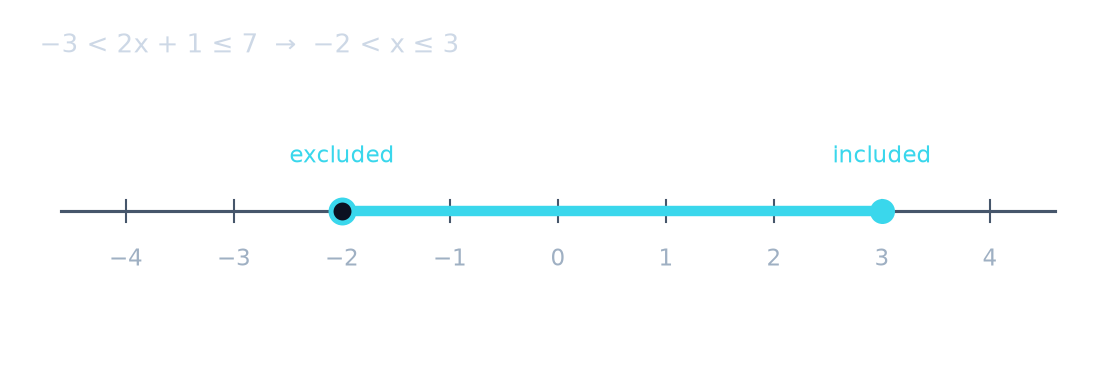
Included or excluded?
For every card, test the real interval −2 < x ≤ 3. No integer restriction is imposed.
Select every offered real value satisfying $-3<2x+1\le7$.
Difficulty 2/5 · 140 coins + a small bonus on first completion today
The equivalent interval is −2 < x ≤ 3. Select −1.5, 0 and 3; the lower endpoint −2 and the value 3.1 fail.
Add conditions by taking the overlap
- If a task also requires $x>0$, combine that with $-2<x\le3$ to get $0<x\le3$. A number must satisfy both conditions; do not join the two sets into one larger range.
- If the task then restricts $x$ to integers, only 1, 2 and 3 remain. The real interval and this integer list answer different domain conditions. Test endpoints and the stated number type together.
Substitute the whole function input
- For $f(x)=x^2-3$, the notation $f(2a)$ means substitute $2a$ everywhere $x$ occurs: $(2a)^2-3=4a^2-3$. It does not mean multiply $f(a)$ by 2.
- Likewise, $f(a+1)=(a+1)^2-3$. Expanding gives $a^2+2a-2$; the middle term comes from multiplying both terms in the brackets. With $a=2$, both forms give 6.
For $f(x)=x^2-3$, which expression equals $f(a+1)$ for every real $a$?
Difficulty 1/5 · 100 coins + a small bonus on first completion today
Substitute the whole input: $(a+1)^2-3=a^2+2a-2$.
Composition has an order
- Keep $f(x)=x^2-3$ and let $g(x)=x+1$. For $f(g(2))$, apply $g$ first: $g(2)=3$, then $f(3)=6$. The inner function supplies the outer function's input.
- Reversing gives $g(f(2))$: first $f(2)=1$, then $g(1)=2$. These two outputs differ. Also, $f(g(2))$ is not the product $f(2)g(2)$.

If $f(x) = 3x - 2$ and $g(x) = x^2$, what is $f(g(2))$?
Difficulty 2/5 · 140 coins + a small bonus on first completion today
$g(2) = 4$; $f(4) = 10$.
Check the intermediate input as well
- In a new example, let $g(x)=\sqrt{x+1}$ and $f(t)=\dfrac1{t-2}$. For $f(g(x))$ to be real and defined, first require $x\ge-1$, then require $g(x)\ne2$.
- Since $\sqrt{x+1}=2$ exactly when $x=3$, the composite domain is $x\ge-1$, excluding 3. At $x=0$, the intermediate value is 1 and the output is $-1$. At 3 the root exists, but the outer denominator is zero.
Let $g(x)=\sqrt{x+1}$ and $f(t)=\dfrac1{t-2}$. Select every offered input where $f(g(x))$ is real and defined.
Difficulty 2/5 · 140 coins + a small bonus on first completion today
Require x ≥ −1 for the root and exclude x = 3 because the intermediate value 2 makes the outer denominator zero. Select −1, 0 and 8.
Let g(x) = √(x + 1) and f(t) = 1/(t − 2). State the real domain of f(g(x)), evaluate it at x = 0, and explain what happens at x = 3.
One possible explanation. Check your restrictions, calculations and original conditions against the model; this local review does not predict a GRE score.
Translate a verbal condition with its domain
- Suppose a fictional club charges a fixed fee of 4 units plus 3 units per visit. The cost is $C(v)=4+3v$, where the number of visits $v$ is a nonnegative integer.
- With a budget of at most 25 units, solve $4+3v\le25$, giving $v\le7$. The greatest allowed count is 7: it costs 25, while 8 visits cost 28. “At most” includes equality; the count restriction rules out fractional visits.
A club charges a fixed 4 units plus 3 units per visit. With a budget of at most 25 units, what is the greatest whole number of visits?
Difficulty 2/5 · 140 coins + a small bonus on first completion today
4 + 3v ≤ 25 gives v ≤ 7. With v a nonnegative integer, the maximum is 7; eight visits cost 28.
Transfer the root check to a new equation
- Solve $\sqrt{2x+3}=x$. Real roots require $x\ge-1.5$, while equality to a square root requires $x\ge0$. Squaring yields $x^2-2x-3=0$.
- Factor as $(x-3)(x+1)=0$. Check the candidates: 3 gives $\sqrt9=3$, but $-1$ gives $\sqrt1=1\ne-1$. Only 3 solves the original equation. The root being defined is weaker than the equation being true.
Which rule was missed?
Each card proposes an incorrect algebra step. Identify the rule that repairs it.
Combine a cancelled expression and an interval
- Consider $\dfrac{x^2-16}{x-4}=x+4$ together with $1<x\le5$. The equality holds wherever its original denominator is nonzero. Combine the restrictions: $1<x\le5$, with 4 excluded.
- From offered values $-1,1,2,4,5,6$, select only 2 and 5. The full real solution set also includes unlisted values such as 2.5. Selecting valid offered entries is different from listing every real solution.
Over the reals, solve (x² − 16)/(x − 4) = x + 4 together with 1 < x ≤ 5. From offered values −1, 1, 2, 4, 5 and 6, select all valid entries. State the full solution set and explain why the offered selections are not the full set.
One possible explanation. Check your restrictions, calculations and original conditions against the model; this local review does not predict a GRE score.
Recap
- Record the original domain, preserve it through cancellation, and check candidates after operations such as squaring. A solution must satisfy every equation and condition in the task.
- Reverse order for a negative multiplier, keep inequality endpoints, substitute whole inputs, and check both stages of a composition. Translate words with the correct quantity and number type.
- domain: The set of allowed inputs for a function or expression.
- elimination: Combining equations to remove a variable while solving a system.