Spending and investing
Introduced| English | Meaning |
|---|---|
| interest/ˈɪntrest/ | A payment for borrowing money or a return earned by lending or depositing it. |
| credit/ˈkredɪt/ | An arrangement that provides money or purchasing power now in return for repayment later. |
| investment/ɪnˈvestmənt/ | Spending on assets intended to provide future returns or increase productive capacity. |
| simple interest/ˈsɪmpl ˈɪntrest/ | Interest calculated only on the original principal, without adding previous interest to it. |
| compound interest/ˈkɒmpaʊnd ˈɪntrest/ | Interest calculated on the original principal together with previously accumulated interest. |
| risk/rɪsk/ | The possibility of an adverse outcome, often assessed using its likelihood and consequences. |
Spending has a future cost
- A purchase has a price today and may have costs later: repairs, subscriptions, interest, or a missed saving opportunity.
- Credit 信贷 lets a person use money now and repay later. It can be useful for a planned need, but it is not extra income.
- Compare the total repayment, not only the small monthly payment.
The monthly payment smiles; the total cost reads the small print.
Credit is extra income that never needs repaying.
Difficulty 1/5 · 100 coins + a small bonus on first completion today
Credit is borrowed money and has a repayment commitment.
Interest changes the decision
- Interest 利息 is the cost of borrowing or the return paid on savings and some investments.
- Simple interest 单利 is calculated only on the original amount. Compound interest 复利 adds interest to an amount that already includes earlier interest.
- The same mechanism can grow savings or make an unpaid debt grow faster.
Which type adds interest to an amount that includes earlier interest?
Difficulty 1/5 · 100 coins + a small bonus on first completion today
Compound interest earns or charges interest on earlier interest too.
Return comes with risk
- An investment 投资 is an asset bought in the hope it will produce income or increase in value.
- Risk 风险 is the chance that the outcome differs from what you expect, including losing money. Higher possible returns commonly come with greater risk.
- Diversification means spreading money across different investments so that one bad result does not decide everything.
Match the financial idea to its meaning.
Difficulty 2/5 · 140 coins + a small bonus on first completion today
Diversification reduces dependence on one outcome; it cannot remove all risk.
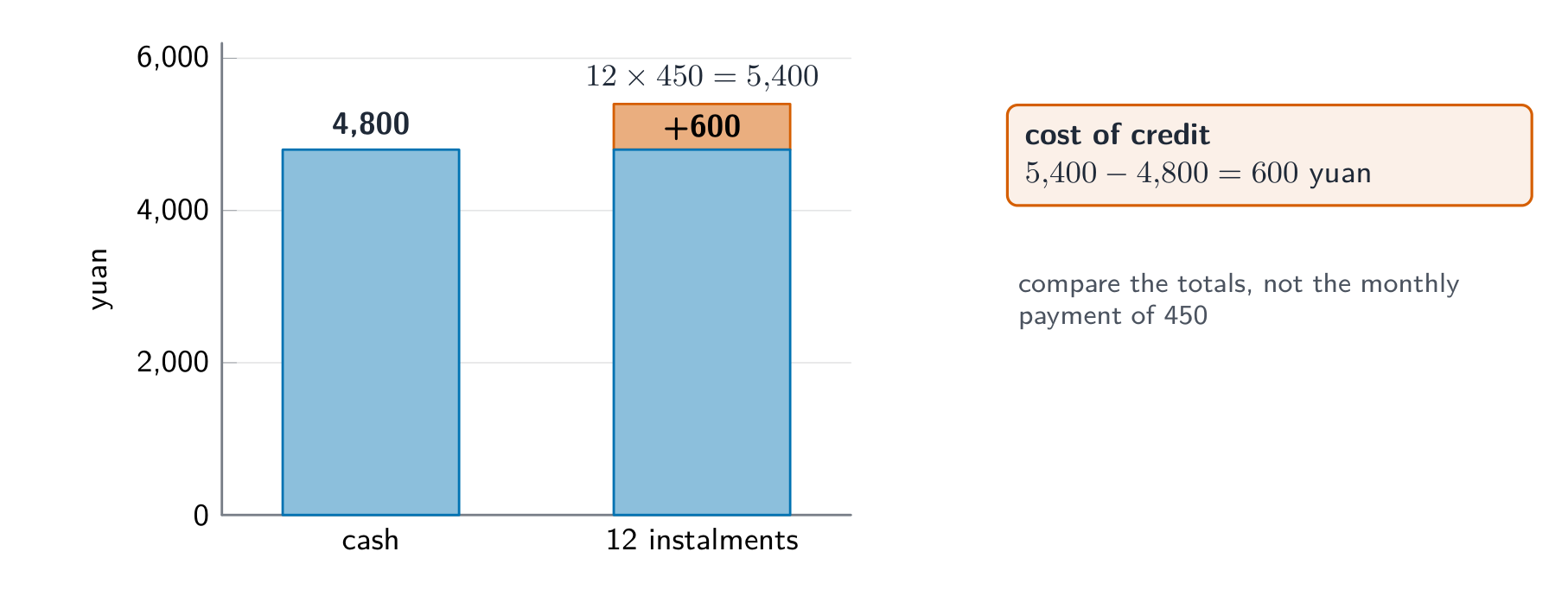
A laptop costs 4,800 yuan in cash or twelve payments of 450 yuan. The instalment plan costs 5,400 yuan in total. The extra 600 yuan is the cost of using credit. The buyer should compare that cost with the benefit of having the laptop now.
There is no universal answer: a necessary work tool may justify planned credit; an impulse purchase may not.
Twelve payments of 450 yuan cost how many yuan in total?
Difficulty 2/5 · 140 coins + a small bonus on first completion today
12 × 450 = 5400 yuan.
Write one English sentence explaining why the buyer should compare total repayment with the cash price.
Difficulty 3/5 · 200 coins + a small bonus on first completion today
Example: “The instalments total 5400 yuan, so credit costs 600 yuan more than paying 4800 yuan in cash.”
State the total, then judge the trade-off. “450 yuan is affordable” ignores eleven other payments. A financial decision needs the whole commitment.
Do not promise that an investment will make money. A past rise in value is evidence about the past, not a guarantee about the future.