Introductory economics for business
Introduced| English | Meaning |
|---|---|
| scarcity/ˈskeəsɪti/ | The condition in which limited resources cannot satisfy all competing wants. |
| opportunity cost/ɒpəˈtjuːnɪti kɒst/ | The value of the best alternative forgone when a choice is made. |
| market/ˈmɑːkɪt/ | An arrangement through which buyers and sellers exchange goods or services. |
| demand/dɪˈmænd/ | The quantity of a good or service that buyers are willing and able to purchase at different prices over a period. |
| supply/səˈplaɪ/ | The quantity sellers are willing and able to offer at different prices over a specified period. |
| equilibrium price/ˌiːkwɪˈlɪbrɪəm praɪs/ | The price at which quantity demanded equals quantity supplied. |
Every choice has a cost
- Scarcity 稀缺性 means resources are limited but people's wants are not.
- A business cannot buy every machine, hire every worker, or run every advert. It must choose.
- The opportunity cost 机会成本 is the next best option given up when that choice is made.
Opportunity cost is the option you did not choose, quietly waving from the other queue.
A bakery buys a delivery bicycle instead of a second oven. What is the opportunity cost?
Difficulty 1/5 · 100 coins + a small bonus on first completion today
Opportunity cost is the next best alternative, not every cost or the money paid.
Price is a signal
- In a market 市场, price links buyers and sellers.
- Demand 需求 is how much consumers are willing and able to buy at each price. A lower price usually leads to more demand.
- Supply 供给 is how much firms are willing and able to sell at each price. A higher price usually makes supply more attractive.
- These are tendencies, not promises. A firm still needs evidence about its own customers.
Demand means that consumers are both willing and able to buy at a stated price.
Difficulty 1/5 · 100 coins + a small bonus on first completion today
Wanting an item without being able to pay for it is not demand in this model.
Match each change to its usual market effect.
Difficulty 2/5 · 140 coins + a small bonus on first completion today
The model describes a tendency. A real firm still checks its own evidence.
The point where plans meet
- An equilibrium price 均衡价格 is the price at which quantity demanded equals quantity supplied.
- Above it, a seller may have unsold stock. Below it, customers may want more than the firm can provide.
- A shortage is not automatically good news: it can mean disappointed customers and lost future sales.
At which price is a market at equilibrium?
Difficulty 1/5 · 100 coins + a small bonus on first completion today
Equilibrium is the match between the quantity buyers want and the quantity sellers offer.
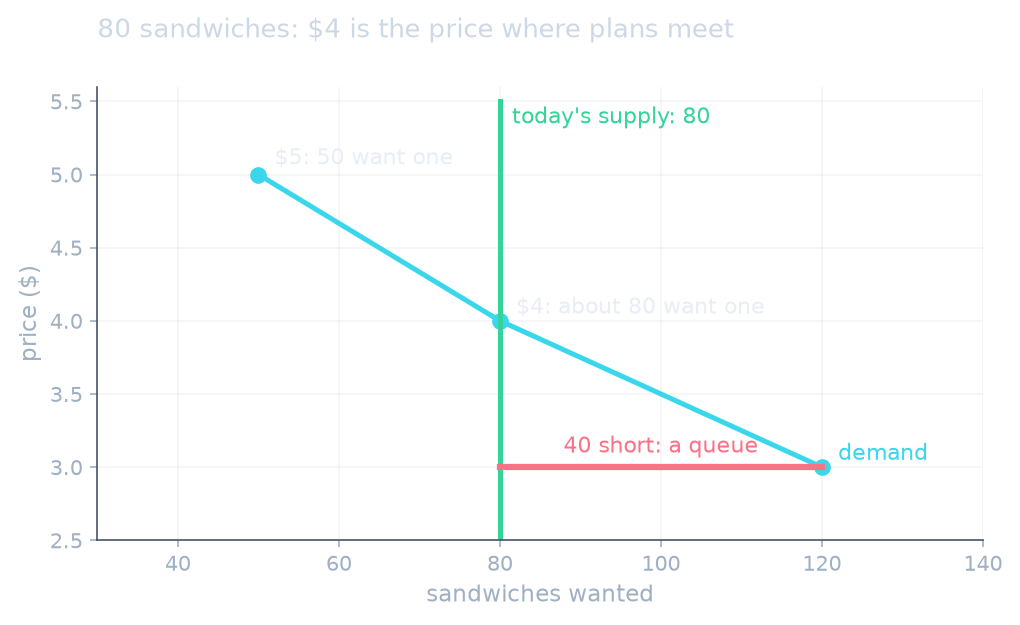
A campus café has 80 sandwiches for lunch. At $3, students want 120. At $5, they want 50. At $4, about 80 want one.
The $4 price is useful because it matches today's supply. Choosing $3 may create a queue, but the opportunity cost is the sales the café cannot make once the sandwiches are gone.
In one English sentence, state why a price of $4 suits the campus café in the worked case.
Difficulty 3/5 · 200 coins + a small bonus on first completion today
The useful link is quantity demanded = quantity supplied, not simply “students like it”.
Name the choice and the next best alternative. “The opportunity cost is money” is too vague. “Buying a second oven means giving up a delivery bicycle” is an economic explanation.
Do not say demand means “how much people like something”. They must be able and willing to buy it at a stated price. A thousand likes do not pay a supplier.