A domestic subsidy in an open market
Introduced| English | Meaning |
|---|---|
| world price/wɜːld praɪs/ | The price at which a good can be bought or sold on international markets. |
| production subsidy/prəˈdʌkʃn ˈsʌbsɪdi/ | A payment from the government to home producers for each unit they make. |
Subsidies for clean energy, 2022
- In 2022 the US passed the Inflation Reduction Act, with about 370 billion dollars of support for clean energy. Much of it pays tax credits to firms that make solar panels, batteries and electric cars in the US. Imports still compete at world prices, but home producers get extra money for each unit.
- A production subsidy protects home firms without a tariff.
The world price
- In an open economy, buyers can import at the world price 国际市场价格, so home producers cannot charge more.
- Imports fill the gap between home demand and home supply at that price.
At the world price, home demand is 150 and home supply 90. How many units are imported?
Difficulty 2/5 · 140 coins + a small bonus on first completion today
150 − 90.
A production subsidy
- A production subsidy 生产补贴 is a payment from the government to home producers for each unit they make.
- Producers receive the world price plus the subsidy, so they supply more. Consumers still pay the world price.
With a production subsidy in an open market, consumers pay
Difficulty 1/5 · 100 coins + a small bonus on first completion today
Imports still sell at the world price.
Worked example: 2 yuan per box
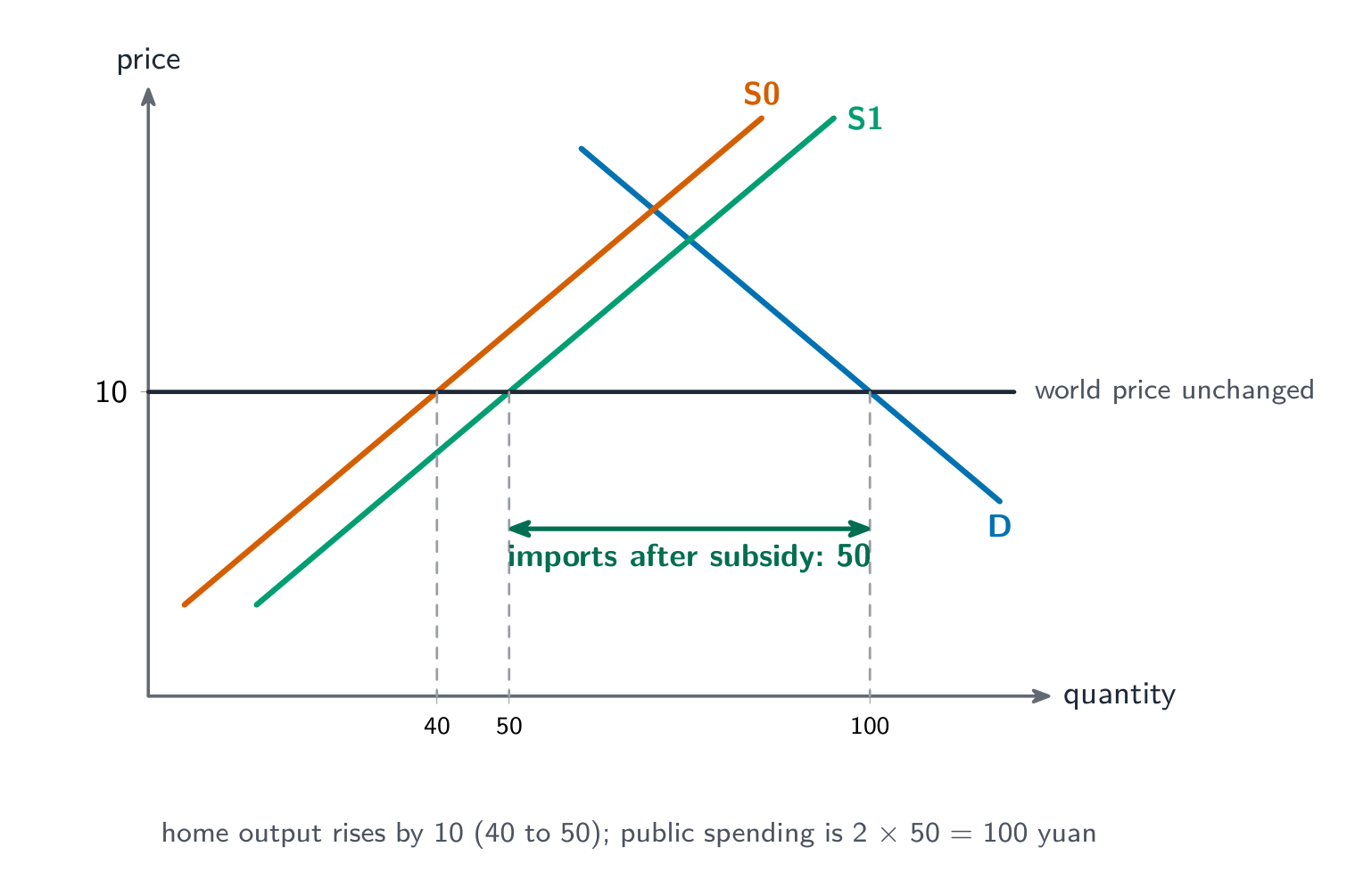
World price 10 yuan a box: home demand 100, home supply 40, imports 60. The government pays home producers 2 yuan a box.
- Producers receive 12: home supply rises to 50. Demand stays at 100 (consumers still pay 10).
- Imports: $100 - 50 = 50$, down from 60.
- Cost to government: $2 \times 50 = 100$ yuan.
A producer subsidy keeps the world price
A subsidy of 2 yuan per box leaves consumers paying 10 while producers receive 12. Home supply rises from 40 to 50, imports fall from 60 to 50, and the government pays 2 × 50 = 100 yuan.
A subsidy raises home supply to 110 while demand stays at 150. How many units are imported now?
Difficulty 2/5 · 140 coins + a small bonus on first completion today
150 − 110.
The subsidy is 3 yuan per unit on 110 units. What does it cost the government?
Difficulty 2/5 · 140 coins + a small bonus on first completion today
3 × 110.
Subsidy versus tariff
- A tariff of 2 yuan would raise the price to 12, cut demand to 90 and imports to 40, and earn revenue.
- The subsidy keeps prices low for consumers but costs the government money.
Match each policy to its effect.
Difficulty 2/5 · 140 coins + a small bonus on first completion today
Compare the tools.
Risks
- Taxpayers fund the subsidy, and the money has an opportunity cost.
- Other countries may complain under WTO rules or reply with their own subsidies.
A production subsidy does not lower the price consumers pay. In an open market the price stays at the world price. The subsidy changes who supplies the goods, not how much consumers pay.
A production subsidy lowers the price consumers pay below the world price.
Difficulty 1/5 · 100 coins + a small bonus on first completion today
The price stays at the world price.
At the world price, imports fill the gap between home demand and supply. A production subsidy raises home supply and cuts imports while consumers keep paying the world price. It costs taxpayers and may draw complaints from trading partners.
Evaluate the use of production subsidies, like those in the US Inflation Reduction Act, to support home industries.
Subsidies in open markets.