Fiscal choices and budget balances
Introduced| English | Meaning |
|---|---|
| budget deficit/ˈbʌdʒɪt ˈdefɪsɪt/ | The amount by which spending exceeds revenue over a given period. |
| fiscal policy/ˈfɪskl ˈpɒlɪsi/ | Government decisions about taxation and spending used to influence economic activity. |
Borrowing for a pandemic, 2020
- In the year to March 2021 the UK government spent about 15% of GDP more than it raised in taxes — the largest gap since the Second World War. It paid furloughed workers' wages and supported firms while much of the economy was closed.
- The gap between spending and revenue is the budget balance.
Budget balances
- A budget deficit 预算赤字 means government spending is greater than tax revenue; a surplus means revenue is greater.
- A deficit is covered by borrowing, which adds to the national debt.
Revenue is 300 billion and spending is 340 billion. What is the deficit?
Difficulty 2/5 · 140 coins + a small bonus on first completion today
340 − 300.
Fiscal policy
- Fiscal policy 财政政策 means changing government spending and taxes.
- Expansionary: spend more or tax less, to boost demand. Contractionary: spend less or tax more, to slow it.
Which are expansionary fiscal policy?
Difficulty 2/5 · 140 coins + a small bonus on first completion today
Raising VAT is contractionary.
Worked example: cutting spending
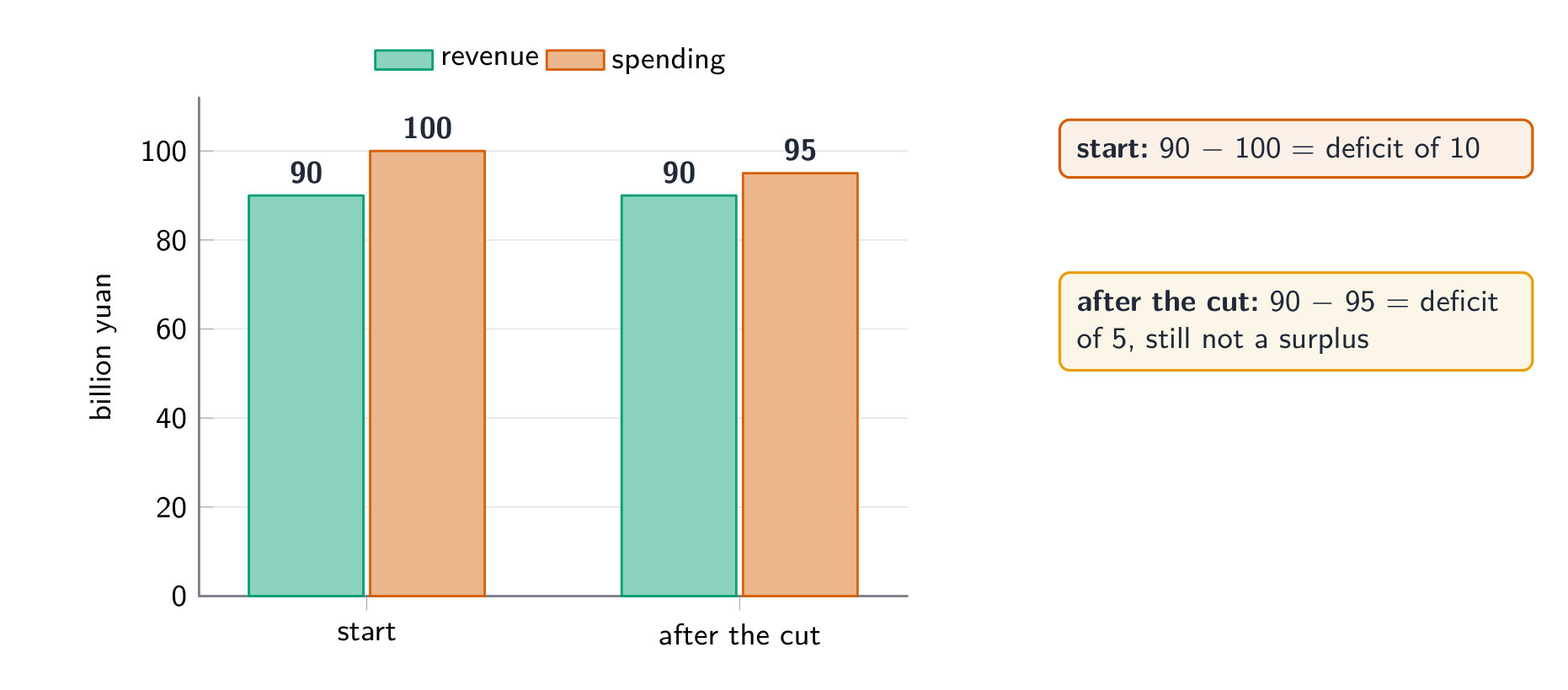
Revenue is 90 billion and spending 100 billion. The government cuts spending to 95 billion.
- Before: deficit $100 - 90 = 10$ billion.
- After: deficit $95 - 90 = 5$ billion.
- Meaning: the deficit halved, but there is still no surplus — the government still borrows 5 billion, and the debt still grows.
A smaller deficit is still a deficit
Revenue 90 billion and expenditure 100 billion give a deficit of 10 billion. Cutting spending to 95 with revenue unchanged reduces the deficit to 5; it does not create a surplus.
Spending is cut to 320 billion with revenue unchanged at 300. What is the new deficit?
Difficulty 2/5 · 140 coins + a small bonus on first completion today
320 − 300.
Why run a deficit?
- In a recession, borrowing to spend supports jobs and demand when firms and consumers spend less.
- Borrowing for roads, railways and schools can raise future output.
Why might a government choose a larger deficit in a recession?
Difficulty 1/5 · 100 coins + a small bonus on first completion today
Expansionary fiscal policy.
Risks of large deficits
- Interest on the debt takes money from other spending.
- Lenders may demand higher interest rates if they doubt the government can repay.
Large debts mean more government money goes on interest payments.
Difficulty 1/5 · 100 coins + a small bonus on first completion today
Less for other spending.
A smaller deficit is not a surplus. Cutting the deficit from 10 to 5 billion still adds 5 billion to the debt. The debt only falls when revenue exceeds spending.
Halving a deficit makes national debt fall.
Difficulty 1/5 · 100 coins + a small bonus on first completion today
Debt still grows by the remaining deficit.
Budget balance = revenue − spending. Deficits are financed by borrowing and add to debt. Expansionary fiscal policy can support an economy in recession; large lasting deficits raise interest costs.
Evaluate the UK government's decision to run a very large deficit in 2020–21.
Fiscal policy.