Environmental objectives and public provision
Introduced| English | Meaning |
|---|---|
| visual pollution/ˈvɪʒuːəl pəˈluːʃn/ | Ugly or cluttered sights, such as billboards and litter, that spoil a shared view or place. |
| legislation/ˌledʒɪˈsleɪʃn/ | Laws passed by a government or parliament. |
A city without billboards
- In 2007 São Paulo, Brazil's largest city, banned outdoor advertising under its "Clean City Law". About 15 000 billboards came down within a year. The city decided that the cluttered streets were a cost to everyone who saw them.
- Governments protect the environment with several kinds of tool.
Environmental objectives
- Cleaner air and water, less waste, protected landscapes, and lower carbon emissions.
- Visual pollution 视觉污染 — billboards, litter, ugly buildings — spoils views and places people share.
Which are examples of visual pollution?
Difficulty 2/5 · 140 coins + a small bonus on first completion today
Noise is not visual.
Legislation
- Legislation 立法 means laws: banning billboards, setting emission limits, requiring recycling.
- Laws act fast and clearly, but need inspectors and fines to work.
Which is an example of legislation to protect the environment?
Difficulty 1/5 · 100 coins + a small bonus on first completion today
A legal ban.
Worked example: a landfill tax
A firm sends 50 tonnes of waste to landfill each month. A landfill tax of 100 yuan per tonne is introduced; recycling costs 70 yuan per tonne.
- Landfill: $50 \times 100 = 5000$ yuan a month.
- Recycling: $50 \times 70 = 3500$ yuan a month.
- Choice: the firm switches to recycling and saves 1500 yuan. The tax changed the cheapest option.
A firm sends 30 tonnes to landfill. The landfill tax is 120 yuan a tonne and recycling costs 80 yuan a tonne. How much does it save each month by recycling?
Difficulty 2/5 · 140 coins + a small bonus on first completion today
30 × (120 − 80).
Public provision
- Governments provide recycling centres, parks, public transport and clean-water systems directly.
- These are paid for from taxes and can be used by all.
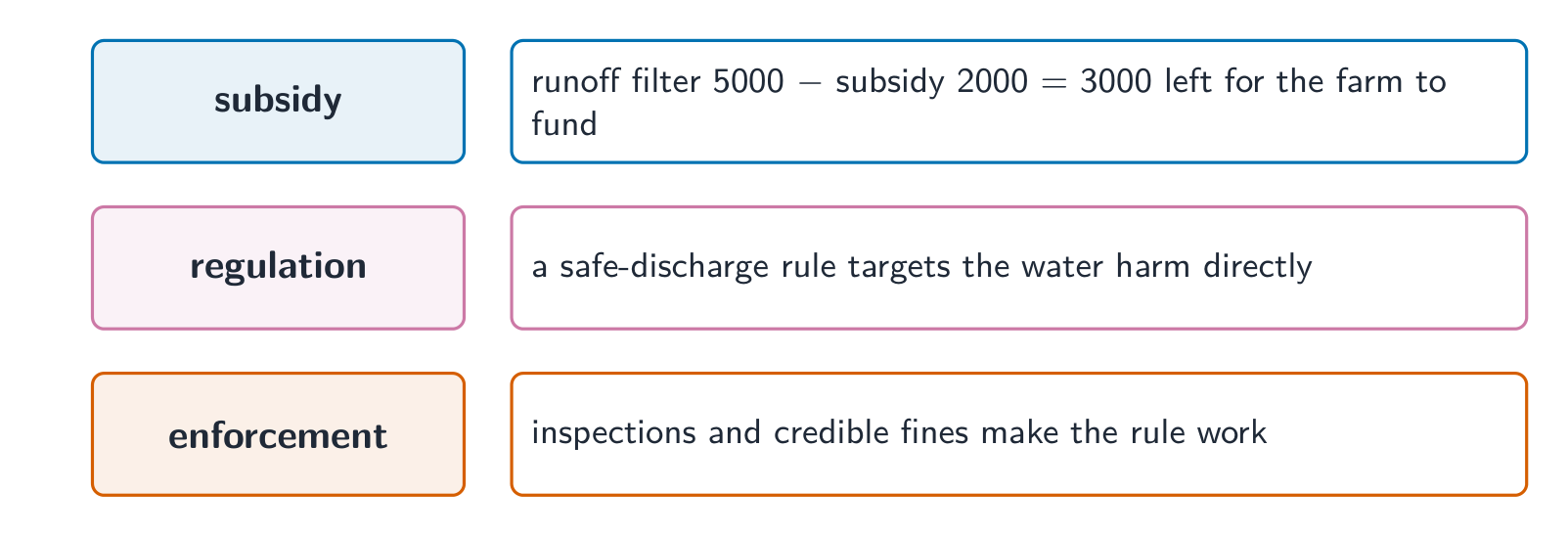
Match each harm to a suitable tool.
Difficulty 2/5 · 140 coins + a small bonus on first completion today
Fit the tool to the harm.
Small charges, big effects
- England introduced a 5p charge on plastic bags in big shops in 2015. Use of those bags fell by more than 95% over the next few years.
- A small price can change habits when cheap alternatives exist.
A small charge can change behaviour a lot when cheap alternatives exist.
Difficulty 1/5 · 100 coins + a small bonus on first completion today
England's bag charge.
No single tool fits every harm. A tax suits pollution that can be measured; a law suits harm that must stop completely; public provision suits services firms will not supply. Match the tool to the harm.
One environmental tool is best for every kind of harm.
Difficulty 1/5 · 100 coins + a small bonus on first completion today
Match the tool to the harm.
Environmental objectives include clean air, less waste and protected landscapes. Tools are legislation, taxes and charges, and public provision. The best tool depends on the harm, how easily it is measured and how easily the rule is enforced.
Evaluate São Paulo's ban on billboards as a way to reduce visual pollution.
Environmental policy.