Competition, firm size and monopoly
Introduced| English | Meaning |
|---|---|
| barrier to entry/ˈbærɪə tʊ ˈentri/ | Anything that makes it hard for a new firm to join a market, such as high start-up costs, patents or licences. |
| niche market/niːʃ ˈmɑːkɪt/ | A relatively small, specialised segment of customers with distinctive needs or preferences. |
Fifteen years to build an airliner
- China's COMAC began its C919 passenger jet in 2008. The first commercial flight came only in May 2023. Designing a large airliner costs many billions and takes over a decade, which is why Airbus and Boeing have long been almost the only sellers.
- Some markets are very hard for new firms to enter.
Barriers to entry
- A barrier to entry 进入壁垒 is anything that makes it hard for new firms to join a market.
- Huge start-up costs, patents, strong brands, control of raw materials and government licences.
Which are barriers to entry?
Difficulty 2/5 · 140 coins + a small bonus on first completion today
Many small firms show low barriers.
Monopoly power
- With high barriers, a dominant firm can keep prices high without new rivals arriving.
- Low barriers mean high profits attract new firms, which pushes prices down.
A firm earns high profits in a market with low barriers to entry. What is likely to happen?
Difficulty 1/5 · 100 coins + a small bonus on first completion today
Profits attract entry.
Worked example: market shares
A market's sales are split: firm A 40%, B 30%, C 20%, and many small firms 10% in total.
- Largest two: $40 + 30 = 70\%$ of sales.
- Largest three: $40 + 30 + 20 = 90\%$ — a few firms dominate, so this is an oligopoly.
- What it does not tell you: whether prices are high. That depends on barriers and how the firms behave.
Firms have shares of 35%, 25%, 15% and 10%. What share do the largest three have?
Difficulty 2/5 · 140 coins + a small bonus on first completion today
35 + 25 + 15.
Small firms survive
- A niche market 利基市场 is a small, specialized part of a market. Ferrari sells only about 14 000 cars a year but at very high prices.
- Small firms also offer personal service, flexibility, and local products.
A shop selling only left-handed tools serves
Difficulty 1/5 · 100 coins + a small bonus on first completion today
A small, specialized part of the market.
Big or small: which is better?
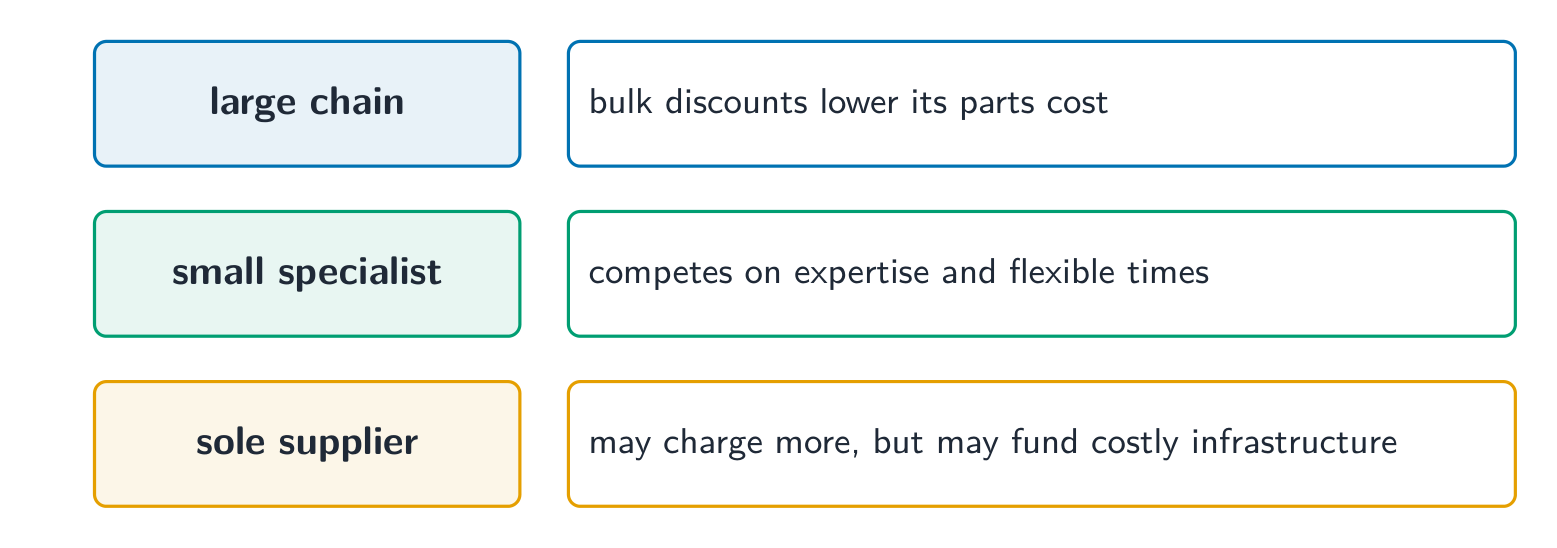
- Large firms gain economies of scale and can cut prices or fund research.
- Small firms are often more flexible and closer to customers. Size alone does not decide price or quality.
Why can small firms survive alongside large ones?
Difficulty 2/5 · 140 coins + a small bonus on first completion today
Large firms usually have lower average costs.
A big firm is not always a monopoly. A firm can be very large in a market with strong rivals. Monopoly power depends on market share and on barriers that keep rivals out.
Every large firm is a monopoly.
Difficulty 1/5 · 100 coins + a small bonus on first completion today
It may face strong rivals.
Barriers to entry protect firms from new rivals and give them power over prices. Market shares show how concentrated a market is. Small firms survive in niche markets and through flexibility; large firms gain from economies of scale.
Explain why few firms make large passenger aircraft, using barriers to entry.
Market structure.