Production factors and changing sectors
Introduced| English | Meaning |
|---|---|
| capital/ˈkæpɪtl/ | Goods made to produce other goods, such as machines, tools and buildings. |
| tertiary sector/ˈtɜːʃjəri ˈsektə/ | The part of the economy that provides services. |
China leaves the fields
- In 1978 about 70% of China's workers worked in farming. By 2022 the share was about 24%, while services employed nearly half. Hundreds of millions of people moved from fields to factories, shops and offices.
- Economies change which sectors their workers are in.
Factors of production
- Land (natural resources), labour (people's work), capital 资本要素 (machines, buildings, tools made to produce other goods) and enterprise (organizing and taking risks).
- Each factor earns a reward: rent, wages, interest and profit.
Match each item to its factor of production.
Difficulty 2/5 · 140 coins + a small bonus on first completion today
Four factors.
Three sectors
- Primary: extracting raw materials (farming, mining, fishing). Secondary: manufacturing and building.
- Tertiary sector 第三产业: services such as banking, teaching, tourism and retail.
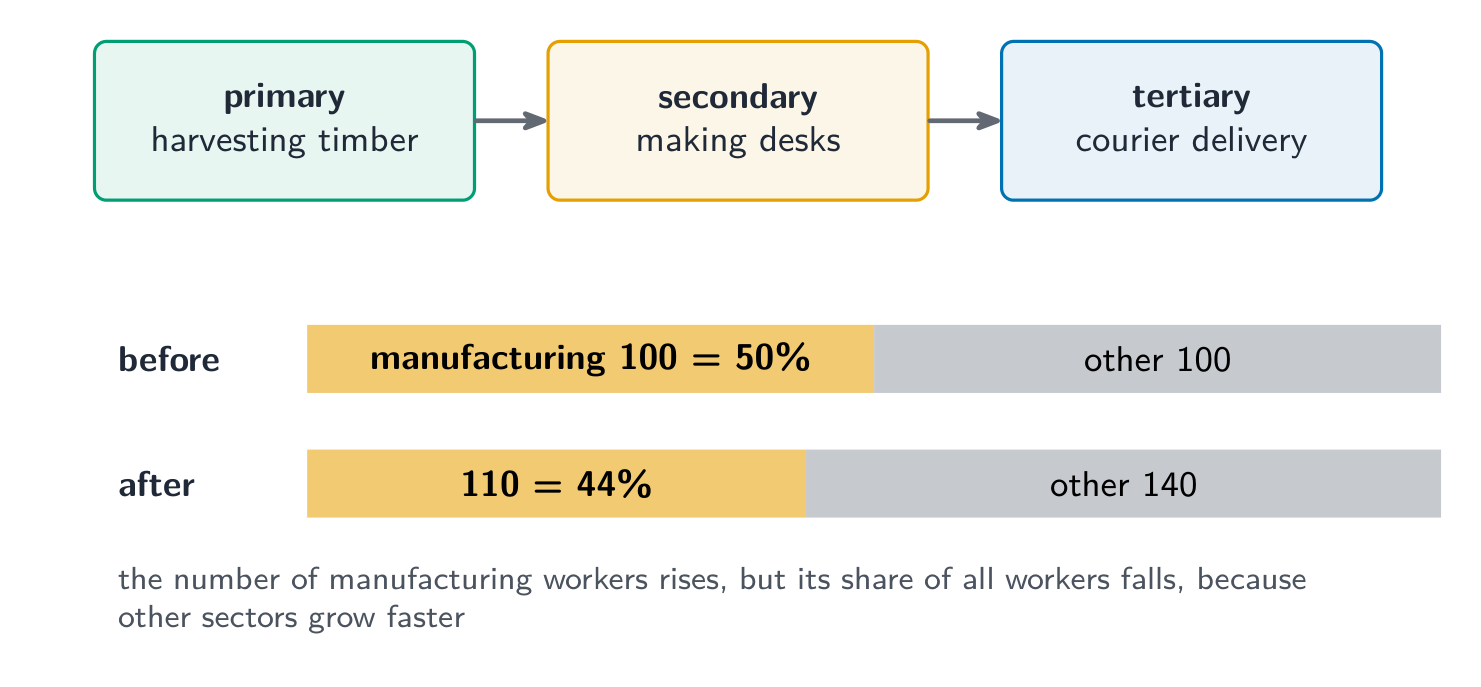
Match each job to its sector.
Difficulty 2/5 · 140 coins + a small bonus on first completion today
Extract, make, serve.
Worked example: a growing sector with a falling share
Manufacturing employs 100 of a town's 200 workers. Ten years later it employs 110 of 250.
- Before: $\dfrac{100}{200} = 50\%$. After: $\dfrac{110}{250} = 44\%$.
- Number: manufacturing jobs rose by 10.
- Share: it fell by 6 percentage points, because total employment grew faster — most new jobs were in services.
More manufacturing workers, a smaller share
Manufacturing employs 100 of 200 workers (50%), then 110 of 250 (44%): the sector grows, but its share of employment falls because total employment grew faster.
A sector employs 90 of 300 workers. What is its share, in per cent?
Difficulty 2/5 · 140 coins + a small bonus on first completion today
90 ÷ 300 × 100.
A sector's share of jobs can fall while its number of jobs rises.
Difficulty 1/5 · 100 coins + a small bonus on first completion today
If total jobs grow faster.
Why sectors change
- As incomes rise, people spend more on services (travel, health, education) than on food.
- Higher farm productivity means fewer farm workers are needed to feed everyone.
Why does the tertiary sector grow as countries develop?
Difficulty 2/5 · 140 coins + a small bonus on first completion today
People still need food, but fewer farmers.
Deindustrialization
- In rich economies, manufacturing's share has fallen as factories move abroad or use more machines. In the UK it is under 10% of jobs.
- Workers in declining industries may need retraining for new jobs.
A falling share does not mean a sector is shrinking. Manufacturing jobs rose from 100 to 110, even though the share fell from 50% to 44%. Check numbers and shares separately.
A falling share of employment always means fewer workers in that sector.
Difficulty 1/5 · 100 coins + a small bonus on first completion today
Check numbers and shares separately.
Production uses land, labour, capital and enterprise. Economies move from primary to secondary to tertiary as they develop. A sector's share can fall while its size grows, if the whole economy grows faster.
Explain two reasons why the share of China's workers in farming fell from about 70% in 1978 to about 24% in 2022.
Sector change.