Supply and production conditions
Introduced| English | Meaning |
|---|---|
| supply/səˈplaɪ/ | The quantity sellers are willing and able to offer at different prices over a specified period. |
| indirect tax/ɪndaɪˈrekt tæks/ | A tax on spending or transactions, usually collected by a seller and included in the price paid by a buyer. |
Solar panels get cheaper
- Between 2010 and 2020, the price of solar panels fell by about 90%. New factories, mostly in China, used better technology and much larger scale. At every price, firms were willing to sell far more panels.
- That is an increase in supply.
What supply means
- Supply 供给 is the amount producers are willing and able to sell at each price.
- A higher price usually brings a larger quantity supplied: it is more profitable to produce.
Movement along supply
- A change in the good's own price moves producers along the supply curve.
- A plant nursery offers 60, 80 and 100 plants at 15, 20 and 25 yuan.
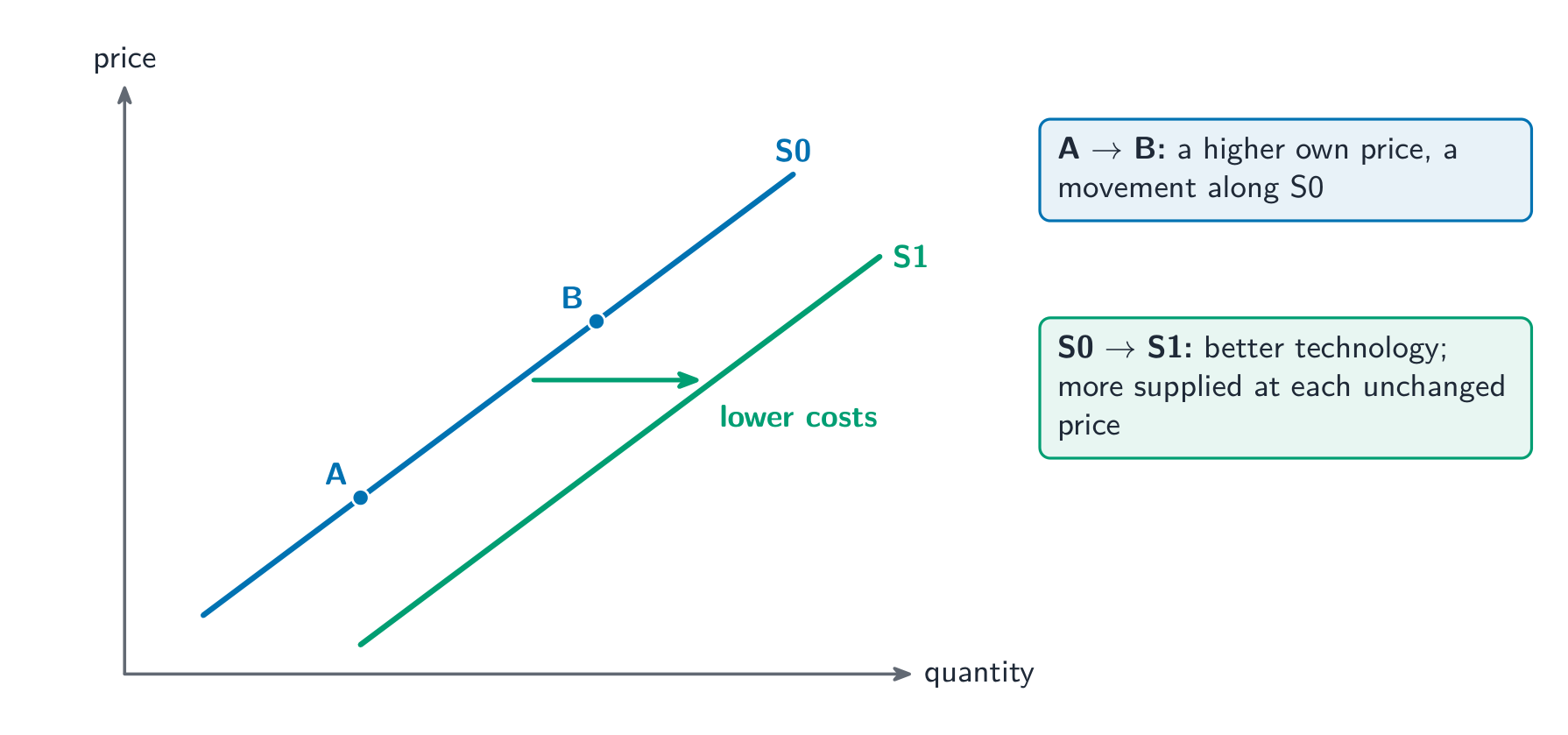
Worked example: cheaper watering
The nursery installs an efficient watering system that lowers its costs. It now offers 80, 100 and 120 plants at 15, 20 and 25 yuan.
- At 20 yuan: quantity supplied rises from 80 to 100, with no change in price.
- Every price: 20 more plants are offered.
- Conclusion: the supply curve has shifted right — an increase in supply, caused by lower costs.
Lower costs, more offered at every price
At 20 yuan per plant the nursery offered 80 plants; with cheaper, efficient watering it offers 100 at the same price. Supply has increased: the curve shifts right. The 15 and 25 yuan rows are illustrative.
Better machines lower the cost of making phones. What happens to phone supply?
Difficulty 1/5 · 100 coins + a small bonus on first completion today
Lower costs increase supply.
At 20 yuan, a nursery offered 80 plants before cheaper watering and 100 after. How many more plants are supplied at that price?
Difficulty 2/5 · 140 coins + a small bonus on first completion today
100 − 80.
What shifts supply?
- Costs of production (wages, materials), technology, the weather, the number of firms.
- Government: an indirect tax 间接税 on each unit raises costs and shifts supply left; a subsidy shifts it right.
Which shift the supply of rice to the left?
Difficulty 2/5 · 140 coins + a small bonus on first completion today
Own price causes a movement.
An indirect tax of 2 yuan per unit is placed on a good. What happens to the supply curve?
Difficulty 1/5 · 100 coins + a small bonus on first completion today
The tax adds to each unit's cost.
Supply shocks
- A storm destroying crops shifts supply left: less is offered at every price.
- Pork prices in China roughly doubled in 2019 when African swine fever killed millions of pigs.
Disease killing many pigs shifts pork supply to the left.
Difficulty 1/5 · 100 coins + a small bonus on first completion today
Less is offered at every price.
A higher price does not shift supply. It moves producers along the supply curve to a larger quantity supplied. Supply shifts only for a non-price reason, such as costs or technology.
A rise in the price of a good shifts its supply curve to the right.
Difficulty 1/5 · 100 coins + a small bonus on first completion today
It is a movement along the curve.
Own price → movement along the supply curve. Costs, technology, weather, number of firms, taxes and subsidies → shift of the curve. Lower costs shift supply right; taxes and disasters shift it left.
Explain why the price of solar panels fell so much between 2010 and 2020, using supply.
Supply shifts.