Income elasticity and changing demand
Introduced| English | Meaning |
|---|---|
| income elasticity of demand/ˈɪŋkʌm ɪlæˈstɪsɪti ɒv dɪˈmænd/ | The percentage change in quantity demanded divided by the percentage change in income. |
| inferior good/ɪnˈfɪərɪə ɡʊd/ | A good whose demand falls when consumers' income rises. |
Fewer instant noodles
- China ate about 46 billion packs of instant noodles in 2013, and fewer than 39 billion in 2016. Incomes were rising fast, and many people switched to fresh food and restaurant meals. Richer consumers bought less of a cheap staple.
- Income elasticity of demand measures how demand responds to income.
The formula
- Income elasticity of demand 需求收入弹性 (YED) $= \dfrac{\% \text{ change in quantity demanded}}{\% \text{ change in income}}$.
- The sign tells you the type of good; the size tells you how strongly demand responds.
Types of good
- Normal goods have positive YED. If YED is above 1, the good is a luxury (holidays, cars).
- An inferior good 劣等品 has negative YED: as income rises, people buy less of it.
Match each YED to the type of good.
Difficulty 2/5 · 140 coins + a small bonus on first completion today
Sign, then size.
Worked example: journeys and instant meals
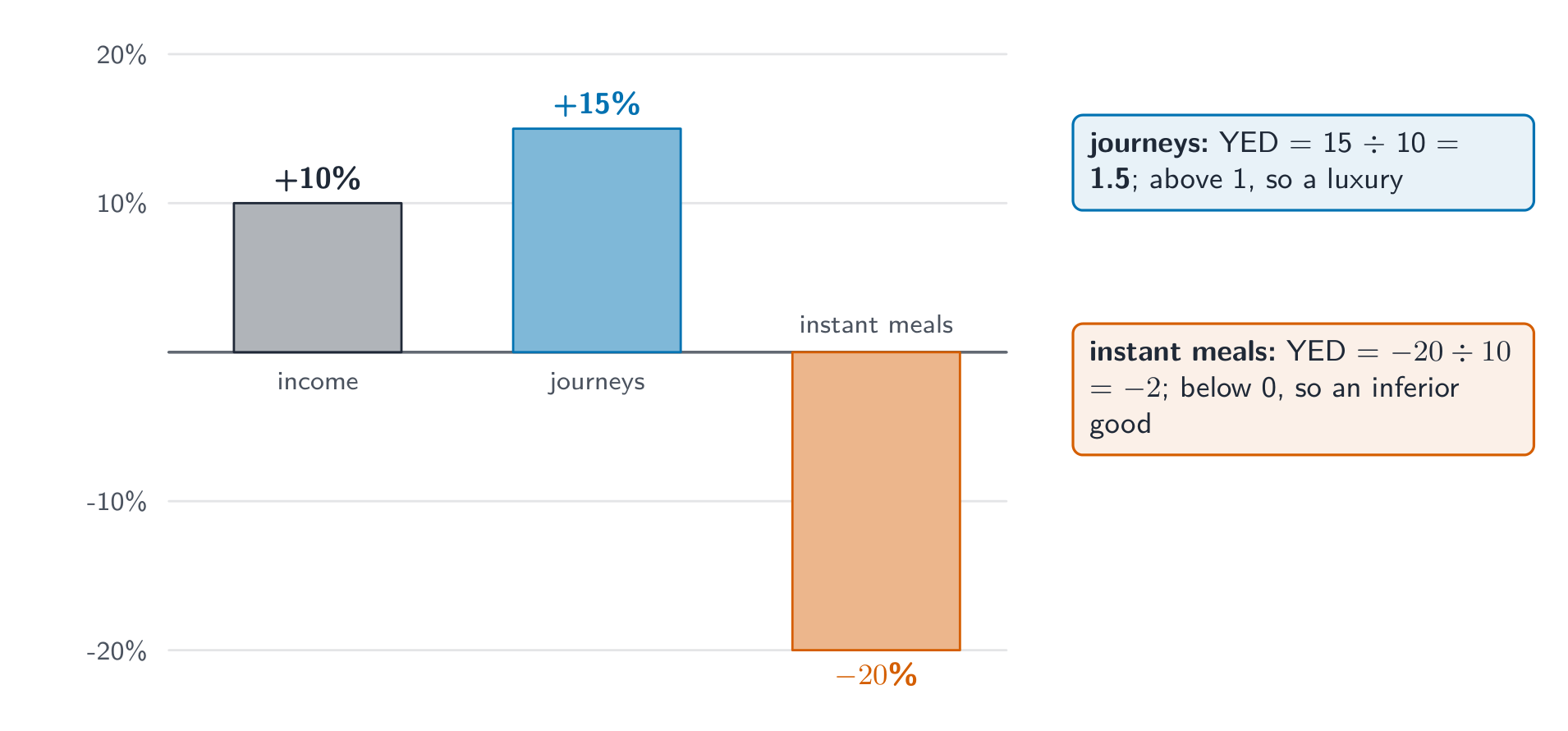
A family's income rises from 2000 to 2200 yuan a month. They take 23 train journeys instead of 20, and buy 20% fewer instant meals.
- % change in income: $\dfrac{200}{2000} \times 100 = 10\%$.
- Journeys: $+15\%$, so YED $= \dfrac{15}{10} = 1.5$ — a luxury.
- Instant meals: $-20\%$, so YED $= \dfrac{-20}{10} = -2$ — an inferior good.
One income rise and two kinds of good
Income rises 10% from 2000 to 2200 yuan. Journeys rise 15% (YED 1.5, a luxury); instant meals fall 20% (YED −2, an inferior good). The sign says normal or inferior; the size says how strongly demand responds.
Income rises 8% and demand for restaurant meals rises 12%. Find the YED.
Difficulty 2/5 · 140 coins + a small bonus on first completion today
12 ÷ 8.
Income rises 5% and demand for bus journeys falls 2%. Find the YED.
Difficulty 2/5 · 140 coins + a small bonus on first completion today
−2 ÷ 5.
Why firms care
- In a growing economy, sellers of luxuries can expect sales to rise quickly; sellers of inferior goods expect sales to fall.
- In a recession the opposite happens: discount shops often do well.
In a recession incomes fall. Which shop is likely to see sales rise?
Difficulty 1/5 · 100 coins + a small bonus on first completion today
Inferior goods sell more when incomes fall.
Changes over time
- A good can be normal in one country and inferior in another. Bicycles became an inferior good in many Chinese cities as car ownership rose in the 2000s.
- YED depends on income level and on what substitutes people can afford.
A good can be normal for some consumers and inferior for others.
Difficulty 1/5 · 100 coins + a small bonus on first completion today
It depends on income level and alternatives.
Inferior does not mean poor quality. It means demand falls when income rises. Instant noodles can be tasty and safe; people simply replace them with dearer options.
An inferior good is one of poor quality.
Difficulty 1/5 · 100 coins + a small bonus on first completion today
It means YED is negative.
YED = % change in quantity demanded ÷ % change in income. Positive: normal (above 1, luxury). Negative: inferior. Firms use YED to predict sales as incomes grow or fall.
Use income elasticity to explain why instant-noodle sales in China fell between 2013 and 2016 while restaurant spending rose.
YED in context.