Parabolas and rectangular hyperbolas
Introduced| English | Meaning |
|---|---|
| parabola/pəˈræbələ/ | The curve formed by points equally distant from a fixed point and a fixed straight line. |
| focus/ˈfəʊkəs/ | A fixed point used with a directrix or another focus to define a conic by distances. |
| rectangular hyperbola/rekˈtæŋɡjʊlə haɪˈpɜːbələ/ | A hyperbola whose asymptotes meet at right angles. |
| normal/ˈnɔːml/ | A line perpendicular to a surface at a given point. |
| directrix/daɪˈrektrɪks/ | A fixed line used with a focus to define a conic by a constant ratio of distances. |
| asymptotes/ˈæsɪmptəʊts/ | Lines or curves that a graph approaches arbitrarily closely in a specified limiting direction. |
A 500-metre dish in Guizhou, 2016
- In September 2016, China finished FAST, a radio telescope 500 m across in a valley in Guizhou. Its 4,450 panels are pulled into the shape of a parabola 抛物线 so that every radio wave from a far star reflects to one point, the focus 焦点, where the receiver hangs.
- FP1 studies the parabola and the rectangular hyperbola 直角双曲线 with Cartesian and parametric equations, and finds their tangents and normals.
Focus and directrix
- A parabola is the set of points the same distance from a fixed point (the focus) and a fixed line (the directrix 准线). For $y^2 = 4ax$ the focus is $(a, 0)$ and the directrix is $x = -a$.
- $y^2 = 12x$ means $4a = 12$, so $a = 3$: focus $(3, 0)$, directrix $x = -3$. The point $(12, 12)$ is 15 from both.
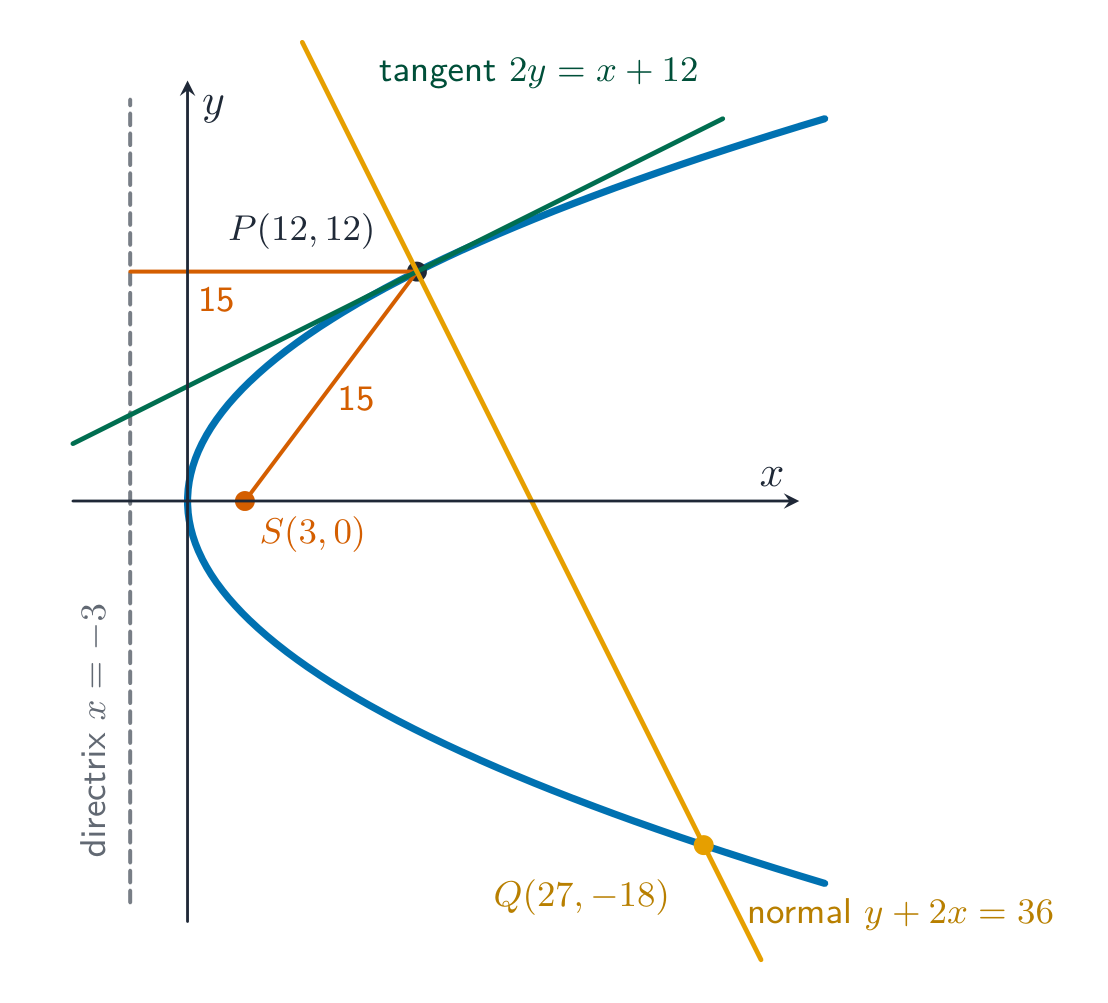
Parabolas and rectangular hyperbolas
For y²=4ax, the focus is (a,0), directrix x=-a and vertex (0,0)
Compare the model with the worked case and explain one change.
Find the focus of $y^2 = 20x$.
Difficulty 1/5 · 100 coins + a small bonus on first completion today
$4a = 20$, so $a = 5$. $(-5, 0)$ is on the directrix $x = -5$.
The point $(3, 6)$ lies on $y^2 = 12x$. Find its distance from the directrix.
Difficulty 2/5 · 140 coins + a small bonus on first completion today
Directrix $x = -3$: distance $3 - (-3) = 6$, the same as to the focus $(3, 0)$.
Parametric forms
- The parabola $y^2 = 4ax$ has parametric form $x = at^2$, $y = 2at$; check: $(2at)^2 = 4a(at^2)$.
- The rectangular hyperbola $xy = c^2$ has $x = ct$, $y = \dfrac{c}{t}$. Its asymptotes 渐近线 are the axes $x = 0$ and $y = 0$.
$x = 2t$, $y = \dfrac{2}{t}$ is a parametric form of $xy = 4$.
Difficulty 1/5 · 100 coins + a small bonus on first completion today
$xy = 2t \times \dfrac{2}{t} = 4$, so $c = 2$.
Worked example: a tangent to a parabola
Find the equation of the tangent to $y^2 = 12x$ at the point $P(3t^2, 6t)$, and use it at $t = 2$.
- Gradient: differentiate $y^2 = 12x$: $2y\dfrac{dy}{dx} = 12$, so $\dfrac{dy}{dx} = \dfrac{6}{y} = \dfrac{6}{6t} = \dfrac{1}{t}$.
- Tangent: $y - 6t = \dfrac{1}{t}(x - 3t^2)$, which simplifies to $ty = x + 3t^2$.
- At $t = 2$: $P = (12, 12)$ and the tangent is $2y = x + 12$. Check: $2(12) = 12 + 12$ ✓.
Find the gradient of the tangent to $y^2 = 8x$ at $(2, 4)$.
Difficulty 2/5 · 140 coins + a small bonus on first completion today
$2y\dfrac{dy}{dx} = 8$, so $\dfrac{dy}{dx} = \dfrac{4}{y} = 1$.
Tangents to $xy = c^2$
- Write $y = c^2x^{-1}$, so $\dfrac{dy}{dx} = -\dfrac{c^2}{x^2}$. At $(ct, \tfrac{c}{t})$, this is $-\dfrac{1}{t^2}$.
- On $xy = 16$ at $(4, 4)$ ($c = 4$, $t = 1$), the gradient is $-1$, so the tangent is $x + y = 8$.
Which is the tangent to $xy = 9$ at $(3, 3)$?
Difficulty 1/5 · 100 coins + a small bonus on first completion today
Gradient $-\dfrac{9}{x^2} = -1$: $y - 3 = -(x - 3)$. $y = x$ is the normal.
Normals
- The normal 法线 is perpendicular to the tangent, so its gradient is $-\dfrac{1}{m}$.
- For $y^2 = 12x$ at $(3t^2, 6t)$ the normal gradient is $-t$, giving $y + tx = 6t + 3t^3$. At $t = 2$: $y + 2x = 36$.
The normal to $y^2 = 12x$ at $(12, 12)$ is $y + 2x = 36$. Where does it cross the $x$-axis? Give $x$.
Difficulty 2/5 · 140 coins + a small bonus on first completion today
Put $y = 0$: $2x = 36$.
Exam-style question
Question (5 marks): The normal to the parabola $y^2 = 12x$ at $P(12, 12)$ meets the parabola again at $Q$. Find the coordinates of $Q$.
- Normal at $P$ (B1): from the step above, with $t = 2$, the normal is $y + 2x = 36$.
- Use the parametric form for $Q$ (M1): $Q = (3s^2, 6s)$ for some $s$. Substitute: $6s + 6s^2 = 36$.
- Solve (M1 A1): $s^2 + s - 6 = 0$, so $(s + 3)(s - 2) = 0$. $s = 2$ is $P$ itself, so $s = -3$.
- Point (A1): $Q = (3 \times 9, 6 \times (-3)) = (27, -18)$. Check: $(-18)^2 = 324 = 12 \times 27$ ✓.
Where marks are lost: substituting $y^2 = 12x$ into the normal and getting a messy equation in $x$; using the parameter avoids the square root. Remember that one root of the quadratic is always $P$.
The line $y = x - 4$ meets $y^2 = 4x$ at the points with parameter $t$, where $x = t^2$, $y = 2t$. Find the larger value of $t$, to 3 decimal places.
Difficulty 2/5 · 140 coins + a small bonus on first completion today
$2t = t^2 - 4$, so $t^2 - 2t - 4 = 0$ and $t = \dfrac{2 \pm \sqrt{20}}{2} = 1 \pm \sqrt{5}$. The larger is $1 + \sqrt{5} = 3.236$.
Reading $a$ as the coefficient of $x$. In $y^2 = 20x$, $4a = 20$ gives $a = 5$, so the focus is $(5, 0)$, not $(20, 0)$. Always match the equation to $y^2 = 4ax$ before reading off the focus or directrix.
A parabola $y^2 = 4ax$ has focus $(a, 0)$, directrix $x = -a$ and parameters $(at^2, 2at)$; a rectangular hyperbola $xy = c^2$ has parameters $(ct, \tfrac{c}{t})$ and the axes as asymptotes. Find tangents by differentiating, and normals with gradient $-\tfrac{1}{m}$.
Show that the tangent to $xy = c^2$ at $(ct, \tfrac{c}{t})$ is $x + t^2y = 2ct$. Find where it meets the $x$-axis.
Differentiate, substitute, simplify.