Oligopoly and barriers to entry
Introduced| English | Meaning |
|---|---|
| oligopoly/ˌɒlɪˈɡɒpəli/ | A market dominated by a small number of interdependent large firms. |
| interdependence/ˌɪntədɪˈpendəns/ | When each firm's best choice depends on what its rivals do. |
| patent/ˈpeɪtənt/ | A legal right for an inventor to be the only maker of an invention for a set time. |
| sunk cost/sʌŋk kɒst/ | A cost already incurred that cannot be recovered. |
| barrier to entry/ˈbærɪə tʊ ˈentri/ | Something that makes it hard for new firms to enter a market. |
Two firms build the world's airliners
- For decades almost every large passenger jet has been made by Boeing or Airbus.
- China's COMAC began work on its C919 in 2008; it carried its first passengers only in 2023. Entry took 15 years and billions of dollars.
- A market dominated by a few large firms is an oligopoly 寡头垄断.
Features of oligopoly
- A few firms supply most of the market: a high concentration ratio.
- Interdependence: each firm's best choice depends on what its rivals do. Boeing must think about Airbus's response to every price or new model.
- High barriers to entry keep new firms out.
Which are features of oligopoly?
Difficulty 2/5 · 140 coins + a small bonus on first completion today
Price takers belong to perfect competition.
Barriers to entry
- Economies of scale: a new entrant at small scale has much higher average costs.
- Legal barriers: a patent 专利 gives an inventor sole rights for about 20 years; licences limit who can operate.
- Brand loyalty, control of key resources or outlets, and sunk costs that a new firm would lose if it failed. Each is a barrier to entry 进入壁垒.
Match each barrier to its example.
Difficulty 2/5 · 140 coins + a small bonus on first completion today
Each makes entry harder.
Worked example: what is sunk?
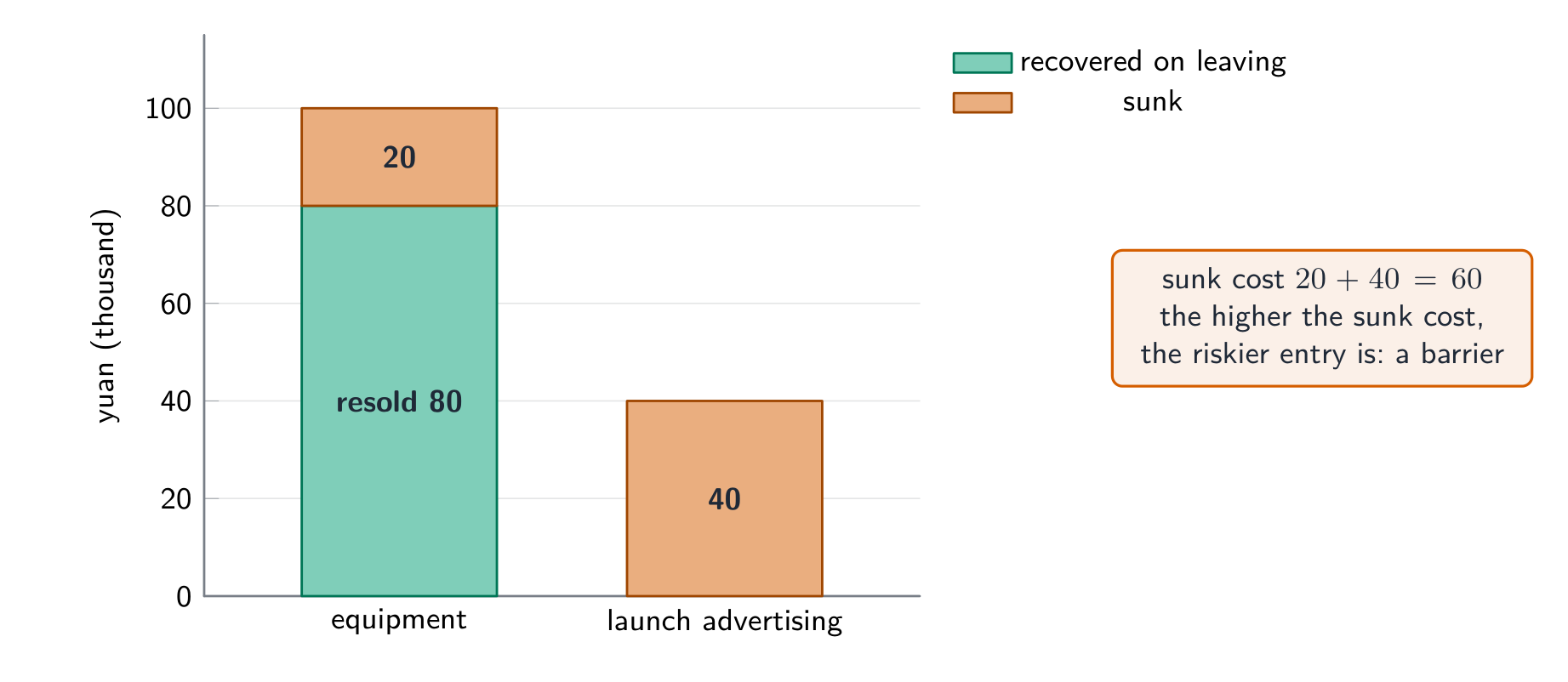
A new firm buys equipment for 100 and spends 40 on launch advertising. If it leaves, it can resell the equipment for 80.
- Sunk cost 沉没成本 of equipment $= 100 - 80 = 20$; advertising cannot be recovered: 40.
- Total sunk cost $= 20 + 40 = 60$, not the whole 140.
- The higher the sunk cost, the riskier entry is — and the stronger the barrier.
An entrant spends 300 on machines (resale value 180) and 70 on advertising. What is the total sunk cost?
Difficulty 2/5 · 140 coins + a small bonus on first completion today
$(300 - 180) + 70 = 190$.
All money spent on entering a market is sunk cost.
Difficulty 1/5 · 100 coins + a small bonus on first completion today
Only the part that cannot be recovered on exit is sunk.
Barriers to exit
- Exit is also costly when assets are specialised: a steel plant or an aircraft factory has few other uses.
- Contracts with suppliers and workers, and redundancy payments, add to the cost of leaving.
Which is a barrier to exit?
Difficulty 1/5 · 100 coins + a small bonus on first completion today
Specialised assets lose value if the firm leaves.
An oligopoly is defined by the market's structure, not by its behaviour. Firms in an oligopoly may compete fiercely on price, or they may collude. "Few firms" tells you about interdependence, not which choice they make.
Firms in an oligopoly always collude to raise prices.
Difficulty 1/5 · 100 coins + a small bonus on first completion today
They may compete or collude.
Oligopoly is a market with a few dominant firms, high barriers to entry and interdependent decisions. Barriers include economies of scale, patents and licences, brand loyalty and sunk costs. Specialised assets and contracts also create barriers to exit.
Explain why it took COMAC so long to enter the large-airliner market.
Use barriers to entry.