Types of efficiency
Introduced| English | Meaning |
|---|---|
| efficiency/ɪˈfɪʃənsi/ | The fraction of total energy or power input converted to useful output. |
| allocative efficiency/ˈæləkətɪv ɪˈfɪʃənsi/ | An allocation of resources that maximises total net benefit; at the efficient output, marginal social benefit equals marginal social cost. |
| productive efficiency/prəˈdʌktɪv ɪˈfɪʃənsi/ | Production at the lowest attainable average total cost for the relevant technology and scale. |
| dynamic efficiency/daɪˈnæmɪk ɪˈfɪʃənsi/ | Improving products and methods over time through investment and innovation. |
The camera company that waited
- An engineer at Kodak built the first digital camera in 1975. Kodak, earning large profits from film, was slow to develop it.
- By 2012 digital cameras and phones had replaced film, and Kodak filed for bankruptcy.
- A firm can be efficient today and still fail to innovate for tomorrow. Economists use four kinds of efficiency 效率.
Four kinds of efficiency
- Allocative efficiency 配置效率: producing the goods people value most, where $P = \text{MC}$ (marginal benefit equals marginal cost).
- Productive efficiency 生产效率: producing at the lowest possible average cost, the bottom of the ATC curve.
- Dynamic efficiency 动态效率: improving products and processes over time through research and investment.
- X-efficiency: no wasted costs at the current output.
Match each type of efficiency to its condition.
Difficulty 2/5 · 140 coins + a small bonus on first completion today
Four different questions about efficiency.
Worked example: the cost of producing too little
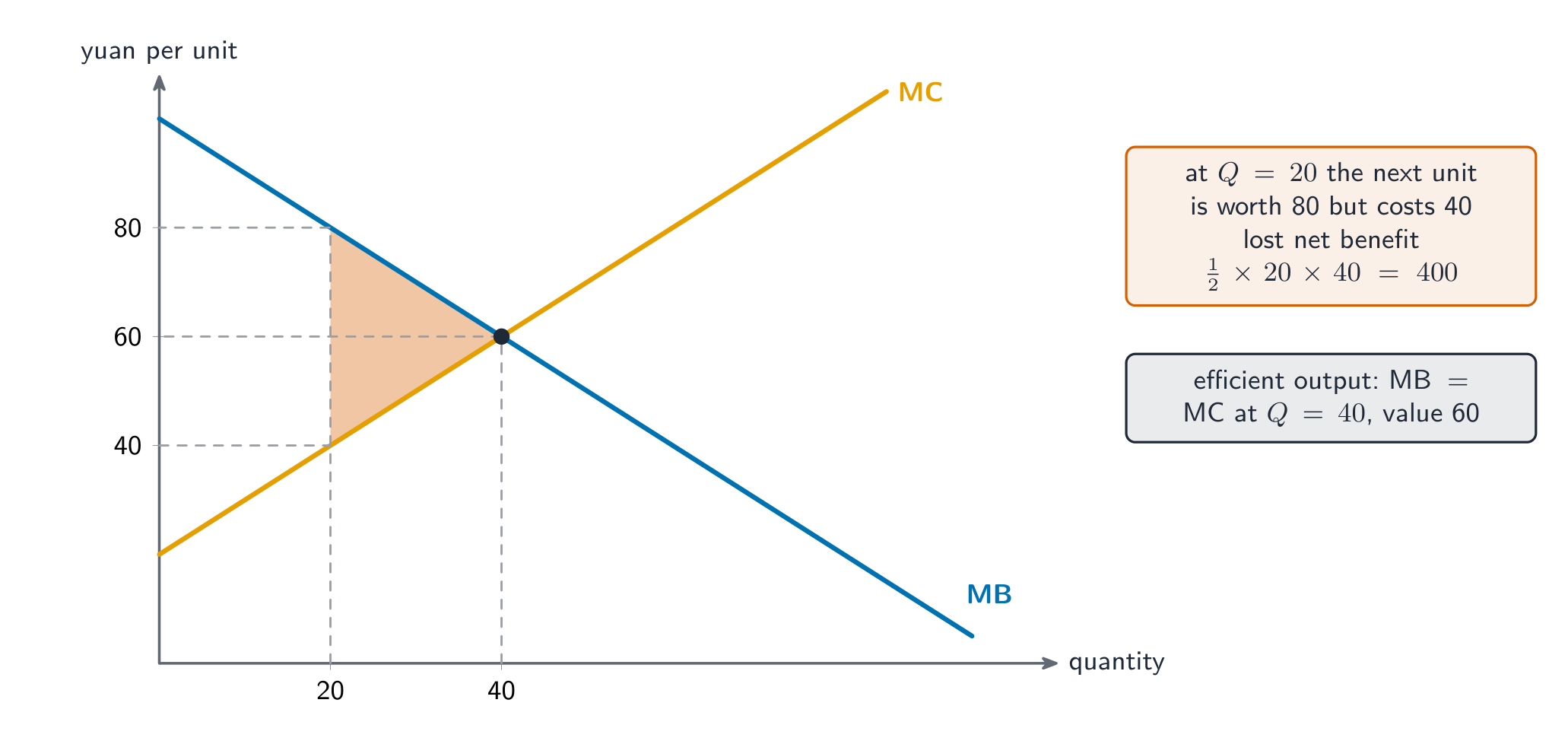
Marginal benefit is $\text{MB} = 100 - Q$ and marginal cost $\text{MC} = 20 + Q$.
- Allocatively efficient output: $100 - Q = 20 + Q$ gives $Q = 40$, where MB = MC = 60.
- At $Q = 20$, $\text{MB} = 80$ but $\text{MC} = 40$: each extra unit up to 40 is worth more than it costs.
- Lost welfare $= \dfrac{1}{2} \times (40 - 20) \times (80 - 40) = 400$.
$\text{MB} = 120 - 2Q$ and $\text{MC} = 30 + Q$. What is the allocatively efficient output?
Difficulty 2/5 · 140 coins + a small bonus on first completion today
$120 - 2Q = 30 + Q$, so $Q = 30$.
In that market only 20 units are produced. At $Q = 20$, MB = 80 and MC = 50. What is the lost welfare?
Difficulty 2/5 · 140 coins + a small bonus on first completion today
$\dfrac{1}{2} \times 10 \times 30 = 150$.
Competition versus monopoly
- In long-run perfect competition, firms produce where $P = \text{MC}$ and at minimum ATC: both allocatively and productively efficient.
- A monopoly sets $P > \text{MC}$ and usually produces less, so it is allocatively inefficient. With no rivals, it may also become X-inefficient.
Why is a profit-maximising monopoly allocatively inefficient?
Difficulty 1/5 · 100 coins + a small bonus on first completion today
At P > MC, consumers value extra units more than they cost.
In long-run equilibrium, a perfectly competitive firm is
Difficulty 2/5 · 140 coins + a small bonus on first completion today
P = MC = minimum ATC with normal profit.
But monopolies can innovate
- Supernormal profit can pay for research. Large pharmaceutical firms spend billions on new medicines, protected by patents.
- So a monopoly may be dynamically efficient even when it is allocatively inefficient — but, as Kodak shows, profit does not guarantee innovation.
Supernormal profit can help a monopoly to be dynamically efficient.
Difficulty 1/5 · 100 coins + a small bonus on first completion today
It can pay for research, though it may not.
"Efficient" needs a type. A firm can be productively efficient (low cost) but allocatively inefficient (price far above MC), or dynamically efficient but X-inefficient. Always say which kind of efficiency you mean.
Allocative efficiency is P = MC; productive efficiency is minimum ATC; dynamic efficiency is innovation over time; X-efficiency is no wasted costs. Perfect competition scores well on the first two; monopoly may do better on dynamic efficiency but worse on the others.
Evaluate whether monopoly is always less efficient than perfect competition.
Compare the types of efficiency.