The benefits of economic growth
Introduced| English | Meaning |
|---|---|
| material living standards/məˈtɪərɪəl ˈlɪvɪŋ ˈstændədz/ | The goods and services people can afford, such as housing, food and transport. |
| fiscal space/ˈfɪskl speɪs/ | How much more a government can borrow or spend without risking its finances. |
800 million people out of poverty
- The World Bank estimates that close to 800 million people in China left extreme poverty between 1980 and 2020.
- Rapid growth raised wages, built schools and hospitals, and gave the state money to spend.
- Growth brings benefits — but each one has conditions, and not everyone shares them equally.
Higher living standards
- Rising real GDP per head means more goods and services per person: higher material living standards 物质生活水平.
- People eat better, live in bigger homes and live longer. China's life expectancy rose from about 66 in 1980 to about 78 in 2020.
Jobs and firms
- Growing demand means firms need more workers, so unemployment falls and wages rise.
- Firms earn higher profits, which pay for investment, so growth can feed further growth.
Which are likely benefits of economic growth?
Difficulty 2/5 · 140 coins + a small bonus on first completion today
Growth does not reduce all prices; it can even raise inflation.
Put the chain of benefits in order.
Difficulty 3/5 · 200 coins + a small bonus on first completion today
Growth creates jobs, which raises incomes and living standards.
Worked example: growth and the budget
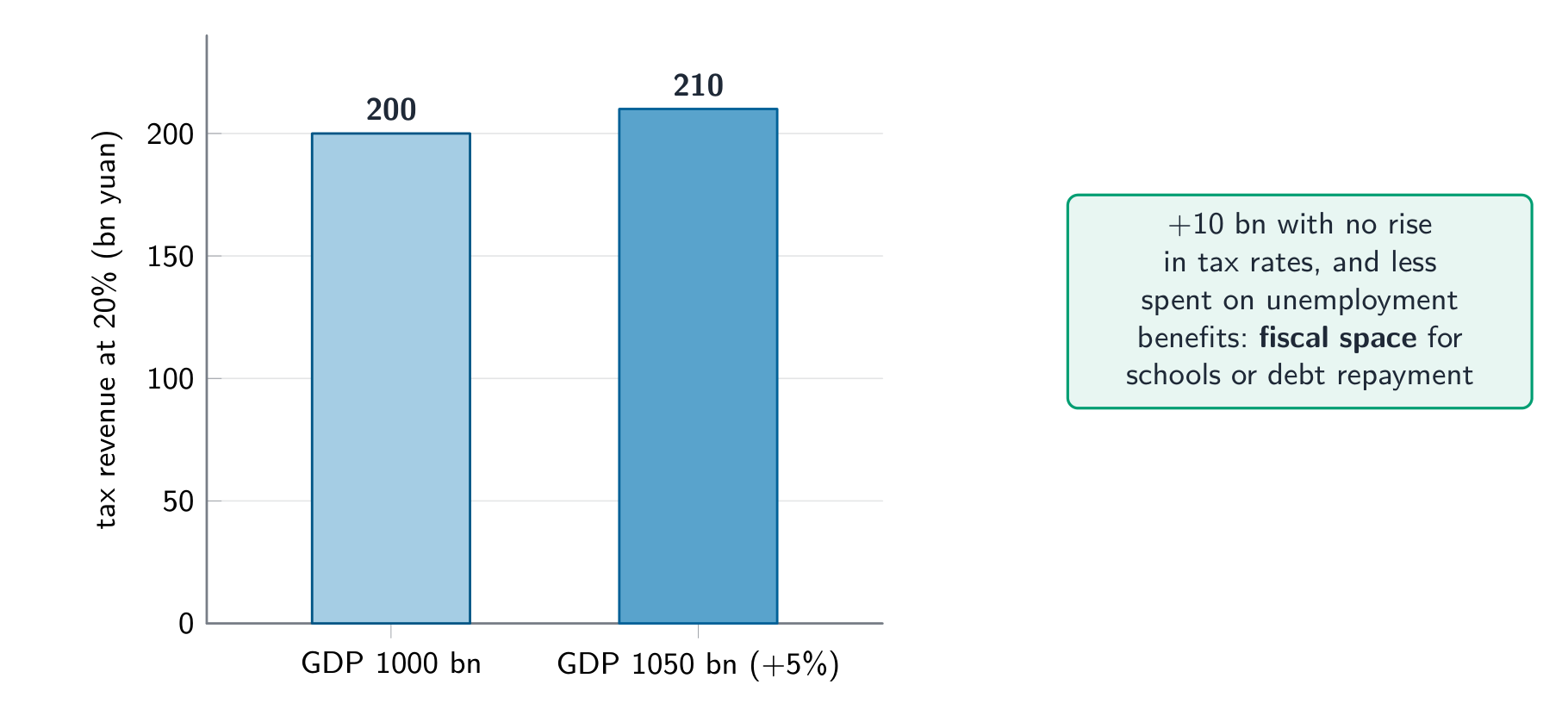
GDP is ¥1000 bn and the government collects 20% in tax. GDP grows by 5%.
- Tax revenue before $= 0.20 \times 1000 = ¥200$ bn.
- After $= 0.20 \times 1050 = ¥210$ bn: ¥10 bn more with no rise in tax rates.
- Spending on unemployment benefits also falls. This extra room is fiscal space 财政空间: money for schools or debt repayment.
GDP is ¥2000 bn and tax is 25% of GDP. GDP grows by 4%. By how much does tax revenue rise?
Difficulty 2/5 · 140 coins + a small bonus on first completion today
$0.25 \times 2080 - 0.25 \times 2000 = 520 - 500 = ¥20$ bn.
What is fiscal space?
Difficulty 1/5 · 100 coins + a small bonus on first completion today
Growth raises revenue and cuts benefit spending.
Conditions on each benefit
- Population: if population grows as fast as GDP, GDP per head does not rise.
- Distribution: if the gains go mainly to the richest, many households see little change.
- What is produced: growth from weapons or wasteful projects adds little to welfare.
Real GDP grows by 3% and population by 3%. Roughly by how much does real GDP per head change, in %?
Difficulty 2/5 · 140 coins + a small bonus on first completion today
Output grows no faster than the number of people sharing it.
Growth in GDP is not the same as rising living standards for everyone. Always check GDP per head, its real value after inflation, and who receives the extra income before claiming that people are better off.
If GDP rises by 5%, every household's income rises by 5%.
Difficulty 1/5 · 100 coins + a small bonus on first completion today
The gains may be unequally shared.
Growth can raise material living standards, create jobs, raise profits and investment, and give the government fiscal space. Each benefit depends on population growth, the distribution of income and what is produced.
Evaluate whether economic growth always raises living standards.
Evaluation needs a reasoned conclusion.