The circular flow, income and wealth
Introduced| English | Meaning |
|---|---|
| wealth/welθ/ | The total value of what a person or country owns at a point in time. |
| income/ˈɪŋkʌm/ | Money received by a person or organisation over a period. |
| net wealth/net welθ/ | What someone owns minus what they owe. |
| income flow/ˈɪŋkʌm fləʊ/ | Money received over a period of time, such as wages each month. |
| wealth effect/welθ ɪˈfekt/ | A change in consumer spending caused by a change in the value of household wealth. |
Rich in flats, short of cash
- About 70% of Chinese household wealth is held in housing. When house prices fell after 2021, many families felt poorer.
- Yet their monthly wages had not changed. Economists separate a flow of income each period from a stock of wealth at one moment.
Is each a flow or a stock?
Difficulty 2/5 · 140 coins + a small bonus on first completion today
A flow has a time period; a stock is measured at a moment.
The circular flow
- Households supply land, labour and capital to firms. Firms pay them income: wages, rent, interest and profit.
- Households spend that income on firms' goods and services. Real resources and goods go one way; money goes the other.
- So, in a simple economy, total output = total income = total spending.
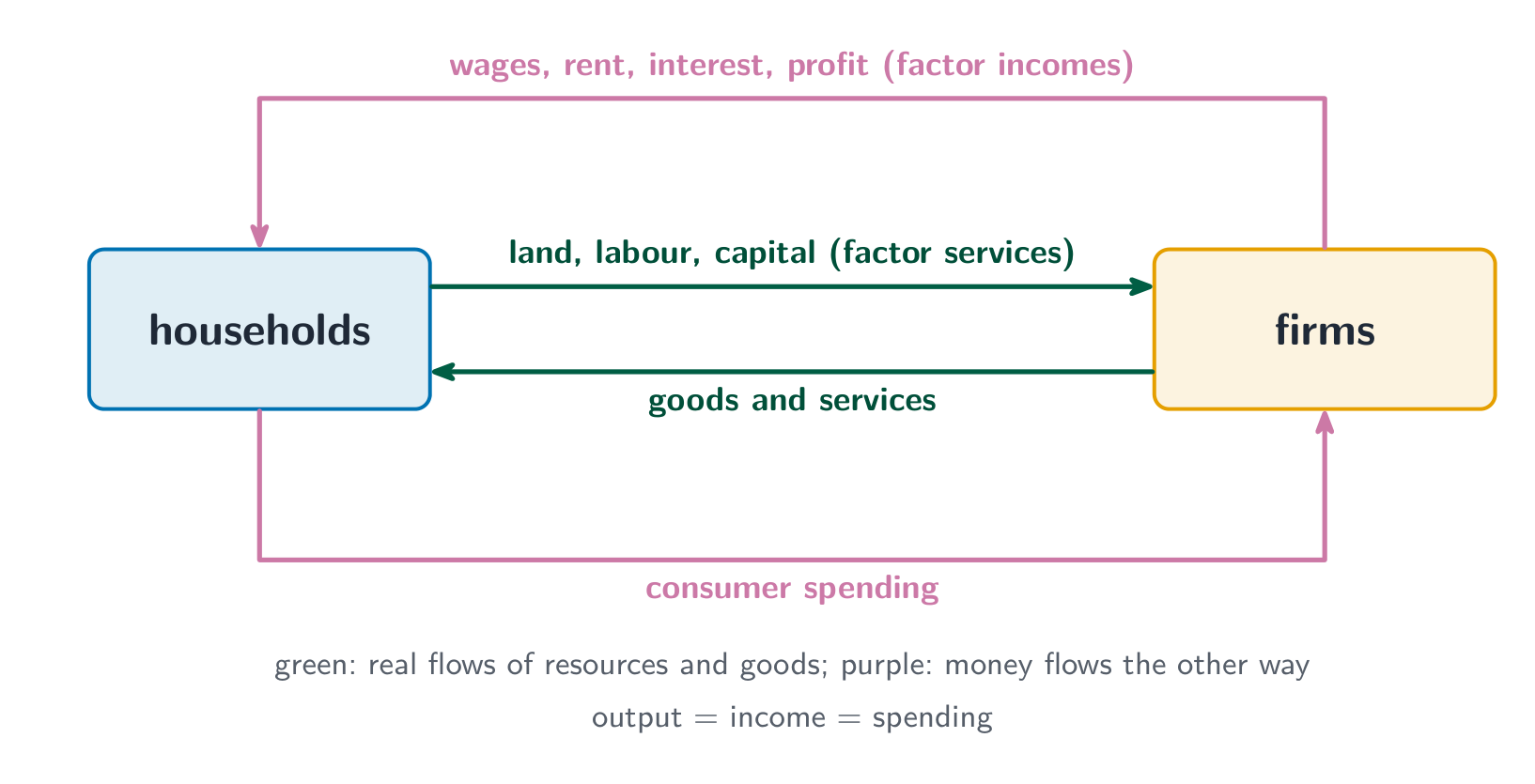
In the circular flow, what do firms give households in return for labour?
Difficulty 1/5 · 100 coins + a small bonus on first completion today
Factor services flow to firms; income flows to households.
Worked example: income versus wealth
A household has assets of 12,000 and debts of 3,000.
- Net wealth 净财富 $= 12{,}000 - 3{,}000 = 9{,}000$ — a stock, measured at one date.
- It saves 200 from this month's income: net wealth becomes 9,200. The 200 came from the income flow 收入流量.
- Its flat then rises in value by 500: net wealth reaches 9,700. No new output was produced, so this is not part of GDP or income.
Net wealth is a stock; saving is the flow that adds to it
Assets 12,000 less debts 3,000 is net wealth 9,000. A month's saving of 200 added to assets takes it to 9,200; that stock is not monthly income. A 500 revaluation raises net wealth again without being any part of GDP.
Assets are ¥250,000 and debts ¥90,000. What is net wealth?
Difficulty 2/5 · 140 coins + a small bonus on first completion today
$250{,}000 - 90{,}000 = ¥160{,}000$.
A rise in house prices is counted as part of GDP.
Difficulty 1/5 · 100 coins + a small bonus on first completion today
No new output is produced; only the value of an existing asset changes.
How the two connect
- Saving out of income builds wealth over time.
- Wealth can produce income: rent from a flat, interest on deposits, dividends on shares.
- Changes in wealth affect spending through the wealth effect: when share or house prices rise, households spend more.
Which are links between income and wealth?
Difficulty 2/5 · 140 coins + a small bonus on first completion today
They are linked, but one is a flow and one a stock.
Why the difference matters
- Income is more equal than wealth in most countries, because wealth builds up over generations.
- A pensioner can have high wealth and low income; a young doctor the opposite.
Why is wealth usually more unequal than income?
Difficulty 1/5 · 100 coins + a small bonus on first completion today
Wealth accumulates over a lifetime and across generations.
Do not add wealth to income. "Net wealth of 9,000" and "income of 3,000 a month" measure different things. A rise in house prices raises wealth but is not income and is not counted in GDP.
The circular flow shows that output, income and spending are equal in a simple economy. Income is a flow per period; wealth is a stock at one date. Saving turns income into wealth, wealth can earn income, and changes in wealth affect spending.
Explain why a fall in house prices could reduce consumption even if incomes do not change.
Use the stock–flow distinction.