Aggregate demand
Introduced| English | Meaning |
|---|---|
| consumption/kənˈsʌmpʃn/ | The use or purchase of goods and services to satisfy needs and wants. |
| investment/ɪnˈvestmənt/ | Spending on assets intended to provide future returns or increase productive capacity. |
| aggregate demand/ˈæɡrɪɡeɪt dɪˈmænd/ | Total planned spending on an economy's goods and services at different general price levels. |
| aggregate expenditure/ˈæɡrɪɡeɪt ekˈspendɪtʃə/ | Total spending in an economy on its goods and services. |
| net exports/net ˈekspɔːts/ | The value of exports minus the value of imports over a period. |
Who does the spending?
- In the US, household consumption is about two-thirds of GDP. In China it is under 40%, while investment is over 40%.
- Both economies' output is bought by the same four groups: households, firms, the government and foreigners.
- Their total planned spending on the country's output is aggregate demand 总需求, also called aggregate expenditure 总支出.
The four components
- $C$: consumption 消费 by households. $I$: investment 投资 in capital goods by firms. $G$: government spending on goods and services.
- $X - M$: net exports 净出口. Imports are subtracted, because spending on foreign goods does not buy domestic output.
Why are imports subtracted in the AD formula?
Difficulty 1/5 · 100 coins + a small bonus on first completion today
C, I and G include some spending on foreign goods, which must be removed.
Worked example: calculating AD
$C = 320$, $I = 80$, $G = 120$, $X = 100$, $M = 90$ (billion).
- AD $= 320 + 80 + 120 + (100 - 90) = 530$.
- Without subtracting imports the total would be 620 — wrongly counting spending on foreign output.
- If investment rises from 80 to 95, AD becomes 545 at the same price level, before any multiplier effect.
AD = C + I + G + (X − M)
C 320, I 80, G 120, X 100 and M 90 give AD 530: imports are subtracted because they are spending on foreign output. Raise I from 80 to 95 and planned AD becomes 545, before any multiplier feedback.
C = 700, I = 200, G = 250, X = 300, M = 350 (billion). What is AD?
Difficulty 2/5 · 140 coins + a small bonus on first completion today
$700 + 200 + 250 + (300 - 350) = 1100$.
Why the AD curve slopes down
- Wealth effect: a lower price level raises the real value of savings, so households spend more.
- Interest-rate effect: lower prices mean people need less money, interest rates tend to fall, and borrowing for spending rises.
- Trade effect: lower domestic prices make exports cheaper and imports dearer, so net exports rise.
Match each effect to its explanation of why AD slopes down.
Difficulty 2/5 · 140 coins + a small bonus on first completion today
All three explain a movement along AD.
Movement or shift?
- A change in the price level moves the economy along the AD curve.
- A change in any component for another reason — confidence, interest rates, taxes, foreign incomes, the exchange rate — shifts the curve.
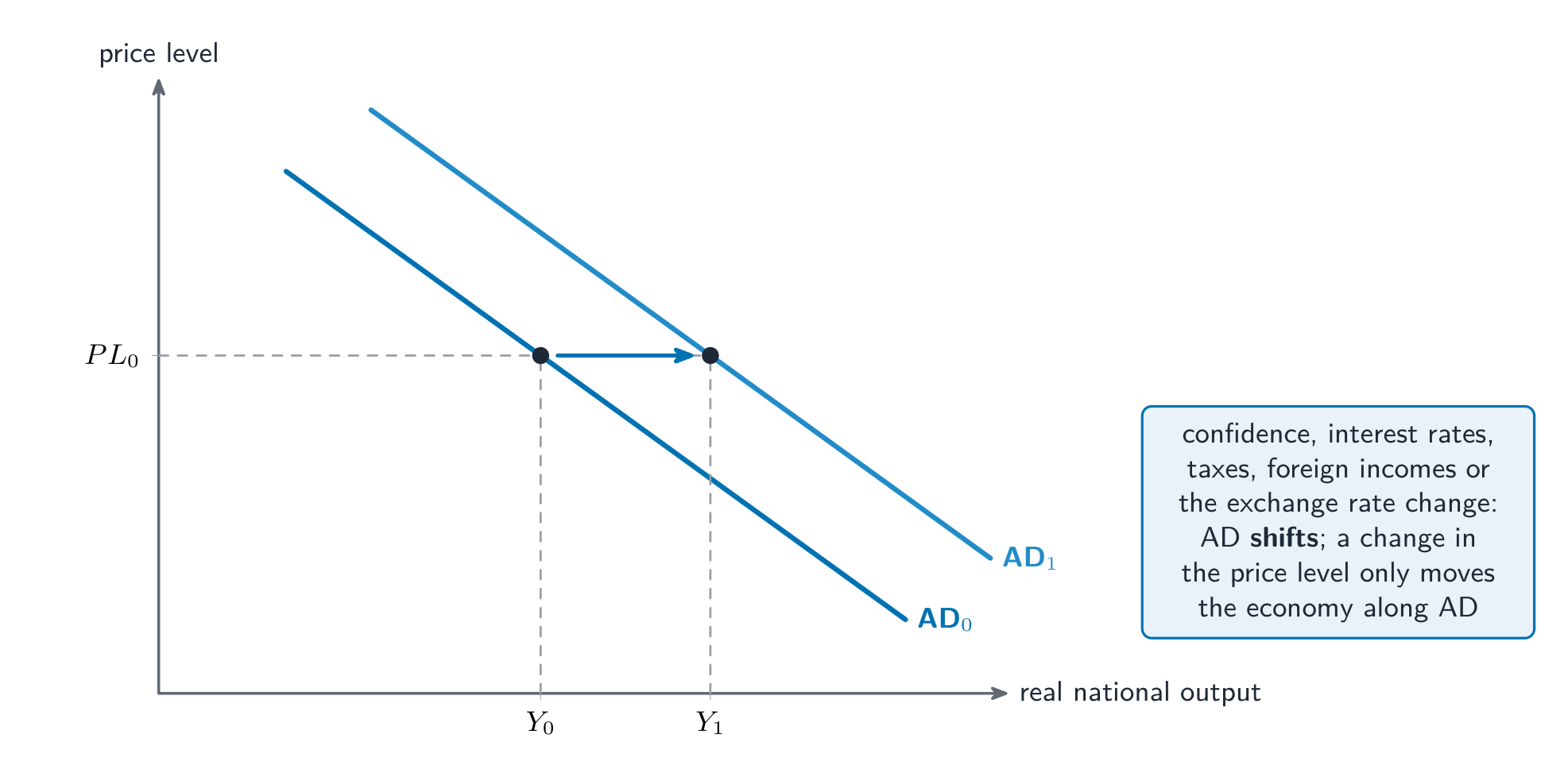
Which changes SHIFT the AD curve to the right?
Difficulty 2/5 · 140 coins + a small bonus on first completion today
A change in the price level is a movement along the curve.
Transfers are not part of G. Pensions and unemployment benefits move money from taxpayers to households but buy no output, so they are not counted in $G$. They affect AD only when the people who receive them spend the money — through $C$.
An increase in state pensions is counted as an increase in G.
Difficulty 1/5 · 100 coins + a small bonus on first completion today
Pensions are transfers; they affect AD through consumption when spent.
Pensions rise by ¥20 bn and pensioners spend 80% of it on domestic goods. By how much does AD rise directly?
Difficulty 2/5 · 140 coins + a small bonus on first completion today
Only the spent part enters $C$: $0.8 \times 20 = ¥16$ bn.
AD is total planned spending on a country's output: C + I + G + (X − M). It slopes down because of wealth, interest-rate and trade effects. A change in the price level moves along AD; a change in a component for any other reason shifts it.
Explain two reasons why a fall in the exchange rate could shift AD to the right.
Trace each effect through X − M.