Tradable pollution permits and property rights
Introduced| English | Meaning |
|---|---|
| cap | A legal limit on the total amount of pollution allowed. |
| tradable pollution permits/ˈtreɪdəbl pəˈluːʃn ˈpɜːmɪts/ | Permits to pollute that firms can buy and sell, under a total cap. |
| property rights/ˈprɒpəti raɪts/ | Recognised rights to use, control, transfer or receive benefits from a resource or asset. |
A market for the right to pollute
- In 2021 China launched a national carbon market covering more than 2,000 power plants, which together emit about 4 billion tonnes of CO₂ a year.
- Each plant needs a permit for every tonne it emits, and permits can be bought and sold.
- The idea: let firms trade, so that pollution is cut wherever cutting it is cheapest.
How tradable permits work
- The government sets a cap 总量上限 on total emissions and issues that many tradable pollution permits 可交易污染许可证.
- A firm that cuts emissions cheaply can sell its spare permits. A firm for which cutting is expensive can buy them.
- The cap fixes the total pollution; trading decides who cuts.
In a permit scheme, what decides the total amount of pollution?
Difficulty 1/5 · 100 coins + a small bonus on first completion today
Total emissions cannot exceed the permits issued.
Worked example: the cheapest way to meet a cap
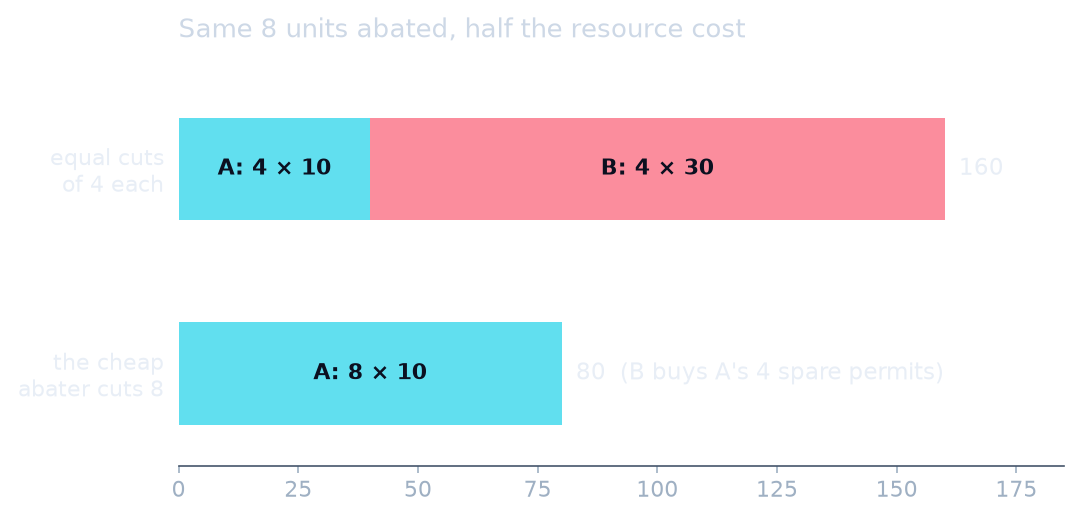
Firms A and B each emit 10 units. The cap is 12, so 8 units must be cut. Cutting one unit costs A ¥10 and B ¥30. Each firm gets 6 permits.
- Equal cuts (4 each): $4 \times 10 + 4 \times 30 = ¥160$.
- With trading: A cuts all 8 for $8 \times 10 = ¥80$ and sells its 4 spare permits to B at ¥20 each.
- Result: the same 8 units are cut for ¥80 instead of ¥160. The ¥80 B pays A is a transfer, not a resource cost.
Trading permits cuts the cost of the cap
A cap of 12 needs 8 units of abatement. Equal cuts of 4 each cost 4 × 10 + 4 × 30 = 160. If A, the cheaper abater, cuts all 8, the cost is 80; A sells its 4 spare permits to B at 20, so 80 changes hands but the resource cost stays 80, not 160.
Cutting a unit costs firm X ¥15 and firm Y ¥45. They must cut 6 units in total. What is the total cost if each cuts 3?
Difficulty 2/5 · 140 coins + a small bonus on first completion today
$3 \times 15 + 3 \times 45 = 45 + 135 = ¥180$.
What is the lowest total cost of cutting those 6 units if the firms can trade permits?
Difficulty 2/5 · 140 coins + a small bonus on first completion today
X, the cheaper firm, cuts all 6: $6 \times 15 = ¥90$.
Strengths
- Pollution is cut at the lowest total cost.
- Firms have a lasting incentive to invest in cleaner technology, because every tonne saved is a permit to sell.
- The government can tighten the cap each year to reduce pollution steadily.
A permit scheme gives firms an incentive to invest in cleaner technology.
Difficulty 1/5 · 100 coins + a small bonus on first completion today
Every tonne a firm stops emitting frees a permit it can sell.
Weaknesses
- If too many permits are issued, their price collapses and nobody needs to cut — as in the EU's market in its early years.
- Measuring each firm's emissions is costly, and firms may move production to countries without a cap.
Which are weaknesses of tradable permits?
Difficulty 2/5 · 140 coins + a small bonus on first completion today
Cutting at the lowest cost is the main strength.
Extending property rights
- Many externalities happen because nobody owns the air, a river or the fish in the sea.
- Property rights 产权 give someone the right to use or protect a resource — for example, fishing quotas that can be traded. Owners then have a reason to look after it, and polluters can be made to pay them.
How can extending property rights reduce over-fishing?
Difficulty 1/5 · 100 coins + a small bonus on first completion today
When a resource is owned, its owner bears the cost of using it up.
A permit market does not let firms "pay to pollute as much as they like". The total is fixed by the cap. Trading changes only who does the cutting, so the environmental result is set by the cap and the cost is minimised by the trade.
Tradable permits cap total pollution and let firms trade, so cuts happen where they are cheapest and firms keep an incentive to invest in clean technology. They fail if the cap is too loose or emissions cannot be measured. Extending property rights gives owners a reason to protect a resource.
Evaluate tradable pollution permits as a way to reduce carbon emissions from power plants.
The cap sets the environmental result; trading sets the cost.