Moral hazard
Introduced| English | Meaning |
|---|---|
| moral hazard/ˈmɒrəl ˈhæzəd/ | Taking bigger risks because someone else will bear the loss. |
| deductible/dɪˈdʌktɪbl/ | The amount an insured person must pay before the insurer pays the rest. |
| too big to fail | When a bank is so large that its collapse would harm the whole economy, so the state rescues it. |
Rescued because it was too big
- In 2008 the American insurer AIG was about to collapse. The US government lent it about $180 billion to stop a wider crisis.
- Rescues like this can save the economy today — but they teach big firms that someone will catch them if they take huge risks.
- That danger is called moral hazard 道德风险.
What moral hazard is
- Moral hazard is when someone takes more risk because they will not bear the full cost if things go wrong.
- It happens after a deal is made, when the other side cannot fully watch behaviour. (Adverse selection happens before.)
Moral hazard occurs when —
Difficulty 1/5 · 100 coins + a small bonus on first completion today
The person shielded from loss changes behaviour after the deal.
Everyday examples
- A student with phone insurance is less careful with the phone.
- A driver with full car insurance may drive less carefully.
- A bank that expects a government rescue may lend to riskier borrowers, because it keeps the profits while taxpayers carry the losses.
Which are examples of moral hazard?
Difficulty 2/5 · 140 coins + a small bonus on first completion today
Sick people buying insurance is adverse selection — hidden information before the deal.
Worked example: why insurers use an excess
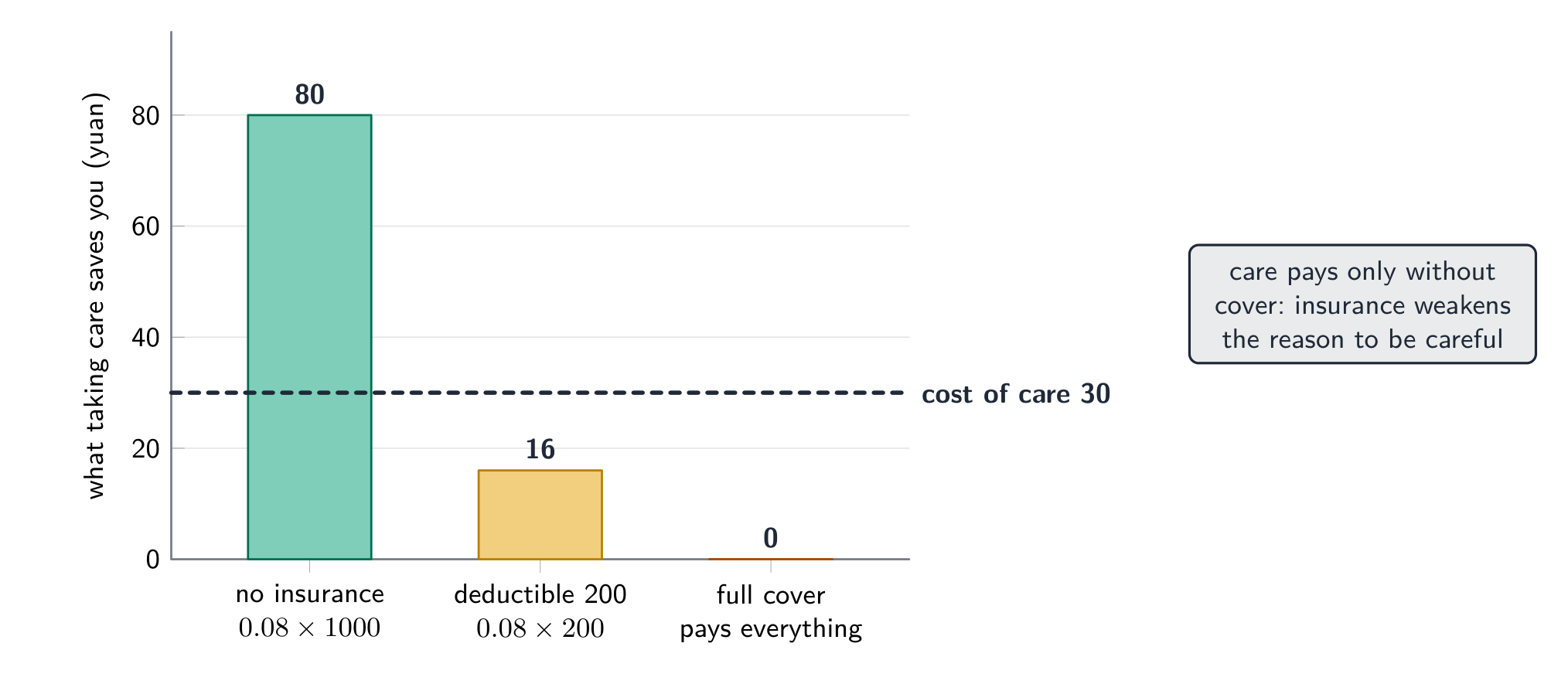
A phone costs ¥3000. Without insurance, a careless drop costs the owner ¥3000. With full insurance it costs ¥0.
- Incentive with full cover: the owner bears none of the loss, so has little reason to take care.
- Add an excess (deductible 免赔额) of ¥500: the owner pays the first ¥500 of every claim.
- Result: the owner still bears a real cost of carelessness, so takes more care, while the insurer still covers the remaining ¥2500.
A laptop worth ¥6000 is insured with an excess of ¥800. It is broken beyond repair. How much does the insurer pay?
Difficulty 2/5 · 140 coins + a small bonus on first completion today
The owner pays the first ¥800, so the insurer pays $6000 - 800 = ¥5200$.
Moral hazard in the financial system
- If large banks believe they are too big to fail 大而不倒, they can take risks with depositors' money: high profits in good times are theirs; losses fall on the state.
- Risky lending can then grow until it causes a financial crisis, harming third parties who never dealt with the bank.
A bank that is "too big to fail" may take more risks because it expects taxpayers to cover big losses.
Difficulty 1/5 · 100 coins + a small bonus on first completion today
Profits stay with the bank while losses fall on the state — a classic moral hazard.
Do not confuse moral hazard with adverse selection. Adverse selection: hidden information before the deal changes who buys (the riskiest people buy insurance). Moral hazard: hidden action after the deal changes how people behave (insured people take less care).
Match each case to the concept.
Difficulty 2/5 · 140 coins + a small bonus on first completion today
Before the deal, hidden information; after the deal, hidden action.
Reducing moral hazard
- Insurance: excesses, no-claims discounts and higher premiums after claims keep part of the cost with the insured.
- Banks: higher capital requirements, so shareholders lose first, and rules that let failing banks close without taxpayer rescue.
Which policy most directly reduces moral hazard among banks?
Difficulty 1/5 · 100 coins + a small bonus on first completion today
More capital means shareholders lose first, so banks bear more of the cost of their own risks.
Moral hazard is extra risk-taking by people or firms that do not bear the full cost of failure. It arises after insurance or a rescue promise, and it can cause financial crises. Excesses, no-claims discounts and capital rules keep part of the cost with the risk-taker.
Explain how a government rescue of a failing bank can lead to moral hazard in the future.
The key is the changed incentive after the rescue.