Signalling, incentive and rationing
Introduced| English | Meaning |
|---|---|
| price mechanism/praɪs ˈmekənɪzəm/ | The way prices signal scarcity and influence the allocation of resources through demand and supply. |
| signal/ˈsɪɡnl/ | Information, such as price changes, that guides decisions about buying, selling and allocating resources. |
| incentive/ɪnˈsentɪv/ | A reward, penalty or other influence that encourages a particular action or choice. |
| ration/ˈræʃn/ | To share out a scarce good among the people who want it. |
| rationing by price/ˈræʃənɪŋ baɪ praɪs/ | Sharing out a scarce good to those willing and able to pay its price. |
When shipping a box cost ten times more
- In 2021 the price of shipping one container from Shanghai to Europe rose to more than five times its usual level.
- Shipping lines responded by ordering a record number of new container ships.
- Nobody ordered them to. The high price did the job. That is the price mechanism 价格机制 at work.
Function 1: signalling
- A rising price is a signal 信号 that a good is scarce and that buyers value it highly.
- A falling price signals a surplus: resources should move elsewhere.
- Prices carry this information to millions of buyers and sellers at once, for free.
The price of lithium falls sharply. What does this signal to producers?
Difficulty 1/5 · 100 coins + a small bonus on first completion today
A falling price signals excess supply.
Function 2: incentive
- A higher price raises expected profit, which gives firms an incentive 激励 to supply more.
- Buyers get an incentive too: to use less, or to find substitutes.
A higher price gives buyers an incentive to use less of a good.
Difficulty 1/5 · 100 coins + a small bonus on first completion today
The incentive works on both sides of the market.
Worked example: a farmer's incentive
A farmer expects to sell her crop for ¥6000. Growing it costs ¥4500.
- Expected profit before $= 6000 - 4500 = ¥1500$.
- The market price rises, so expected revenue becomes ¥7000 while costs stay at ¥4500.
- Expected profit after $= 7000 - 4500 = ¥2500$. The extra ¥1000 is her incentive to plant more next season.
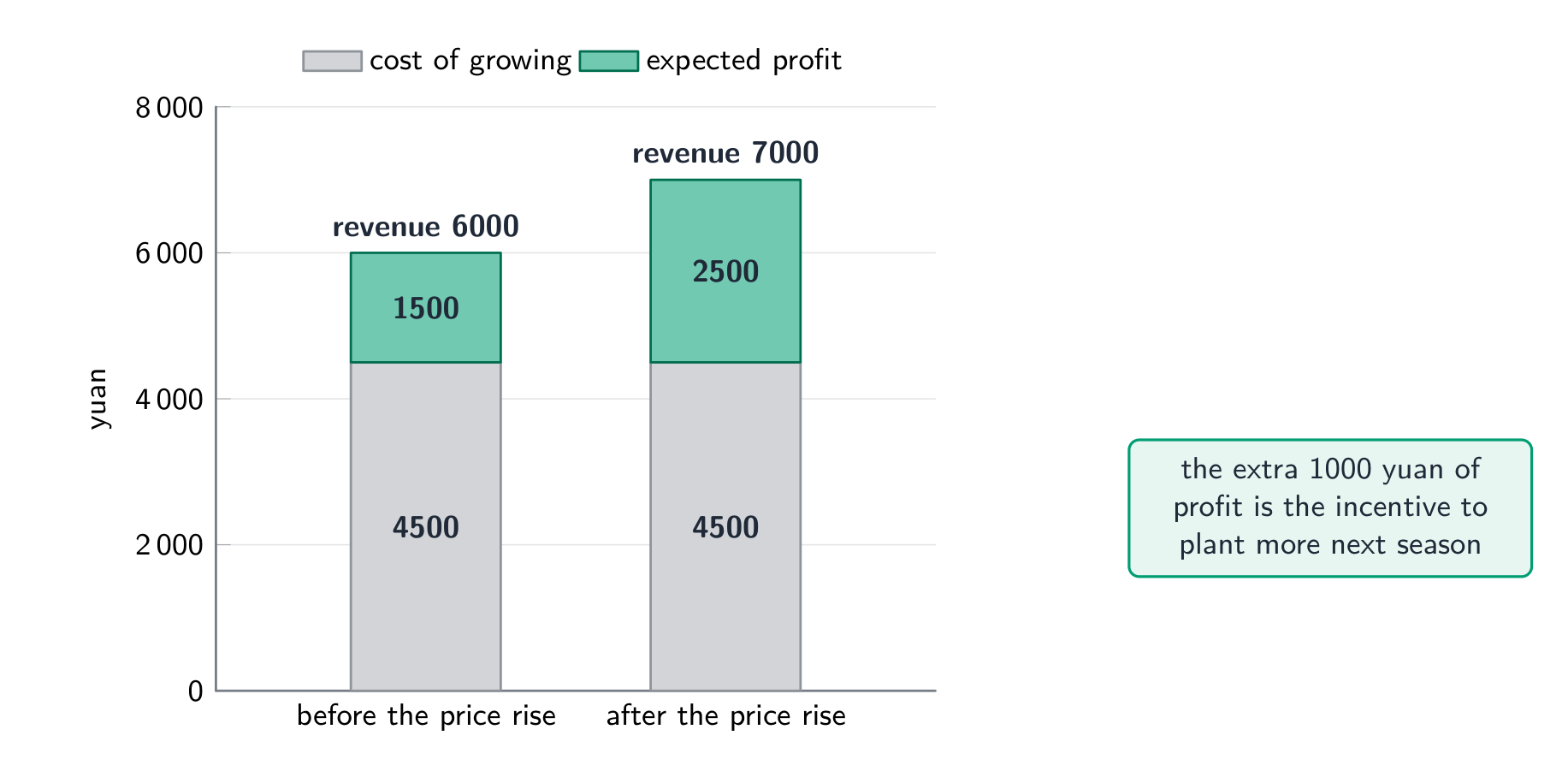
A higher price raises expected profit
Expected revenue 6000 against cost 4500 gives profit 1500. If the price rise lifts expected revenue to 7000 with cost unchanged, profit becomes 2500, an incentive to grow more next season.
Expected revenue falls from ¥7000 to ¥5000 while costs stay at ¥4500. What is the new expected profit?
Difficulty 2/5 · 140 coins + a small bonus on first completion today
$5000 - 4500 = ¥500$: a weaker incentive, so the farmer may plant less.
Function 3: rationing
- When a good is scarce, a higher price rations 配给 it: only buyers who value it most, and can pay, still buy.
- Rationing by price 价格配给 replaces queues or coupons. During the shipping crisis, firms with the most valuable cargo paid to ship first.
Match each event to the function of the price mechanism.
Difficulty 2/5 · 140 coins + a small bonus on first completion today
Signal, incentive and rationing are the three functions.
Rationing by price is efficient but not always fair. It gives a good to those willing and able to pay, and ability to pay depends on income. A rich person's wish for a second car can outbid a poor family's need for medicine. That is one reason governments sometimes intervene.
Why might rationing by price be considered unfair?
Difficulty 1/5 · 100 coins + a small bonus on first completion today
Willingness AND ability to pay decide who gets the good.
Local, national and global markets
- The price mechanism works in a local market (a town's vegetable market), a national market (housing in one country) and a global market (oil, shipping, copper).
- In global markets one event — a blocked canal, a war, a drought — changes prices, and so behaviour, around the world.
Which is the best example of a global market?
Difficulty 1/5 · 100 coins + a small bonus on first completion today
Crude oil is traded worldwide, so its price links buyers and sellers in many countries.
Price does three jobs. It signals where goods are scarce, gives firms and buyers an incentive to respond, and rations scarce goods to those willing and able to pay. These jobs coordinate local, national and global markets without a planner — but not always fairly.
Use the functions of the price mechanism to explain how the shipping market responded to high prices in 2021.
Name the function, then show it in the case — application earns the marks.