Carrying out practicals and judging measurements
Introduced 7:22
Unit 6: Practical Skills in Biology II
Unit 6 is the last Biology paper, and it looks like no other. One question hands you a half-complete statistics table; another asks you to plan a whole…
English narration · English and 中文 subtitles you can switch
In this lesson
| English | Meaning |
|---|---|
| tidal volume/ˈtaɪdl ˈvɒljuːm/ | The volume of air breathed in or out in a normal breath. |
How much oxygen does a seed use?
- A germinating pea uses far less than 1 cm³ of oxygen in an hour. To measure it, you need clever apparatus and careful reading.
- Unit 6 asks how you would carry out the core practicals, and how good your measurements really are.
The respirometer (core practical 16)
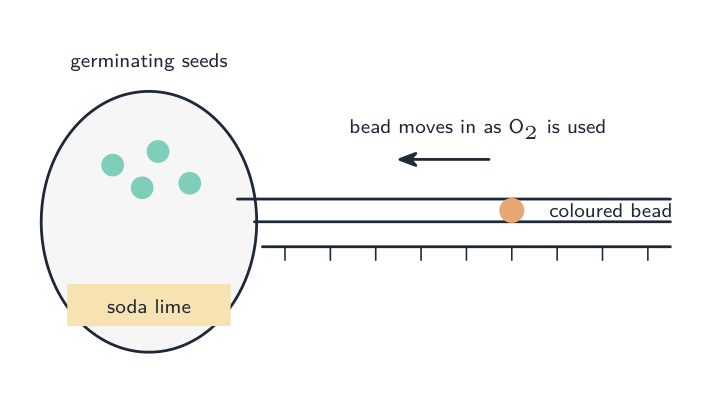
- Organisms sit in a sealed tube above soda lime, which absorbs carbon dioxide. As they use oxygen, the gas volume falls and the coloured liquid moves along the scale.
- A control tube with glass beads of the same volume instead of seeds shows changes caused by temperature or pressure.
What is the job of the soda lime in a respirometer?
Difficulty 1/5 · 100 coins + a small bonus on first completion today
With CO₂ removed, only oxygen uptake changes the gas volume.
From distance to volume
- Volume of oxygen used = π r² × distance moved, where r is the radius of the capillary tube.
- Divide by time and by the mass of organisms to compare rates fairly.
Worked example. The liquid moves 24 mm in 10 minutes. The tube has a radius of 0.5 mm. The seeds have a mass of 5 g.
- Volume = 3.14 × 0.5² × 24 = 18.8 mm³ of oxygen.
- Rate = 18.8 ÷ 10 ÷ 5 = 0.38 mm³ per minute per gram.
The liquid moves 40 mm in a tube of radius 0.5 mm. What volume of oxygen was used, in mm³? Use π = 3.14.
Difficulty 2/5 · 140 coins + a small bonus on first completion today
3.14 × 0.5² × 40 = 31.4 mm³.
The spirometer (core practical 17)
- A spirometer trace shows tidal volume 潮气量 (the height of one breath) and breathing rate (breaths per minute). Minute ventilation = tidal volume × breathing rate.
- The trace slopes down over time because soda lime absorbs the carbon dioxide breathed out; the slope gives oxygen uptake.
Tidal volume is 0.5 dm³ and the breathing rate is 16 breaths per minute. What is the minute ventilation in dm³ per minute?
Difficulty 2/5 · 140 coins + a small bonus on first completion today
0.5 × 16 = 8 dm³ per minute.
Judging your measurements
- Accuracy: how close a reading is to the true value. Precision: how close repeated readings are to each other.
- Uncertainty is usually half the smallest scale division. A larger measurement on the same scale has a smaller percentage uncertainty.
Match each term to its meaning.
Difficulty 2/5 · 140 coins + a small bonus on first completion today
Results can be precise but not accurate.
Errors and how to reduce them
- Random errors make repeats spread out (for example judging a colour change by eye); reduce them with more repeats and objective methods such as a colorimeter.
- Systematic errors shift every reading the same way (for example a balance that reads 0.2 g with nothing on it); find them with a control or calibration.
Match each problem to the type of error.
Difficulty 2/5 · 140 coins + a small bonus on first completion today
Systematic errors shift every reading the same way.
More repeats make results more reliable, not more accurate. Repeats reduce the effect of random error. They cannot remove a systematic error, which shifts every reading by the same amount.
Repeating a measurement many times removes systematic error.
Difficulty 1/5 · 100 coins + a small bonus on first completion today
Use a control or calibration to find systematic error.
A respirometer measures oxygen uptake: soda lime absorbs CO₂, volume = π r² × distance, and a control tube corrects for temperature and pressure. A spirometer gives tidal volume, breathing rate and minute ventilation. Accuracy is closeness to the true value, precision is closeness of repeats. Repeats reduce random error; calibration and controls deal with systematic error.
Explain why a respirometer experiment uses a control tube with glass beads instead of seeds.
Say what the control detects and how it is used.
What went wrong? Only the site team sees this.