Acids with metals: choose the salt and hydrogen products
Introduced| English | Meaning |
|---|---|
| salt/sɒlt/ | An ionic compound formed when hydrogen ions in an acid are replaced by metal ions or other positive ions. |
| iron(II) salt/ˈaɪən sɒlt/ | A salt containing Fe²⁺ ions; aqueous iron(II) salt solutions are often pale green under the stated conditions. |
Filling balloons in 1783
- The first hydrogen balloon, launched in Paris in 1783, was filled by pouring sulfuric acid over about 500 kg of iron scrap.
- Metals above hydrogen in the reactivity series react with acids to make hydrogen and a salt 盐.
The general equation
- metal + acid → salt + hydrogen.
- The salt is named from the metal and the acid: hydrochloric → chloride, sulfuric → sulfate, nitric → nitrate.
Metal + acid → salt + ____.
Difficulty 1/5 · 100 coins + a small bonus on first completion today
The gas from the acid.
Naming the salt
- Magnesium + hydrochloric acid → magnesium chloride + hydrogen: $\text{Mg} + 2\text{HCl} \rightarrow \text{MgCl}_2 + \text{H}_2$.
- Zinc + sulfuric acid → zinc sulfate + hydrogen: $\text{Zn} + \text{H}_2\text{SO}_4 \rightarrow \text{ZnSO}_4 + \text{H}_2$.
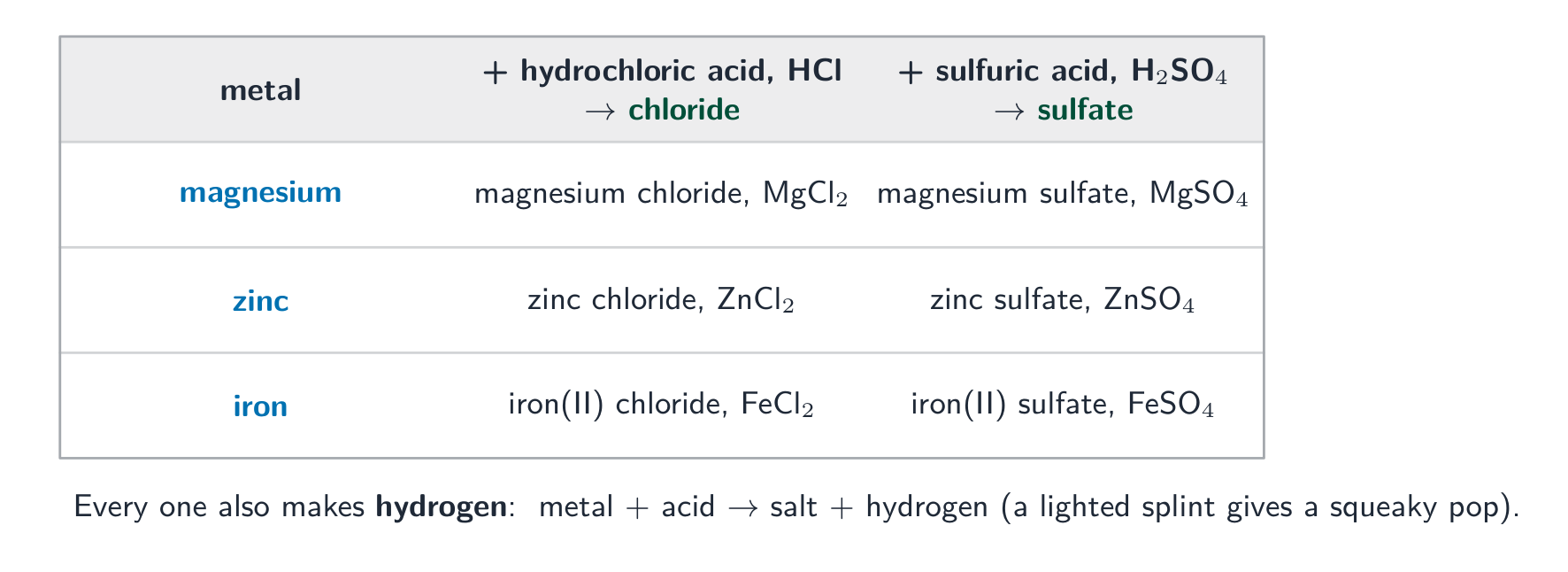
Name the salt formed.
Difficulty 2/5 · 140 coins + a small bonus on first completion today
Metal name + acid ending.
Worked example: iron and hydrochloric acid
Write and balance the equation for iron reacting with hydrochloric acid to form an iron(II) salt 亚铁盐.
- Salt: iron(II) chloride, FeCl₂ (Fe²⁺ needs two Cl⁻).
- Unbalanced: $\text{Fe} + \text{HCl} \rightarrow \text{FeCl}_2 + \text{H}_2$.
- Balanced: $\text{Fe} + 2\text{HCl} \rightarrow \text{FeCl}_2 + \text{H}_2$ — 1 Fe, 2 H, 2 Cl on each side.
A metal and an acid give a salt and hydrogen
Fe + 2HCl → FeCl₂ + H₂ balances one Fe, two Cl and two H on each side. Iron chloride is the salt; the gas is hydrogen.
In $\text{Mg} + x\text{HCl} \rightarrow \text{MgCl}_2 + \text{H}_2$, what is $x$?
Difficulty 2/5 · 140 coins + a small bonus on first completion today
Two Cl and two H are needed.
What is the formula of zinc chloride (Zn²⁺)?
Difficulty 1/5 · 100 coins + a small bonus on first completion today
Two Cl⁻ balance Zn²⁺.
Testing for hydrogen
- Hold a lit splint at the mouth of the tube: hydrogen burns with a squeaky pop.
- More reactive metals fizz faster; copper gives no bubbles at all.
What is the test for hydrogen?
Difficulty 1/5 · 100 coins + a small bonus on first completion today
Hydrogen burns with a pop.
Copper reacts with dilute hydrochloric acid to make hydrogen.
Difficulty 1/5 · 100 coins + a small bonus on first completion today
Copper is below hydrogen.
The hydrogen gas comes from the acid, not the metal. The metal stays in the salt. That is why copper, which cannot take the place of hydrogen, makes no gas.
Metals above hydrogen react with dilute acids to make a salt and hydrogen gas, which gives a squeaky pop. Name the salt from the metal and the acid (chloride, sulfate, nitrate), and balance the equation.
Write a word equation and a balanced symbol equation for zinc reacting with hydrochloric acid, and describe one observation.
Salt + hydrogen.