Higher Tier, Chemistry-only: titration concentrations follow the equation ratio
Introduced| English | Meaning |
|---|---|
| titre/ˈtɪtə/ | The volume of solution added from the burette in a titration: end reading minus start reading. |
| end-point/end pɔɪnt/ | The point in a titration where the indicator just changes colour permanently. |
Checking the drain cleaner
- A quality-control chemist must check that each batch of sodium hydroxide drain cleaner has the right concentration.
- She measures exactly 25.0 cm³ with a pipette and adds sulfuric acid of known concentration from a burette until it is just neutralised.
- This is a titration. This lesson is Higher Tier.
Titre and end-point
- The end-point 滴定终点 is when the indicator just changes colour: the acid has exactly reacted with the alkali.
- The titre 滴定体积 is the volume added from the burette: final reading minus initial reading.
A burette reads 1.20 cm³ at the start and 23.70 cm³ at the end-point. What is the titre?
Difficulty 2/5 · 140 coins + a small bonus on first completion today
$23.70 - 1.20 = 22.50$ cm³.
The calculation
- 1. Moles of the known solution $= c \times V$ (V in dm³).
- 2. Use the equation ratio to find moles of the other solution.
- 3. Concentration $= \dfrac{\text{moles}}{V}$.
How many moles of HCl are in 20.0 cm³ of 0.150 mol/dm³ HCl?
Difficulty 2/5 · 140 coins + a small bonus on first completion today
$0.150 \times 0.0200 = 0.00300$ mol.
Worked example: finding the NaOH concentration
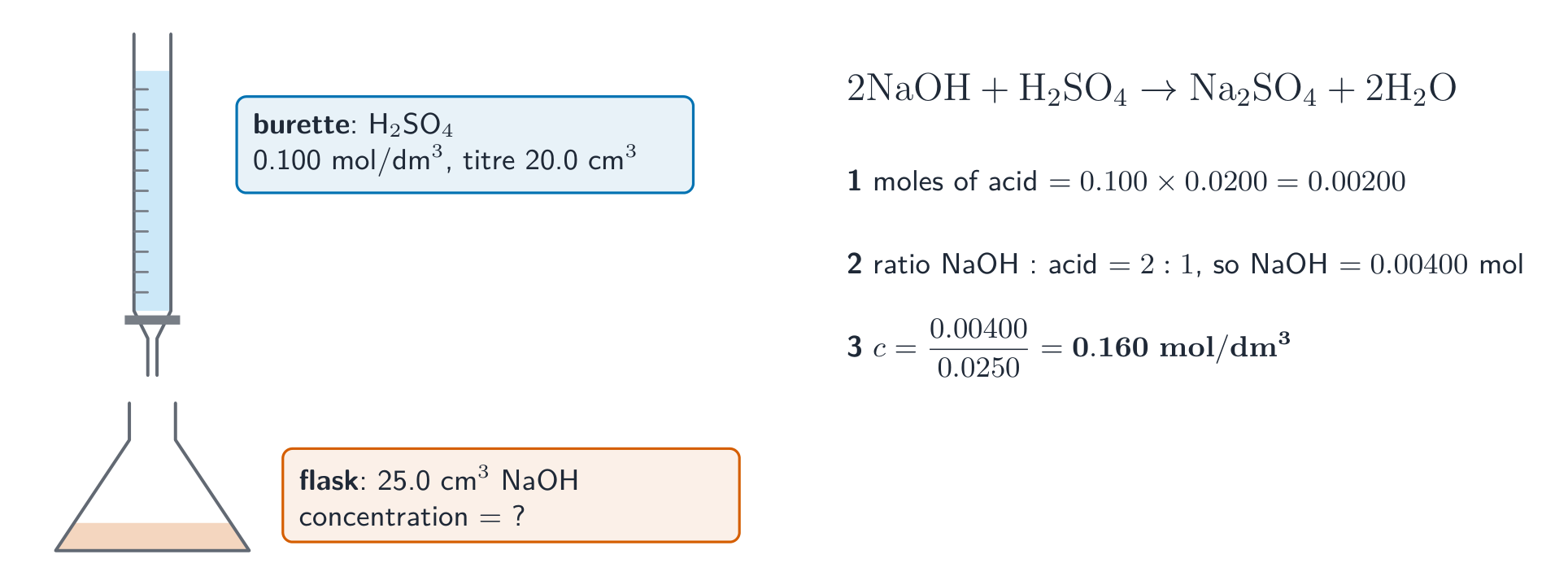
25.0 cm³ of NaOH needs a titre of 20.0 cm³ of 0.100 mol/dm³ H₂SO₄. $2\text{NaOH} + \text{H}_2\text{SO}_4 \rightarrow \text{Na}_2\text{SO}_4 + 2\text{H}_2\text{O}$
- Moles of acid $= 0.100 \times 0.0200 = 0.00200$ mol.
- Ratio 2 : 1, so moles of NaOH $= 0.00400$ mol.
- Concentration $= \dfrac{0.00400}{0.0250} = 0.160 \, \dfrac{\text{mol}}{\text{dm}^3}$.
Readings, mole ratio and the original concentration
$V_{titre}=V_f-V_i,\quad n=cV$
Use both burette readings and the equation ratio. Added water dilutes the flask sample but leaves its solute amount unchanged.
25.0 cm³ of NaOH is neutralised by 20.0 cm³ of 0.150 mol/dm³ HCl. $\text{NaOH} + \text{HCl} \rightarrow \text{NaCl} + \text{H}_2\text{O}$. What is the NaOH concentration?
Difficulty 2/5 · 140 coins + a small bonus on first completion today
0.00300 mol ÷ 0.0250 dm³ = 0.120.
25.0 cm³ of NaOH needs 12.5 cm³ of 0.100 mol/dm³ H₂SO₄. What is the NaOH concentration?
Difficulty 2/5 · 140 coins + a small bonus on first completion today
0.00125 mol acid × 2 = 0.00250 mol NaOH; ÷ 0.0250 = 0.100.
Water in the flask
- Rinsing the flask with water, or adding water to see the colour, does not change the moles of alkali in it.
- So the titre stays the same: only the moles from the pipette matter.
Adding 20 cm³ of water to the conical flask increases the titre needed.
Difficulty 1/5 · 100 coins + a small bonus on first completion today
The moles of alkali are unchanged.
Equal volumes do not mean equal amounts. Sulfuric acid has two H⁺ for every molecule, so it reacts with twice as many moles of NaOH. Always use the ratio from the balanced equation.
Why does 0.10 mol/dm³ H₂SO₄ neutralise twice as much NaOH as 0.10 mol/dm³ HCl of the same volume?
Difficulty 1/5 · 100 coins + a small bonus on first completion today
Use the balanced equation.
In a titration, find the moles of the known solution from $c \times V$, use the balanced equation's ratio to get the moles of the other, then divide by its volume in dm³ to find its concentration.
A 25.0 cm³ sample of KOH needs 18.0 cm³ of 0.200 mol/dm³ HNO₃ ($\text{KOH} + \text{HNO}_3 \rightarrow \text{KNO}_3 + \text{H}_2\text{O}$). Calculate the KOH concentration.
Three steps.