Higher Tier, Chemistry-only: choose a reaction pathway from several criteria
Introduced| English | Meaning |
|---|---|
| reaction pathway/rɪˈækʃn ˈpæθweɪ/ | The route of steps that turns starting materials into a product. |
| trade-off/treɪd ɒf/ | A choice that involves giving up some benefit or objective to gain another. |
Two routes to the same product
- Ethanol can be made from ethene and steam (100% atom economy, fast, but uses crude oil) or by fermenting sugar (51% atom economy, slow, but renewable).
- Neither route is best at everything. Choosing a reaction pathway 反应路线 means weighing several factors.
- This lesson is Higher Tier.
What chemists compare
- Atom economy and percentage yield.
- Rate of reaction, and equilibrium position if it is reversible.
- Cost and energy: temperature, pressure, raw materials, and whether by-products can be sold.
Which factors are compared when choosing a reaction pathway?
Difficulty 2/5 · 140 coins + a small bonus on first completion today
Colour does not affect the choice.
Multiply the percentages
- Atom economy sets the most product possible; yield sets how much of that you collect.
- Overall fraction $= \text{atom economy} \times \text{yield}$.
A route has 90% atom economy and 70% yield. What overall percentage of the reactant mass becomes product?
Difficulty 2/5 · 140 coins + a small bonus on first completion today
$0.90 \times 0.70 = 0.63$.
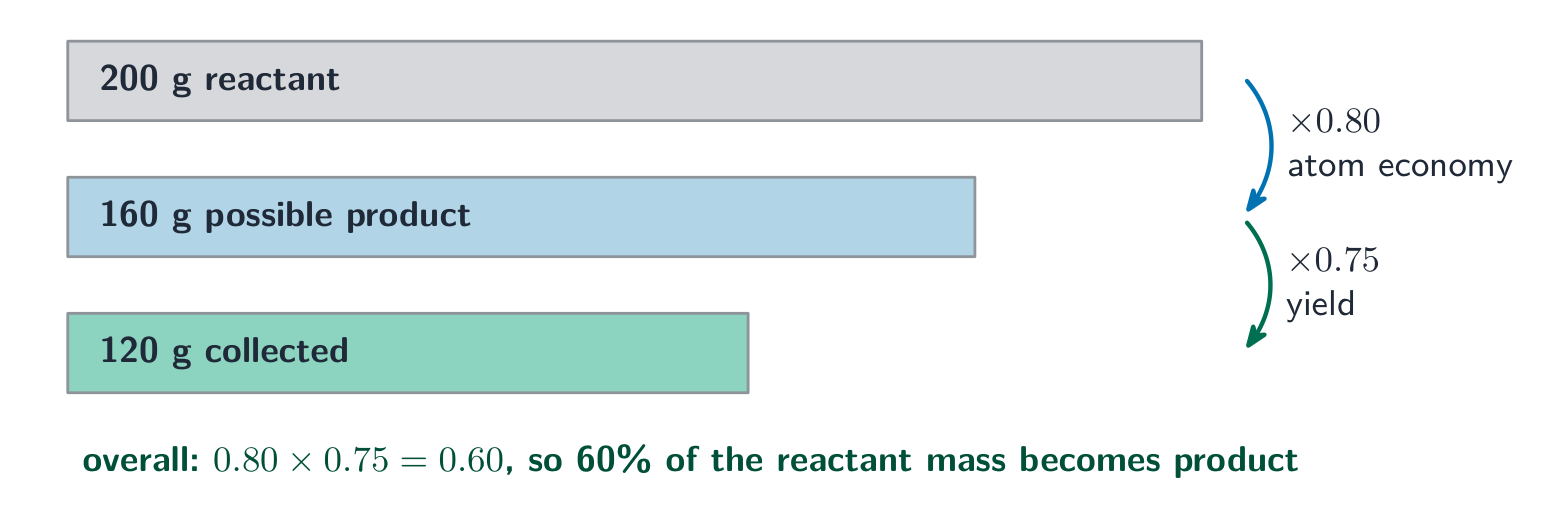
Worked example: combined efficiency
200 g of reactant. The route has 80% atom economy and a 75% yield.
- Possible product $= 200 \times 0.80 = 160$ g.
- Collected $= 160 \times 0.75 = 120$ g.
- Overall $= \dfrac{120}{200} \times 100 = 60\%$ of the reactant mass ends up as product.
Atom economy and recovery multiply
200 g of reactant at 80% atom economy can give 160 g of the wanted product; recovering 75% of that gives 120 g. The percentages multiply: 200 × 0.80 × 0.75 = 120 g, 60% overall.
500 g of reactant, 60% atom economy and 50% yield. What mass of product is collected?
Difficulty 2/5 · 140 coins + a small bonus on first completion today
$500 \times 0.60 \times 0.50 = 150$ g.
Making a justified choice
- Every choice involves a trade-off 权衡: a faster route may need more energy; a greener one may be slower.
- A good answer compares numbers, then states which factor matters most for this product and why.
A by-product that can be sold makes a low atom economy route more attractive.
Difficulty 1/5 · 100 coins + a small bonus on first completion today
Its atoms are no longer wasted.
Gaining one advantage while accepting a disadvantage is called a trade-____.
Difficulty 1/5 · 100 coins + a small bonus on first completion today
Every pathway choice involves one.
Highest atom economy is not automatically the best route. A route with 100% atom economy but a 20% yield gives less product than one with 60% atom economy and a 90% yield ($0.6 \times 0.9 = 54\%$).
Route A: 100% atom economy, 30% yield. Route B: 60% atom economy, 80% yield. Which gives more product?
Difficulty 1/5 · 100 coins + a small bonus on first completion today
Multiply the two percentages.
Choose a reaction pathway by comparing atom economy, yield, rate, equilibrium, cost, energy and the value of by-products. Multiply atom economy by yield to find the overall fraction of reactant mass that becomes product, then justify which factor is most important.
Evaluate making ethanol by hydration of ethene versus fermentation of sugar.
Weigh several criteria.