Introduction to Agriculture
Introduced 8:32
Agriculture and Rural Land-Use Patterns and Processes
Two farmers. The same job: grow food. Completely different worlds. One drives a machine across a field so wide you cannot see the end of it, and every grain…
English narration · English and 中文 subtitles you can switch
In this lesson
| English | Meaning |
|---|---|
| agriculture/ˈæɡrɪkʌltʃə/ | The deliberate growing of crops and raising of animals. |
| subsistence agriculture/sʌbˈsɪstəns ˈæɡrɪkʌltʃə/ | Farming primarily to feed the producer's household or local community rather than to supply commercial markets. |
| commercial agriculture/kəˈmɜːʃl ˈæɡrɪkʌltʃə/ | Farming primarily to sell products in markets rather than mainly to feed the producer's own household. |
| intensive/ɪnˈtensɪv/ | Describing agriculture using relatively high inputs of labour, capital or other resources per unit of land. |
| extensive/ekˈstensɪv/ | Describing agriculture using relatively low inputs of labour or capital per unit of land, often over large areas. |
Why rice in Guangdong, wheat in Henan?
- Farmers in Guangdong grow rice in flooded paddies, often two crops a year. Farmers in Henan, about 1,000 km to the north, grow winter wheat and maize. The difference starts with physical geography: Guangdong is warm and wet all year; Henan has cold, dry winters.
- Agriculture 农业 is the deliberate growing of crops and raising of animals. Where and how it is done depends on climate, soil and terrain, and on the farmer's purpose and resources.
Physical factors
| Factor | How it shapes farming | Example |
|---|---|---|
| Climate | temperature and rainfall decide which crops grow and how many harvests a year | rice needs heat and lots of water; wheat tolerates cooler, drier conditions |
| Soil | fertile soils support crops; poor soils may only support grazing | rich loess and river soils of the North China Plain |
| Terrain | flat land is easier to plough and irrigate; steep slopes need terraces or are used for grazing | terraced rice in Yunnan; sheep on hill pastures in Wales |
| Water | irrigation lets farming happen in dry places | cotton in Xinjiang using mountain meltwater |
Match each farming practice to the physical factor it responds to.
Difficulty 2/5 · 140 coins + a small bonus on first completion today
Farmers adapt to climate, soil, terrain and water.
Purpose: subsistence or commercial
- Subsistence agriculture 自给农业: farmers grow food mainly to feed their own families; little is sold. Common in less developed regions.
- Commercial agriculture 商业农业: farmers grow crops or raise animals to sell for profit, often on large, mechanised farms linked to distant markets.
A family grows rice and eats almost all of it. What type of agriculture is this?
Difficulty 1/5 · 100 coins + a small bonus on first completion today
Food is grown mainly for the family.
Inputs: intensive or extensive
- Intensive 集约 farming puts much labour or capital (money, machines, fertiliser) on a small area and gets high output per hectare: market gardening, wet-rice paddies, plantations, mixed crop and livestock farms.
- Extensive 粗放 farming puts little labour or capital over a large area and gets low output per hectare: shifting cultivation, nomadic herding, ranching. Expensive land near cities usually pushes farming towards intensive use.
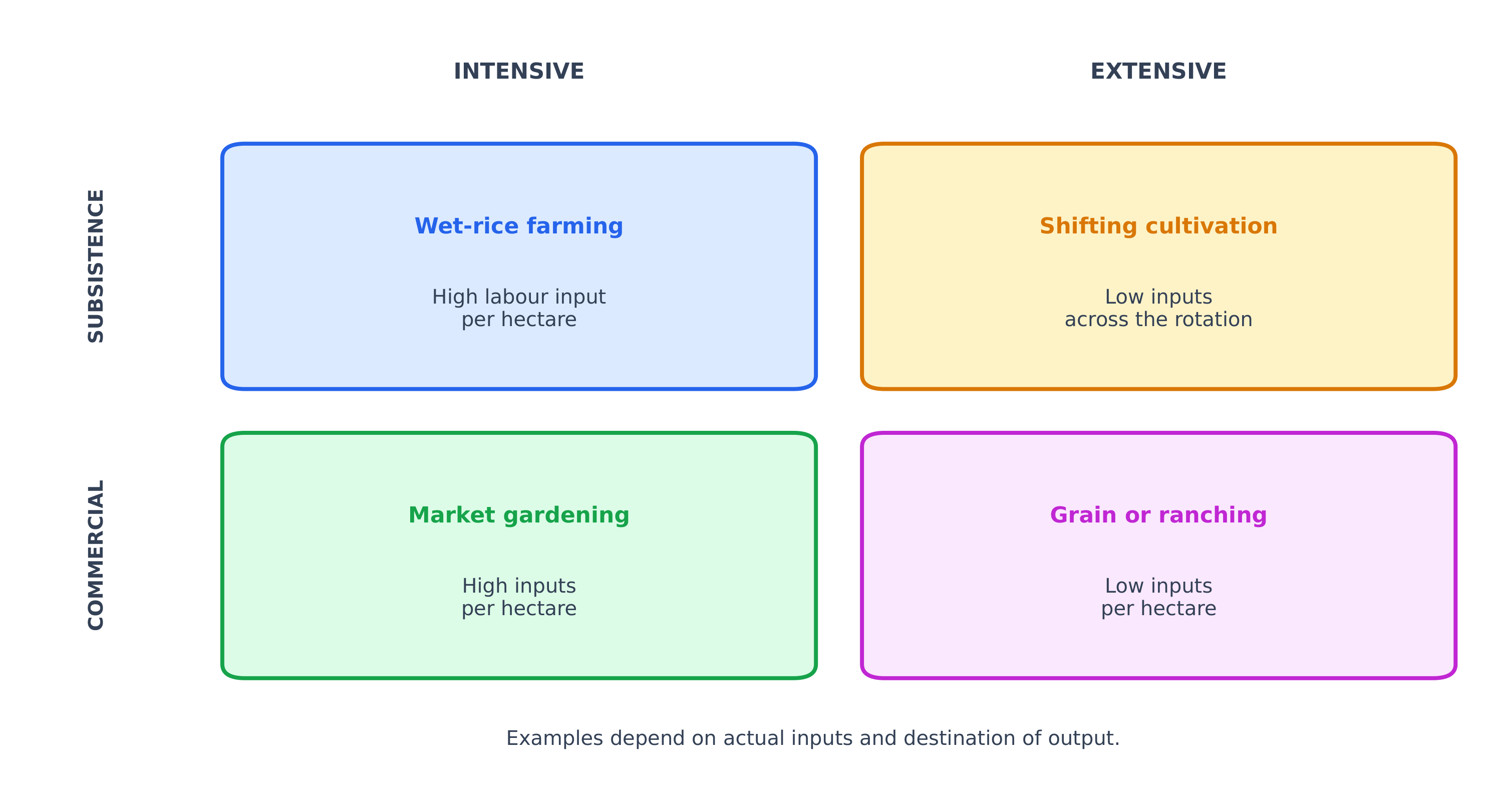
Intensive or extensive?
Sort each farm by its intensity.
Match each practice to intensive or extensive.
Difficulty 2/5 · 140 coins + a small bonus on first completion today
Inputs per hectare decide the type.
Expensive land near cities tends to push farmers towards intensive farming.
Difficulty 1/5 · 100 coins + a small bonus on first completion today
High land costs must be covered by high output per hectare.
Worked FRQ answer
(A) Identify ONE physical factor that influences what crops are grown. Climate, especially temperature and rainfall.
(B) Explain why wet-rice farming is concentrated in South and East Asia. Rice paddies need high temperatures and large amounts of water; monsoon rains and river floodplains in these regions provide both, and dense populations supply the labour that the intensive method requires.
(C) Explain why ranching is an extensive form of agriculture. Cattle graze over very large areas with few workers and little investment per hectare, so output per hectare is low.
- Why it scores: (B) links a physical requirement to the region and adds a human factor (labour); (C) uses the definition of extensive.
Intensive vs extensive is about inputs per hectare, not farm size alone. A large plantation can still be intensive if it uses much labour and capital per hectare.
Agriculture is shaped by physical factors: climate, soil, terrain and water. By purpose it is subsistence or commercial; by inputs per hectare it is intensive (market gardening, wet rice, plantations, mixed farming) or extensive (shifting cultivation, nomadic herding, ranching).
FRQ practice. (A) Describe ONE difference between subsistence and commercial agriculture. (B) Explain how climate influences agriculture in ONE region you know.
Purpose and environment together explain farming.
What went wrong? Only the site team sees this.