Connecting Limits at Infinity and Horizontal Asymptotes
Introduced 16:31
Limits & Continuity
Start with a puzzle. A car's speedometer reads sixty kilometres per hour. But what does that mean at a single instant? Speed is distance over time. Yet in one…
English narration · English and 中文 subtitles you can switch
In this lesson
| English | Meaning |
|---|---|
| end behavior/end bɪˈheɪvjə/ | The way a function behaves as its input becomes very large positively or negatively. |
| limits at infinity/ˈlɪmɪts æt ɪnˈfɪnɪti/ | Values or behaviours a function approaches as its input increases or decreases without bound. |
| horizontal asymptote/ˌhɒrɪˈzɒntl ˈæsɪmptəʊt/ | A horizontal line approached by a function as its input tends to positive or negative infinity. |
Zoom out: what happens far away?
- Now let $x$ run off to $+\infty$ or $-\infty$. $\displaystyle\lim_{x\to\infty}f(x)=L$ says $f$ settles toward $L$: these are limits at infinity 无穷远处的极限.
- They describe the end behavior 末端行为 of a graph: its shape far left and far right.
Race of the highest powers
- For a rational function, compare the degrees of top and bottom. Bottom higher → $0$. Equal → ratio of leading coefficients. Top higher → $\pm\infty$.
- To show it, divide every term by the highest power in the denominator; each $\tfrac{1}{x^n}\to0$.
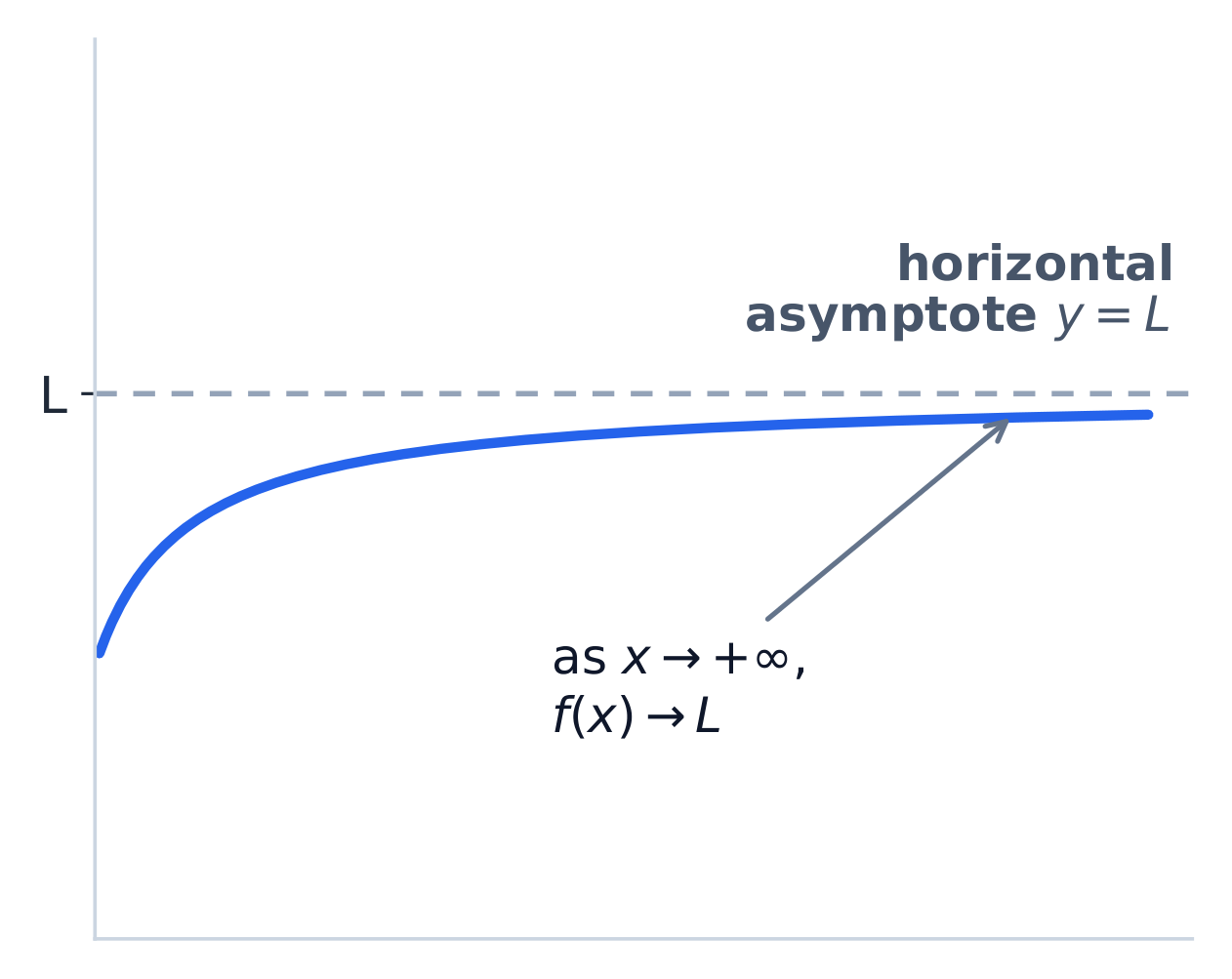
A horizontal asymptote y = L: f approaches L as x grows without bound
A curve that flattens far out
y = a / (x − b) + d
Slide $x$ toward the edges — a reciprocal-type curve flattens toward a horizontal asymptote as $x\to\pm\infty$.
What is $\displaystyle\lim_{x\to\infty}\dfrac{x}{x^2+1}$?
Difficulty 1/5 · 100 coins + a small bonus on first completion today
Denominator degree is higher, so the fraction shrinks to $0$.
Select all rational functions with horizontal asymptote $y=0$.
Difficulty 2/5 · 140 coins + a small bonus on first completion today
Denominator degree higher → $y=0$. The third ties in degree, giving $y=3$ instead.
Find $\displaystyle\lim_{x\to\infty}\dfrac{2x^2-3x}{5x^2+7}$.
- Degrees tie. Divide by $x^2$: $\dfrac{2-\tfrac3x}{5+\tfrac7{x^2}}\to\dfrac25$.
- So $y=\tfrac25$ is a horizontal asymptote 水平渐近线.
Evaluate $\displaystyle\lim_{x\to\infty}\dfrac{3x^2+1}{x^2-5}$.
Difficulty 2/5 · 140 coins + a small bonus on first completion today
Equal degrees → ratio of leading coefficients $\frac31=3$.
A finite limit at infinity, $\lim_{x\to\infty}f(x)=L$, gives a ____ asymptote $y=L$.
Difficulty 1/5 · 100 coins + a small bonus on first completion today
The graph flattens toward $y=L$.
The two ends can differ
- Check $+\infty$ and $-\infty$ separately. $\arctan x\to\tfrac{\pi}{2}$ on the right and $-\tfrac{\pi}{2}$ on the left: two horizontal asymptotes.
- Square roots cause this too, because $\sqrt{x^2}=|x|$, which is $-x$ when $x<0$.
For $\arctan x$, the two limits $\lim_{x\to+\infty}$ and $\lim_{x\to-\infty}$ are...
Difficulty 1/5 · 100 coins + a small bonus on first completion today
The two ends can differ — here two horizontal asymptotes.
The square-root trap. Find $\displaystyle\lim_{x\to\infty}\dfrac{3x}{\sqrt{x^2+1}}$ and $\displaystyle\lim_{x\to-\infty}\dfrac{3x}{\sqrt{x^2+1}}$.
- For large $|x|$, $\sqrt{x^2+1}\approx\sqrt{x^2}=|x|$.
- $x\to\infty$: $\dfrac{3x}{x}\to3$. $x\to-\infty$: $|x|=-x$, so $\dfrac{3x}{-x}\to-3$. Two asymptotes: $y=3$ and $y=-3$.
Find $\displaystyle\lim_{x\to-\infty}\dfrac{2x+1}{\sqrt{4x^2+3}}$.
Difficulty 2/5 · 140 coins + a small bonus on first completion today
For large $|x|$, $\sqrt{4x^2+3}\approx2|x|$, and $|x|=-x$ when $x<0$. So the ratio $\approx\dfrac{2x}{-2x}=-1$.
Who grows fastest?
- Far out, exponentials beat powers, and powers beat logarithms: $\ln x \ll x^n \ll e^x$.
- So $\dfrac{x^3}{e^x}\to0$, $\dfrac{\ln x}{x}\to0$ and $\dfrac{e^x}{x^2}\to\infty$ as $x\to\infty$. Also $e^{-x}\to0$.
What is $\displaystyle\lim_{x\to\infty}\dfrac{x^5+100}{e^x}$?
Difficulty 1/5 · 100 coins + a small bonus on first completion today
Exponentials grow faster than any power, so the bottom wins and the fraction goes to 0.
- A graph may cross a horizontal asymptote in the middle. Only the far-away trend matters.
- "Top higher" means no horizontal asymptote, not "the limit is the ratio".
- Divide by the highest power of the denominator, and remember $\sqrt{x^2}=|x|$ when $x\to-\infty$.
A graph can cross its horizontal asymptote in the middle and still approach it at the ends.
Difficulty 1/5 · 100 coins + a small bonus on first completion today
Horizontal asymptotes describe far-away behavior only; crossing in the middle is allowed.
Limits at infinity give end behavior. Rationals: bottom wins → 0; tie → leading-coefficient ratio; top wins → $\pm\infty$. Growth order: $\ln x \ll x^n \ll e^x$. Check both ends: roots and $\arctan$ can give two different horizontal asymptotes.