Estimating Limit Values from Tables
Introduced 16:31
Limits & Continuity
Start with a puzzle. A car's speedometer reads sixty kilometres per hour. But what does that mean at a single instant? Speed is distance over time. Yet in one…
English narration · English and 中文 subtitles you can switch
In this lesson
| English | Meaning |
|---|---|
| estimate/ˈestɪmət/ | |
| trend/trend/ | The general direction in which a quantity or pattern changes over time. |
| two-sided limit/tuː ˈsaɪdɪd ˈlɪmɪt/ | The value a function approaches from both sides of a point, when the left-hand and right-hand limits agree. |
Sneak up on the limit with a table
- No graph and no algebra trick? You can still estimate 估计值 a limit: make a table of outputs for inputs that creep toward $c$ from both sides.
- $\dfrac{x^2-4}{x-2}$ at $x=2$ gives $\tfrac00$, so build a table instead.
Close in from both sides
| $x$ | $1.9$ | $1.99$ | $1.999$ | $\to 2 \leftarrow$ | $2.001$ | $2.01$ | $2.1$ |
|---|---|---|---|---|---|---|---|
| $f(x)$ | $3.9$ | $3.99$ | $3.999$ | ? | $4.001$ | $4.01$ | $4.1$ |
- Both sides close in on $4$, so $\displaystyle\lim_{x\to 2}\dfrac{x^2-4}{x-2}=4$. The trend 趋势 matters, not any single value.
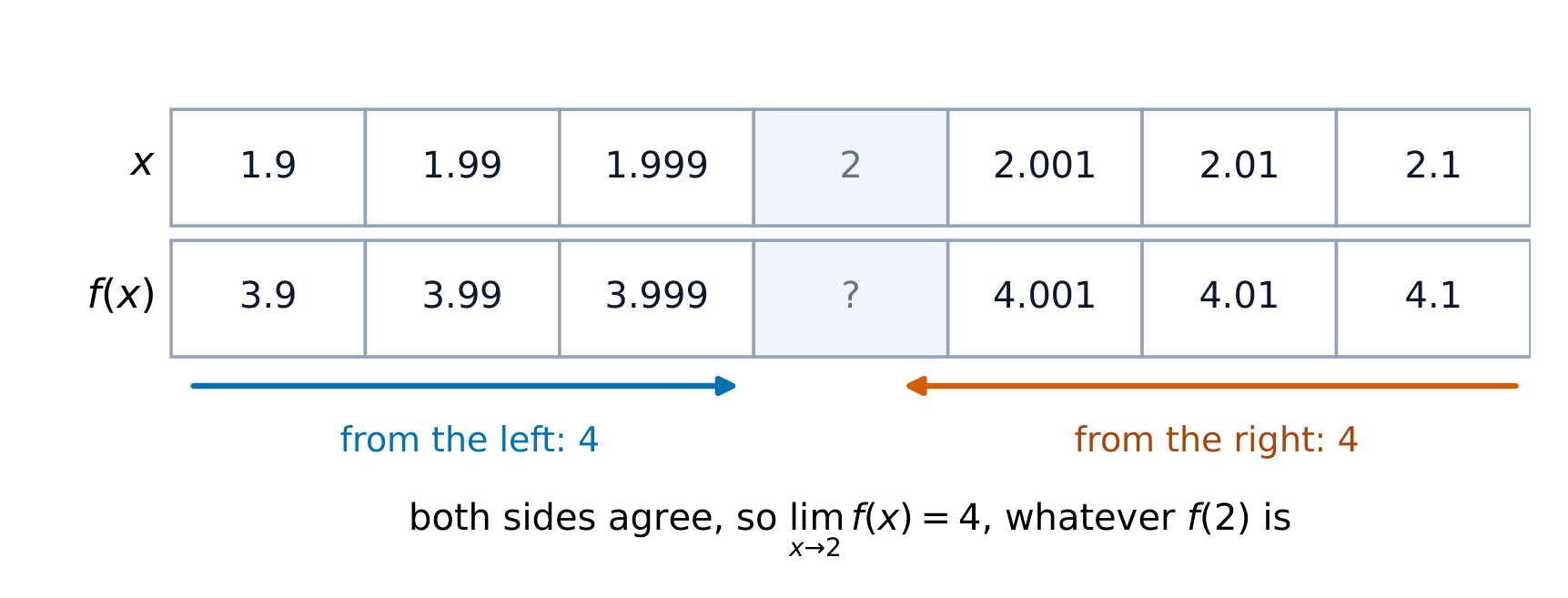
Values from both sides close in on 4, so the limit is 4 whatever f(2) is
A table gives $f(2.9)=6.9$, $f(2.99)=6.99$, $f(3.01)=7.01$, $f(3.1)=7.1$. Estimate $\lim_{x\to 3} f(x)$.
Difficulty 2/5 · 140 coins + a small bonus on first completion today
Both sides close in on $7$, so the limit is $7$.
To estimate $\lim_{x\to 4} f(x)$ from a table, the best inputs to use are...
Difficulty 1/5 · 100 coins + a small bonus on first completion today
Inputs must close in on $4$ from both sides — and avoid $x=4$ itself.
The two sides must trend together
- If both sides head for the same number, that is your estimate of the two-sided limit 双侧极限.
- If the left side heads for one value and the right side for another, the limit does not exist: the numbers refuse to meet in the middle.
If a table's left column trends to $2$ and its right column trends to $5$, the two-sided limit does not ____.
Difficulty 1/5 · 100 coins + a small bonus on first completion today
Different one-sided trends mean the two-sided limit does not exist.
A famous limit. Estimate $\displaystyle\lim_{x\to 0}\dfrac{\sin x}{x}$ ($x$ in radians).
- $x=0.1\Rightarrow0.99833$, $x=0.01\Rightarrow0.99998$, $x=0.001\Rightarrow0.9999998$. Negative $x$ gives the same values, because $\dfrac{\sin(-x)}{-x}=\dfrac{\sin x}{x}$.
- Both sides close in on $1$, so $\displaystyle\lim_{x\to0}\dfrac{\sin x}{x}=1$. You will meet this limit again in 1.8.
The curve behind the table
y = sin(ax)/x
Each table value is a point on this curve. Near $x=0$ the curve heads to height $a$, though $\tfrac{\sin ax}{x}$ is undefined at $0$ itself.
A table for $\dfrac{\sin x}{x}$ near $x=0$ gives $0.998, 0.99998, 0.9999998, \dots$. The limit is...
Difficulty 1/5 · 100 coins + a small bonus on first completion today
The outputs close in on $1$, so the limit is $1$ — even though $f(0)$ is the indeterminate $\tfrac00$.
For $h(x)=\dfrac{e^x-1}{x}$: $h(0.1)=1.0517$, $h(0.01)=1.0050$, $h(0.001)=1.0005$, $h(-0.01)=0.9950$, $h(-0.001)=0.9995$. Estimate $\displaystyle\lim_{x\to0}h(x)$.
Difficulty 2/5 · 140 coins + a small bonus on first completion today
From the right the values fall toward 1; from the left they rise toward 1. Both sides meet at 1.
AP-style table. $g$ is a function with these values:
| $x$ | $2.9$ | $2.99$ | $2.999$ | $3$ | $3.001$ | $3.01$ | $3.1$ |
|---|---|---|---|---|---|---|---|
| $g(x)$ | $5.2$ | $5.02$ | $5.002$ | $8$ | $1.998$ | $1.98$ | $1.8$ |
- Left side → $5$; right side → $2$. They disagree, so $\displaystyle\lim_{x\to3}g(x)$ does not exist.
- The value $g(3)=8$ in the middle column plays no part in any limit.
A table gives $k(0.99)=6.98$, $k(0.999)=6.998$, $k(1)=2$, $k(1.001)=7.002$, $k(1.01)=7.02$. What is $\displaystyle\lim_{x\to1}k(x)$?
Difficulty 1/5 · 100 coins + a small bonus on first completion today
Both sides close in on 7. The value at $x=1$ itself plays no part in the limit.
- A table only suggests a limit. It cannot prove one: the function could change very close to $c$.
- Inputs that are badly chosen can mislead. $\sin\dfrac{\pi}{x}$ at $x=1,\tfrac12,\tfrac13,\dots$ gives $0,0,0,\dots$, but near 0 the function swings between $-1$ and $1$, so the limit does not exist.
- Use inputs genuinely close to $c$, from both sides.
A neat table of values proves exactly what a limit equals.
Difficulty 1/5 · 100 coins + a small bonus on first completion today
A table only suggests a value — it can be fooled by oscillation. Proof needs algebra or a theorem.
Select all good practices when estimating a limit from a table.
Difficulty 2/5 · 140 coins + a small bonus on first completion today
Close in from both sides and stay skeptical. Plugging in $x=c$ misses the point — the limit is about the approach.
Evaluate the function at inputs approaching $c$ from both sides and read the shared trend. Matching trends suggest a limit; different trends suggest DNE. Ignore the value at $c$ itself. A table is strong evidence, not proof.