Science: data representation and defensible extrapolation
Introduced| English | Meaning |
|---|---|
| interpolation/ɪnˌtɜːpəˈleɪʃn/ | Estimating a value inside the measured range of the data. |
| extrapolation/ekˈstræpəleɪʃn/ | Estimating a value outside the range of observed data by extending a pattern or model. |
Reading between and beyond the points
- A table shows a gas's volume at 10, 20, 30 and 40 °C. A question asks for the volume at 25 °C; another for 100 °C.
- Interpolation 插值 (inside the data) is usually safe; extrapolation 外推 (beyond the data) depends on the trend continuing.
Read values correctly
- Check which axis is which and the units (mL vs L, °C vs K). On multi-line graphs, use the key to choose the right series.
- Note the conditions: "at constant pressure" means the data apply only under that condition.
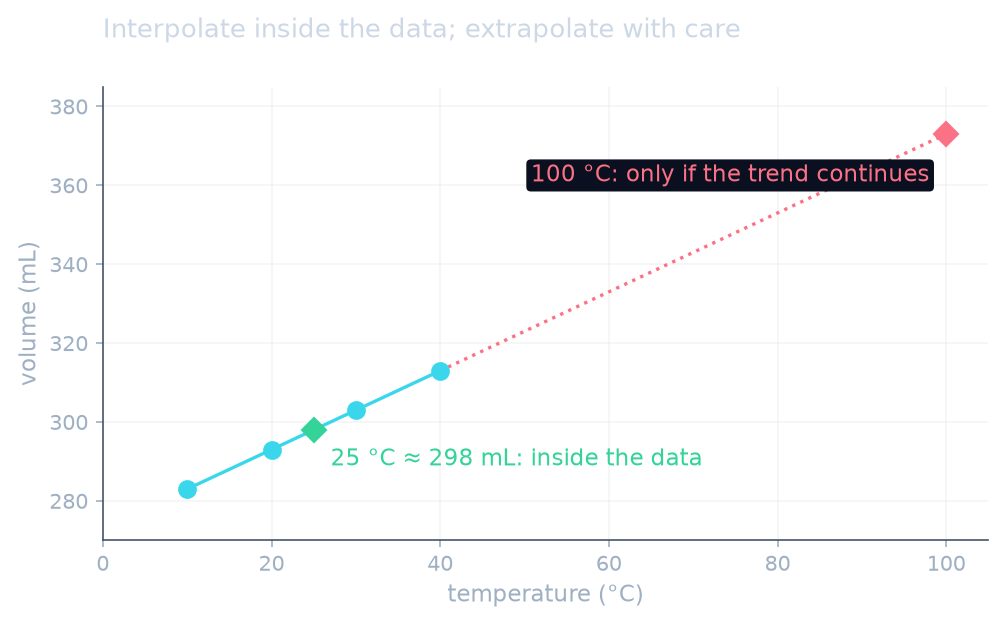
Gas volume against temperature: 25 °C lies inside the data, 100 °C needs extrapolation
Trends and interpolation
- Describe the trend: volume increases by about 10 mL for every 10 °C. Then estimate between points: at 25 °C, about halfway between the 20 °C and 30 °C values.
- If the trend is curved, use the neighbouring points rather than a straight line through all the data.
Table: 20 °C → 293 mL; 30 °C → 303 mL. At 25 °C, the volume is about 298 mL (halfway).
A plant was 12 cm tall on day 10 and 18 cm on day 14, growing steadily. Estimate its height in cm on day 12.
Difficulty 2/5 · 140 coins + a small bonus on first completion today
Halfway between 12 and 18.
Estimating a value between measured points is called ____.
Difficulty 1/5 · 100 coins + a small bonus on first completion today
Within the data range.
Volume rises from 293 mL at 20 °C to 303 mL at 30 °C. By how many mL does it rise per degree?
Difficulty 2/5 · 140 coins + a small bonus on first completion today
10 mL over 10 °C.
Defensible extrapolation
- Extending a steady linear trend a little beyond the data is reasonable; extending it far, or past a change of state (water boiling), is risky.
- The ACT often asks which prediction is most likely given the trend; choose the value that continues the pattern.
Safe estimate or risky?
Judge whether a prediction stays within defensible limits.
A spring stretches 2 cm for each 1 N, measured from 0 to 5 N. Which prediction is most defensible?
Difficulty 1/5 · 100 coins + a small bonus on first completion today
A short extension of a steady trend is reasonable; 500 N is far outside the data.
Traps
- Wrong series or unit on a crowded graph.
- Ignoring conditions: data at constant pressure do not apply when pressure changes.
Data collected at constant pressure can be applied unchanged when the pressure doubles.
Difficulty 1/5 · 100 coins + a small bonus on first completion today
The conditions limit where the data apply.
Recap
- Read axes, units, key and conditions before any value.
- Interpolate between neighbours; extrapolate only a short way along a steady trend.