Optional Science: data, investigations and models
Introduced| English | Meaning |
|---|---|
| independent variable/ˌɪndɪˈpendənt ˈveərɪəbl/ | An input or factor whose value is chosen or varied to examine its effect on another quantity. |
| dependent variable/dɪˈpendənt ˈveərɪəbl/ | The measured or calculated outcome whose response to changes in another variable is studied. |
| control group/kənˈtrəʊl ɡruːp/ | A comparison group that does not receive the treatment being investigated, or receives a standard alternative. |
Science without much science
- ACT Science shows experiments, graphs and two scientists' viewpoints. Most questions can be answered from the data — little outside knowledge is needed.
- The skills: interpreting data, understanding experiments (variables, controls) and evaluating models (which viewpoint the evidence supports).
Read the figure first
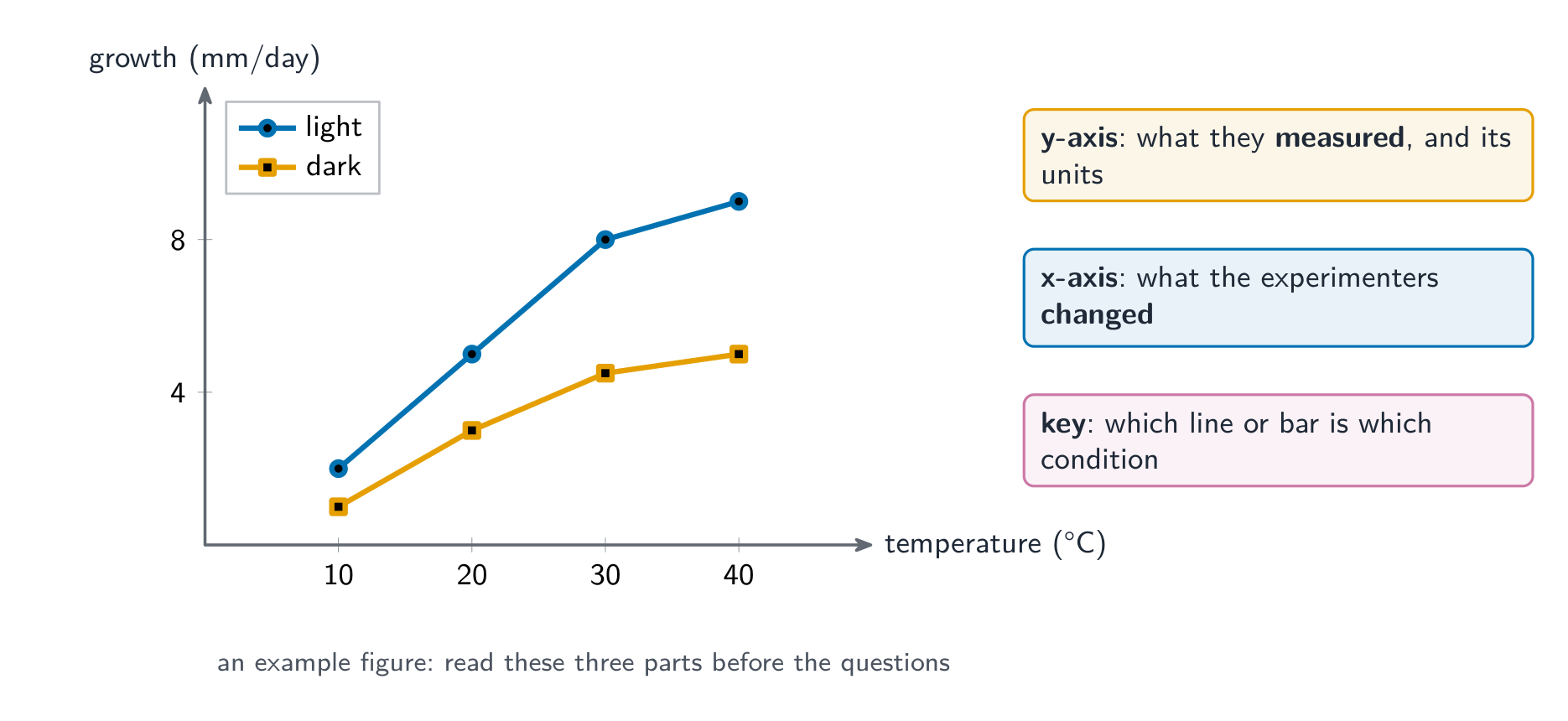
- Before the questions, read the axes, units and the key. Ask: what changes on the $x$-axis, what is measured on the $y$-axis?
- Describe the trend in words: "As temperature increases, dissolved oxygen decreases."
A table: water at 10 °C holds 11.3 mg/L of oxygen; at 20 °C, 9.1 mg/L; at 30 °C, 7.6 mg/L. Which statement describes the trend?
Difficulty 1/5 · 100 coins + a small bonus on first completion today
Each higher temperature has a lower oxygen value.
Using the oxygen table (10 °C: 11.3; 20 °C: 9.1; 30 °C: 7.6), estimate the oxygen at 25 °C to one decimal place, assuming a straight line between 20 °C and 30 °C.
Difficulty 2/5 · 140 coins + a small bonus on first completion today
Halfway between 9.1 and 7.6 is about 8.35 (8.3–8.4).
Variables and controls
- Independent variable 自变量: what the scientist changes. Dependent variable 因变量: what is measured. Controlled variables: kept the same so the test is fair.
- A control group 对照组 shows what happens without the treatment, for comparison.
Study: plants get 0, 2, 4 or 6 hours of extra light; height is measured after a month; soil, water and pot size are the same. Independent: hours of light. Dependent: height. Controlled: soil, water, pot size.
Which kind of variable?
Classify variables in an experiment.
Students drop a ball from heights of 1, 2 and 3 m and measure how high it bounces, using the same ball and floor. What is the independent variable?
Difficulty 1/5 · 100 coins + a small bonus on first completion today
The students choose the drop height; bounce height is measured.
Controlled variables are the ones the scientist keeps the same.
Difficulty 1/5 · 100 coins + a small bonus on first completion today
True. Controlled variables are held constant so that only the independent variable, which the scientist changes, can affect the result.
The variable that is measured in an experiment is the ____ variable.
Difficulty 1/5 · 100 coins + a small bonus on first completion today
It depends on the independent variable.
Conflicting viewpoints
- Summarise each scientist's claim in a line and note what each predicts.
- A finding supports Scientist 1 if it matches what Scientist 1 predicts and not what Scientist 2 predicts.
Traps
- Reading the wrong line or unit on a graph with several series.
- Using outside knowledge that contradicts the passage's data; the test wants the data's answer.
Recap
- Read axes, units and keys; describe the trend in words.
- Name independent, dependent and controlled variables; judge viewpoints by their predictions.