Describing motion
Introduced| English | Meaning |
|---|---|
| distance/ˈdɪstəns/ | The total length of a path travelled. |
| displacement/dɪˈspleɪsmənt/ | The straight-line change in position, including direction. |
| speed/spiːd/ | The distance travelled per unit time. |
| velocity/vəˈlɒsɪti/ | The rate of change of displacement. |
| acceleration/əkˌseləˈreɪʃn/ | The rate of change of velocity. |
| gradient/ˈɡreɪdɪənt/ | The change in the vertical coordinate divided by the change in the horizontal coordinate. |
| deceleration/dɪˌseləˈreɪʃn/ | Acceleration opposite to an object's velocity, causing its speed to decrease. |
| tangent/ˈtændʒənt/ | A straight line that touches a curve at a point and has the same direction there. |
There and back
- A runner does one lap of a $400\ \text{m}$ track and stops where they started.
- Distance 距离 travelled: $400\ \text{m}$. Displacement 位移: $0$.
- Describing motion well starts with getting words like these exactly right.
Five key words
- distance (scalar) — total path length; displacement (vector) — straight line, start to end.
- speed 速率 (scalar) — rate of change of distance; velocity 速度 (vector) — rate of change of displacement.
- acceleration 加速度 (vector) — rate of change of velocity. Units: $\dfrac{\text{m}}{\text{s}}$ and $\dfrac{\text{m}}{\text{s}^2}$.
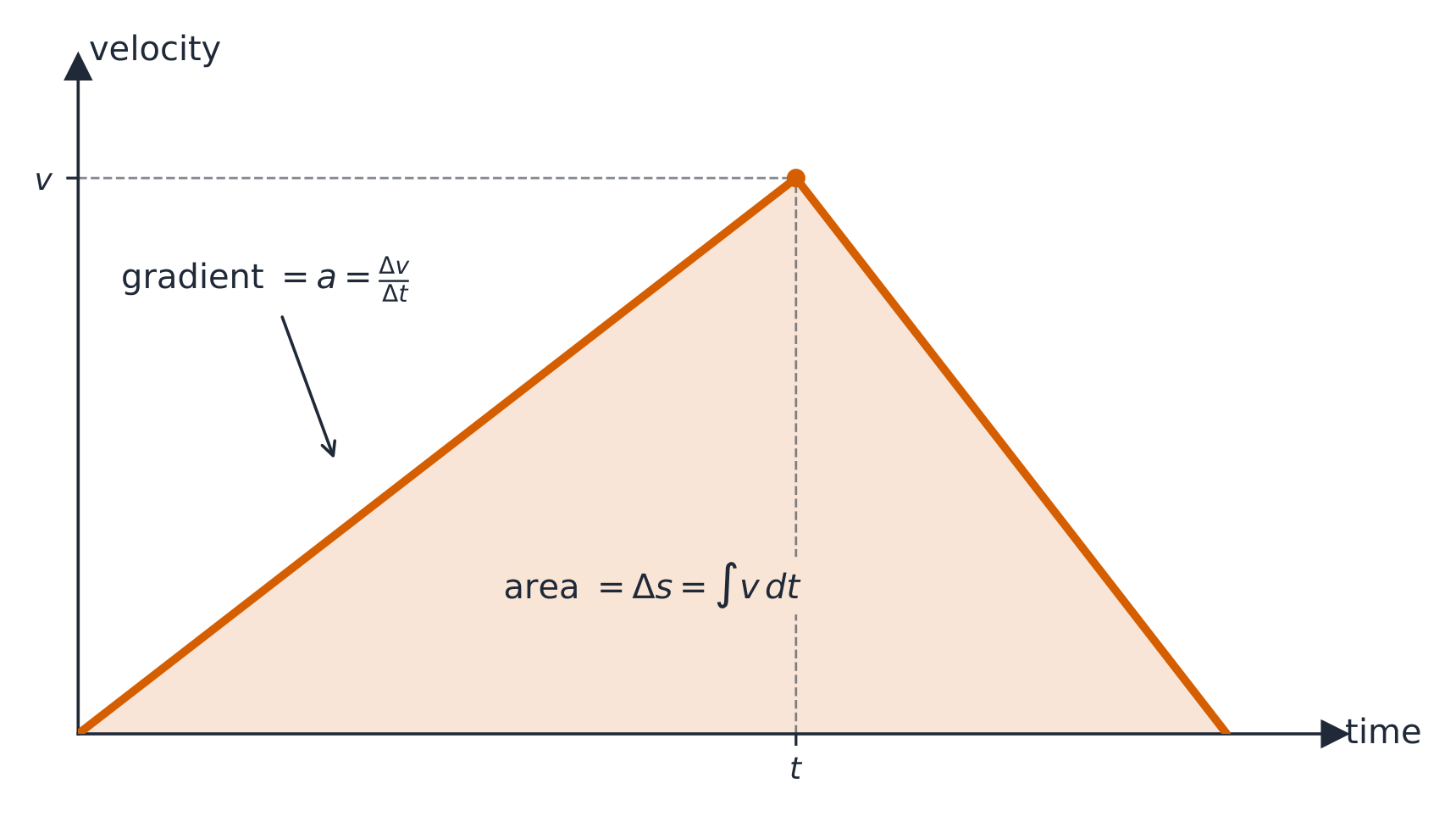
Velocity–time graph — gradient 斜率 gives acceleration, area gives displacement
The velocity–time graph
v = u + at
On a speed–time graph the gradient is the acceleration and the area underneath is the distance travelled.
The rate of change of velocity with time is called ____.
Difficulty 1/5 · 100 coins + a small bonus on first completion today
Acceleration is how fast the velocity changes — a vector, in $\dfrac{\text{m}}{\text{s}^2}$.
Which quantity is the rate of change of displacement?
Difficulty 1/5 · 100 coins + a small bonus on first completion today
Velocity is the rate of change of displacement (a vector). Speed is the rate of change of distance (a scalar).
Match each term to the definition the examiner marks.
Difficulty 2/5 · 140 coins + a small bonus on first completion today
Speed and velocity differ by one word, distance against displacement, and that word is the mark.
Deceleration 减速度 is not a new quantity — it is just acceleration pointing opposite to the velocity (a negative acceleration).

Experimental set-up for measuring the acceleration due to free fall
Deceleration is a completely separate quantity from acceleration.
Difficulty 1/5 · 100 coins + a small bonus on first completion today
No — deceleration is just acceleration in the opposite direction to the motion (a negative acceleration).
Two graphs do the work
- Most motion questions use a displacement–time or a velocity–time graph.
- The whole skill is knowing what the gradient and the area mean on each.
Displacement–time graph
- The gradient (steepness) = the velocity.
- Flat → at rest. Straight → constant velocity. Curved → take a tangent 切线.
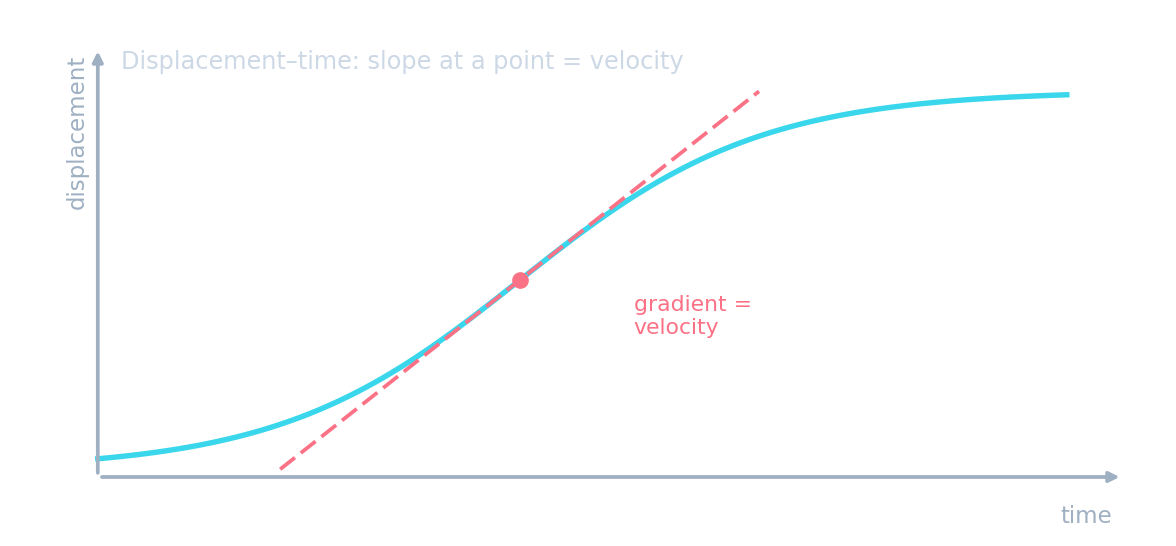
On a displacement–time graph, a flat (horizontal) line means the object is at rest.
Difficulty 1/5 · 100 coins + a small bonus on first completion today
A flat line has zero gradient, and the gradient is the velocity — so the velocity is zero (at rest).
Velocity–time graph
- The gradient = the acceleration.
- The area under the line = the displacement.
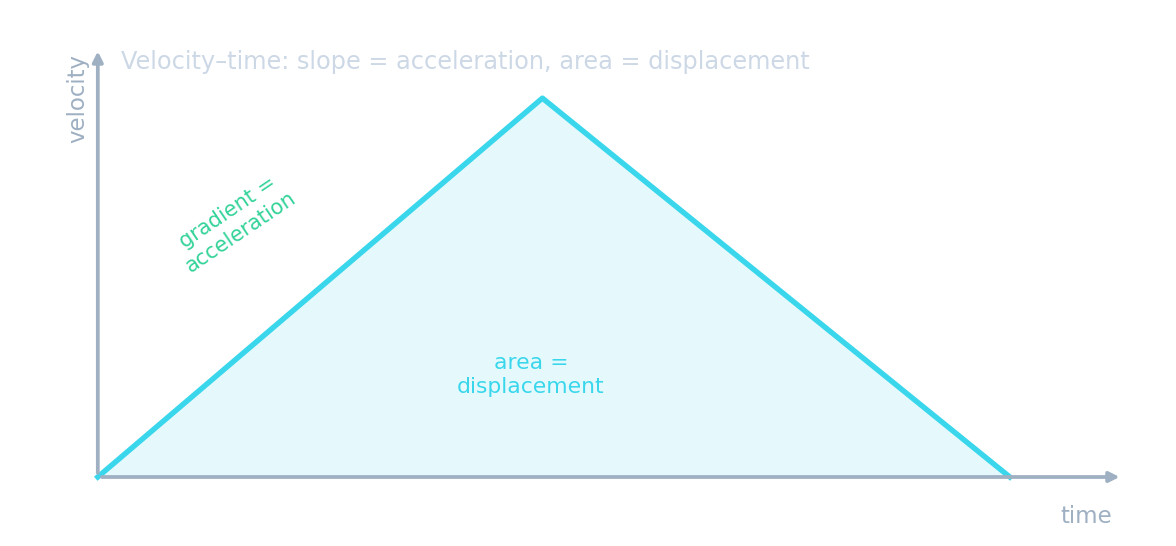
Match each graph feature to what it tells you.
Difficulty 2/5 · 140 coins + a small bonus on first completion today
Gradients give rates of change; the area under a velocity–time graph builds up the displacement.
Displacement from the area
- Split the area into triangles and rectangles, then add them up.
- Triangle $= \tfrac{1}{2} \times \text{base} \times \text{height}$; rectangle $= \text{base} \times \text{height}$.
A car speeds up from rest to $20\ \dfrac{\text{m}}{\text{s}}$ in $10\ \text{s}$ (a straight velocity–time line). How far does it travel?
Difficulty 2/5 · 140 coins + a small bonus on first completion today
Displacement = area under the line = $\tfrac{1}{2} \times \text{base} \times \text{height} = \tfrac{1}{2} \times 10 \times 20 = 100\ \text{m}$.
Worked example: reading a lift's journey
- A velocity-time graph shows a lift rising: $0$ to $2.0\ \text{m/s}$ in $4.0\ \text{s}$, then steady for $10\ \text{s}$, then back to rest in $2.0\ \text{s}$. Find the acceleration in each stage and the total distance.
- Gradients give the accelerations: $2.0/4.0 = 0.50\ \text{m/s}^2$, then $0$, then $-2.0/2.0 = -1.0\ \text{m/s}^2$.
- Areas give the distances: a triangle $\tfrac{1}{2}(4.0)(2.0) = 4.0\ \text{m}$, a rectangle $(10)(2.0) = 20\ \text{m}$, a triangle $\tfrac{1}{2}(2.0)(2.0) = 2.0\ \text{m}$.
- Total: $26\ \text{m}$. Split the graph into triangles and rectangles and add. Never try to fit one formula to the whole journey.
- The commonest error here is taking the gradient when the question wants the area. Gradient is acceleration; area is displacement.
On a velocity-time graph a lift speeds up from rest to 2.0 m/s in 4.0 s. How far does it travel in that stage, in metres?
Difficulty 2/5 · 140 coins + a small bonus on first completion today
The area under that part is a triangle: half of 4.0 x 2.0 = 4.0 m. Area is displacement; the gradient, 0.50 m/s^2, is the acceleration.
Worked example: when there is no time given
- A car accelerates uniformly from $8.0\ \text{m/s}$ to $20\ \text{m/s}$ over $56\ \text{m}$. Find its acceleration.
- List what you have: $u = 8.0$, $v = 20$, $s = 56$, $a = ?$, and $t$ is not wanted and not given.
- So choose the equation with no $t$ in it: $v^2 = u^2 + 2as$.
- $20^2 = 8.0^2 + 2a(56)$, so $400 - 64 = 112a$ and $a = 3.0\ \text{m/s}^2$.
- That is the whole method for these questions: write out $s, u, v, a, t$, mark the one you do not have and do not want, and pick the equation that is missing it.
Put the method for a constant-acceleration problem in order.
Difficulty 3/5 · 200 coins + a small bonus on first completion today
Choosing the equation that is missing the quantity you neither have nor want avoids solving two equations at once.
A car accelerates uniformly from 8.0 m/s to 20 m/s over 56 m. What is its acceleration, in m/s^2?
Difficulty 2/5 · 140 coins + a small bonus on first completion today
No time is given or wanted, so use v^2 = u^2 + 2as: 400 - 64 = 112a, a = 3.0 m/s^2.
Marks that slip away
- Gradient is acceleration, area is displacement. Read which one the question wants before touching the graph.
- The equations of motion apply only to constant acceleration. On a curved graph only the graph methods work.
- Choose one direction as positive and keep the signs consistent for the whole journey. With up positive, $a = -9.81\ \text{m/s}^2$ on the way down as well as on the way up.
- Distance is the total path length; displacement is from start to finish in a stated direction. A there-and-back trip has a distance but zero displacement.
- Speed is the rate of change of distance, velocity the rate of change of displacement. The two definitions differ by one word and that word is the mark.
Which of these are errors in kinematics questions? Select all that apply.
Difficulty 2/5 · 140 coins + a small bonus on first completion today
The last one is the correct method. The sign error is the subtlest: once up is positive, a stays negative for the whole flight, downward part included.
You've got it
- distance & speed are scalars; displacement, velocity & acceleration are vectors
- displacement–time gradient = velocity; velocity–time gradient = acceleration
- area under a velocity–time graph = the displacement