The equations of motion
Introduced| English | Meaning |
|---|---|
| free fall/friː fɔːl/ | Motion under gravity alone, with other forces neglected. |
| equations of motion/ɪˈkweɪʒnz ɒv ˈməʊʃn/ | equations of motion |
| constant acceleration/ˈkɒnstənt əkˌseləˈreɪʃn/ | Motion in which velocity changes by equal amounts over equal time intervals. |
| symmetric/sɪˈmetrɪk/ | Having corresponding parts or relationships that remain equivalent under a specified transformation or interchange. |
| light gate/laɪt ɡeɪt/ | A timing sensor that detects an object interrupting a beam of light. |
A hammer and a feather
- On the Moon, an astronaut dropped a hammer and a feather together — they landed at the same time.
- With no air, free fall 自由落体 is the same for every mass.
- To handle motion like this, we use the equations of motion 运动方程.
Five symbols
- Straight-line motion with constant acceleration 匀加速 uses five symbols.
- $u$ start velocity · $v$ final velocity · $a$ acceleration · $s$ displacement · $t$ time.

A speedometer shows speed: the distance travelled per unit time
The equations of motion
v = u + at
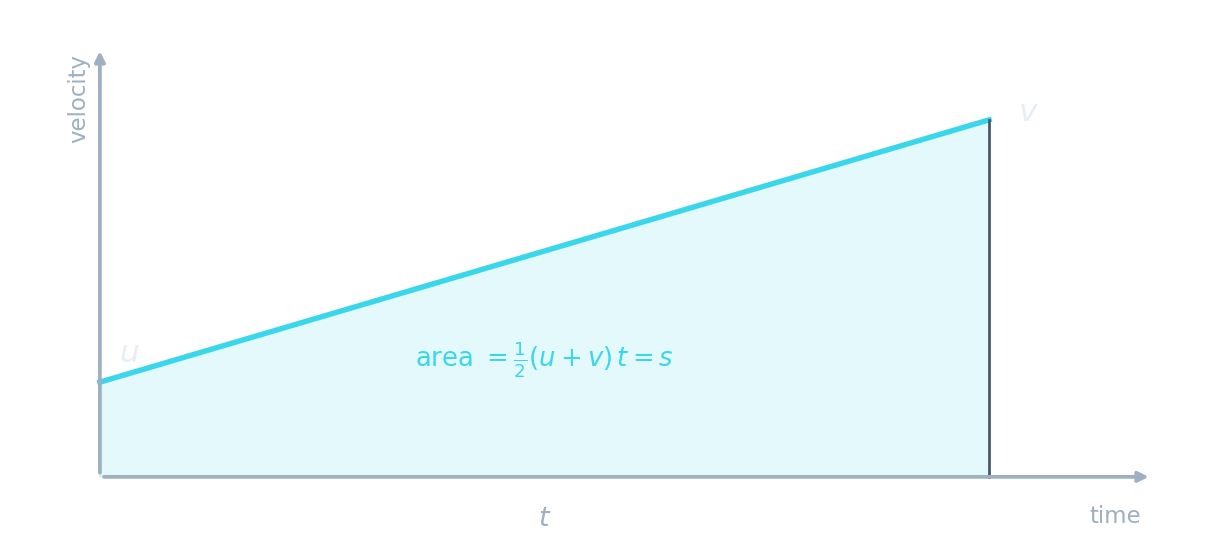
The suvat results come straight from the v–t graph: gradient = a, area = displacement.
The four equations
- $v = u + at$
- $s = ut + \tfrac{1}{2}at^{2}$
- $s = \tfrac{1}{2}(u + v)t$
- $v^{2} = u^{2} + 2as$
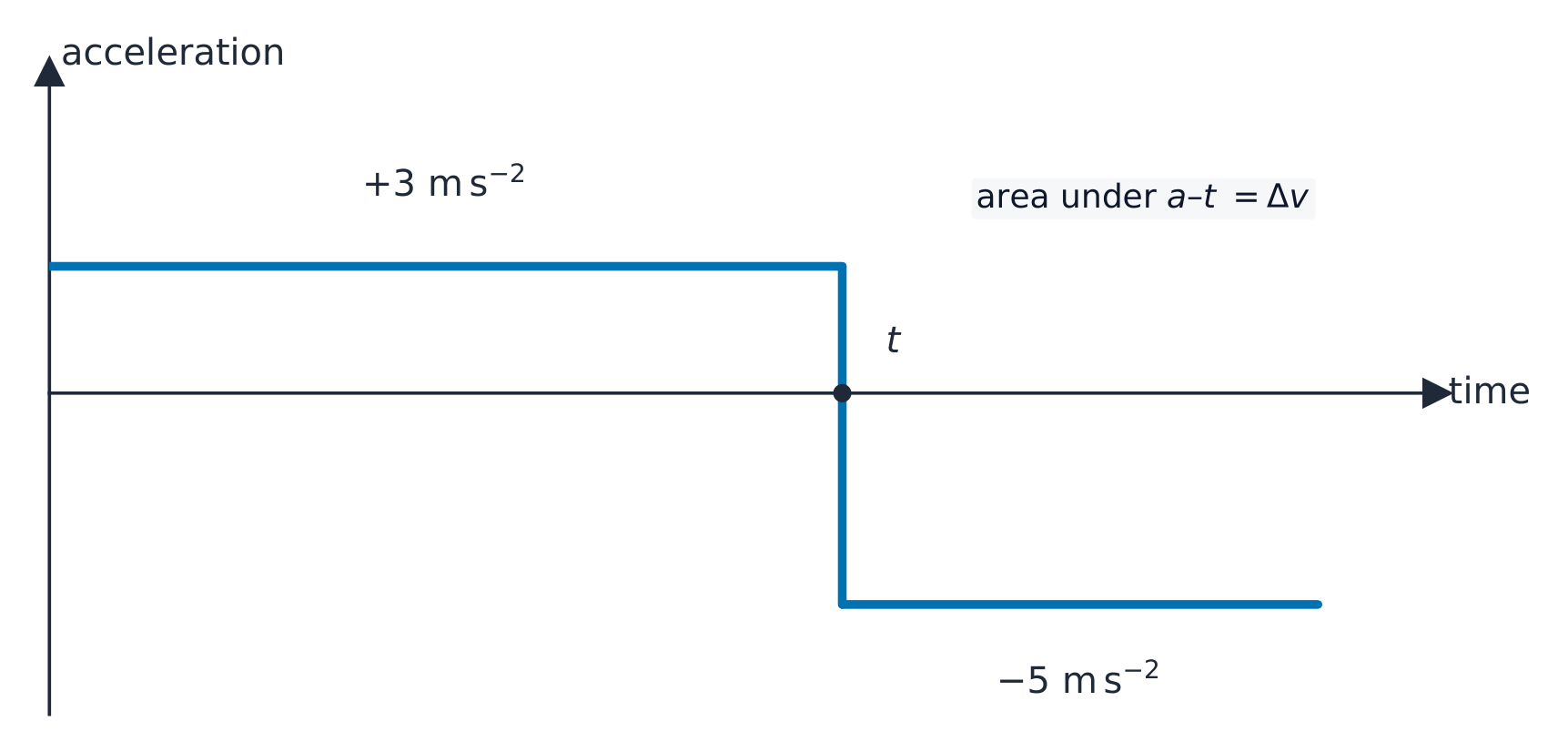
Acceleration–time graph derived from the same motion
When may the equations of motion be used? Select all that apply.
Difficulty 2/5 · 140 coins + a small bonus on first completion today
Air resistance makes the acceleration change, so only graph methods work there. A curved velocity-time graph is the visible warning.
Choosing the right one
- Each equation uses four of the five symbols.
- Write down what you know and what you want, then pick the equation with exactly those.
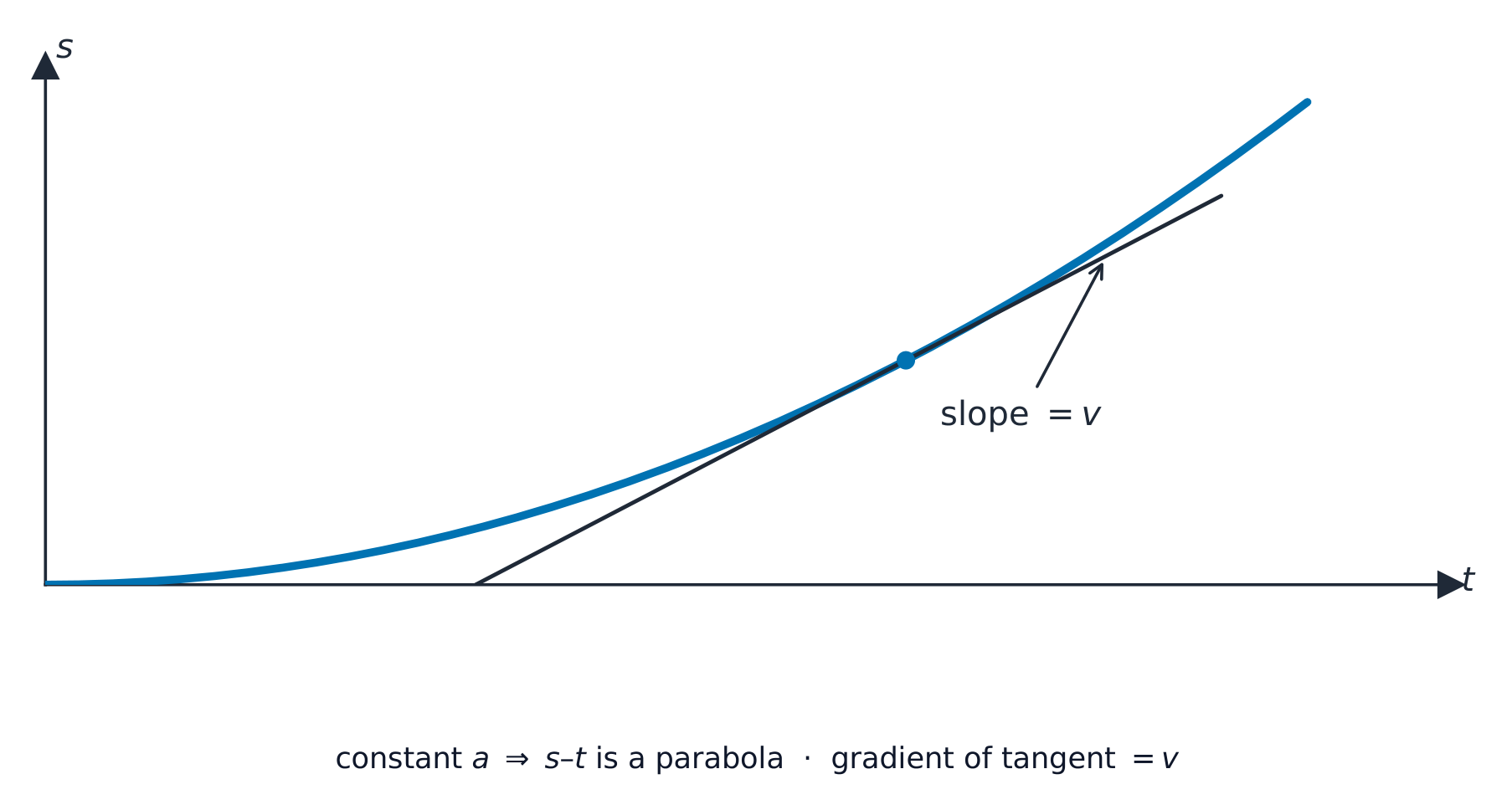
Displacement–time graph for uniform acceleration — the slope at any point equals the instantaneous velocity
Each SUVAT equation leaves out one symbol. Match each to the one it does not contain.
Difficulty 2/5 · 140 coins + a small bonus on first completion today
Spotting the missing symbol is how you choose: pick the equation that has your four known/wanted symbols and leaves out the one you neither know nor want.
A car starts at $u = 2\ \dfrac{\text{m}}{\text{s}}$ and accelerates at $a = 3\ \dfrac{\text{m}}{\text{s}^2}$ for $t = 4\ \text{s}$. Find $v$.
Difficulty 2/5 · 140 coins + a small bonus on first completion today
Use $v = u + at = 2 + 3 \times 4 = 14\ \dfrac{\text{m}}{\text{s}}$.
Put the method for choosing a suvat equation in order.
Difficulty 3/5 · 200 coins + a small bonus on first completion today
Picking the equation that is missing the quantity you neither have nor want saves solving two equations together.
Match each equation to the quantity it does not contain.
Difficulty 2/5 · 140 coins + a small bonus on first completion today
Knowing which quantity each equation leaves out is what makes the choice instant.
Where they come from
- $v = u + at$ is the gradient of a velocity–time line ($a = \tfrac{v-u}{t}$).
- $s = \tfrac{1}{2}(u+v)t$ is the area under it (a trapezium).
Which equation is just the gradient of a velocity–time graph?
Difficulty 1/5 · 100 coins + a small bonus on first completion today
The gradient is $a = \dfrac{v - u}{t}$, which rearranges to $v = u + at$.
Pick a positive direction first and keep it. For a ball thrown up with "up" positive, $a = -g$ — gravity points the other way.
A ball is thrown straight up at 20 m/s. What is the greatest height it reaches, in metres? (g = 9.81 m/s^2)
Difficulty 2/5 · 140 coins + a small bonus on first completion today
At the top v = 0, so v^2 = u^2 + 2as gives 0 = 400 - 2(9.81)s and s = 20.4 m. With up positive, a is negative for the whole flight.
Free fall
- Ignoring air, a falling object accelerates at $g \approx 9.81\ \dfrac{\text{m}}{\text{s}^2}$ downward — the same for every mass.
- Dropped from rest: $h = \tfrac{1}{2}gt^{2}$, $\;v = gt$, $\;v^{2} = 2gh$.
With no air resistance, a heavy ball falls faster than a light one.
Difficulty 1/5 · 100 coins + a small bonus on first completion today
No — free fall has the same acceleration $g$ for every mass. Air resistance is what makes a feather seem to fall slower.
A stone is dropped from rest and falls for $2.0\ \text{s}$. How far does it fall? (Use $g = 9.81\ \dfrac{\text{m}}{\text{s}^2}$.)
Difficulty 2/5 · 140 coins + a small bonus on first completion today
$h = \tfrac{1}{2}gt^{2} = \tfrac{1}{2} \times 9.81 \times 2.0^{2} \approx 19.6\ \text{m}$.
Thrown straight up
- The motion is symmetric 对称: it rises, stops, and falls back the same way.
- Greatest height $h = \dfrac{u^{2}}{2g}$; time to the top $t = \dfrac{u}{g}$; total time up and down $= \dfrac{2u}{g}$.
A ball is thrown straight up at $20\ \dfrac{\text{m}}{\text{s}}$. How long until it reaches the top? (Use $g = 9.81\ \dfrac{\text{m}}{\text{s}^2}$.)
Difficulty 2/5 · 140 coins + a small bonus on first completion today
At the top $v = 0$, so $t = \dfrac{u}{g} = \dfrac{20}{9.81} \approx 2.0\ \text{s}$.
Measuring $g$
- Drop an object a height $h$ and time the fall: $g = \dfrac{2h}{t^{2}}$.
- Plot $h$ against $t^{2}$ — the gradient is $\dfrac{g}{2}$. Light gates 光电门 remove reaction-time error.
You drop an object from several heights and plot $h$ against $t^{2}$. The gradient equals:
Difficulty 1/5 · 100 coins + a small bonus on first completion today
From $h = \tfrac{1}{2}gt^{2}$, plotting $h$ against $t^{2}$ gives a straight line of gradient $\tfrac{1}{2}g$ — so $g$ is twice the gradient.
You've got it
- four SUVAT equations link $u, v, a, s, t$ — pick the one with the four symbols you have
- free fall: constant $g \approx 9.81\ \dfrac{\text{m}}{\text{s}^2}$ down, the same for every mass
- a vertical throw is symmetric: time up $= \dfrac{u}{g}$