Motion in two directions
Introduced| English | Meaning |
|---|---|
| vertical/ˈvɜːtɪkl/ | Along the local direction of gravity, or perpendicular to a horizontal reference. |
| horizontal/ˌhɒrɪˈzɒntl/ | Parallel to the horizon or perpendicular to the local vertical direction. |
| parabola/pəˈræbələ/ | The curve formed by points equally distant from a fixed point and a fixed straight line. |
| range/reɪndʒ/ | The horizontal distance travelled by a projectile between its launch and a specified landing level or point. |
| symmetric/sɪˈmetrɪk/ | Having corresponding parts or relationships that remain equivalent under a specified transformation or interchange. |
| projectile/prəˈdʒektaɪl/ | An object moving after being launched, typically modelled under gravity with air resistance neglected. |
Drop one, throw one
- Drop a ball and throw another one sideways at the same instant.
- They hit the ground at the same time.
- The sideways motion does not change how fast it falls.
Two motions, side by side
- Horizontal 水平 and vertical 竖直 motion are independent.
- Treat each direction as its own SUVAT problem, linked only by the time $t$.

A high-speed train: its motion can be shown on a distance-time graph
Launch a projectile
Fire the ball, then change the angle and speed. The horizontal motion is steady while gravity pulls it down — together they trace a parabola. Find the angle for the longest range, and try the Moon.
A horizontal throw
- Horizontal: constant velocity $u_{\text{H}}$, so $x = u_{\text{H}}t$.
- Vertical: free fall from rest, so $y = \tfrac{1}{2}gt^{2}$.
- The time to land depends only on the height, not on $u_{\text{H}}$.

Displacement–time graph of a car on a test track
A ball thrown horizontally and a ball dropped from the same height hit the ground at the same time (no air resistance).
Difficulty 1/5 · 100 coins + a small bonus on first completion today
Yes — the vertical motion is the same free fall for both, and the horizontal speed does not change the fall time.
Launched at an angle
- Split the launch velocity: horizontal $u\cos\theta$ (stays constant), vertical $u\sin\theta$.
- The vertical part slows, stops at the top, then grows downward — tracing a parabola 抛物线.
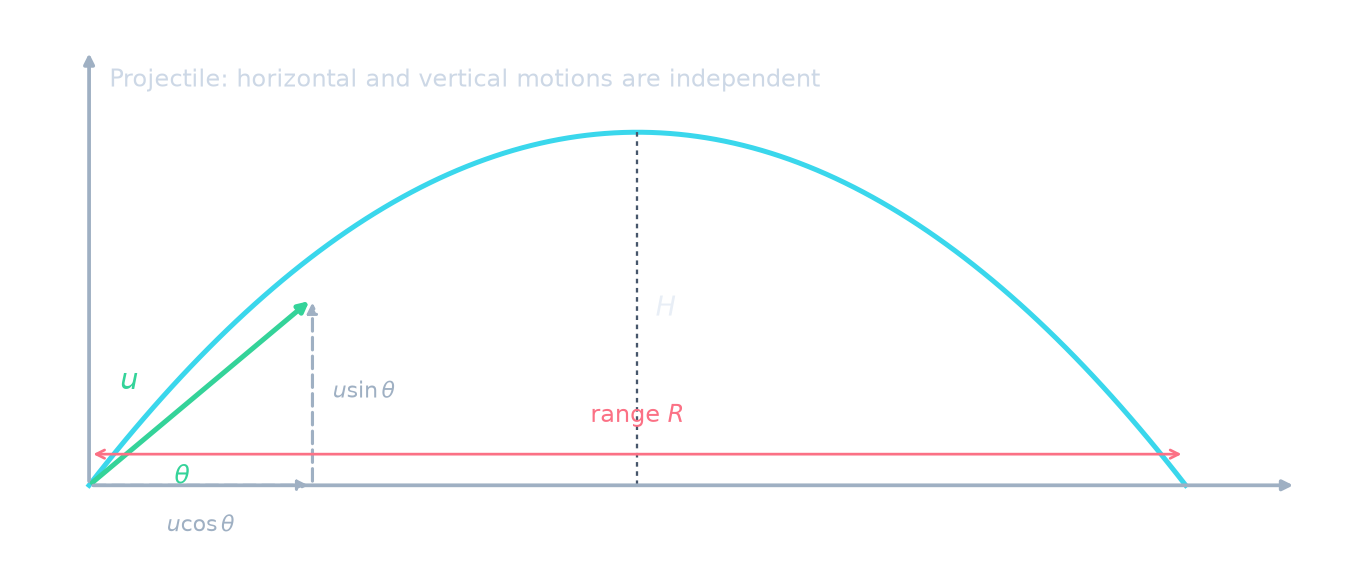
A projectile is launched at $20\ \dfrac{\text{m}}{\text{s}}$, $30^{\circ}$ above the horizontal. What is the vertical part of the launch velocity?
Difficulty 2/5 · 140 coins + a small bonus on first completion today
Vertical part $= u\sin\theta = 20 \times \sin 30^{\circ} = 20 \times 0.5 = 10\ \dfrac{\text{m}}{\text{s}}$.
At the top and the range 射程
- At the highest point $v_{\text{V}} = 0$, but $v_{\text{H}} = u\cos\theta$ is unchanged.
- Time to the top $= \dfrac{u\sin\theta}{g}$; the flight is symmetric 对称, so total time is twice that.
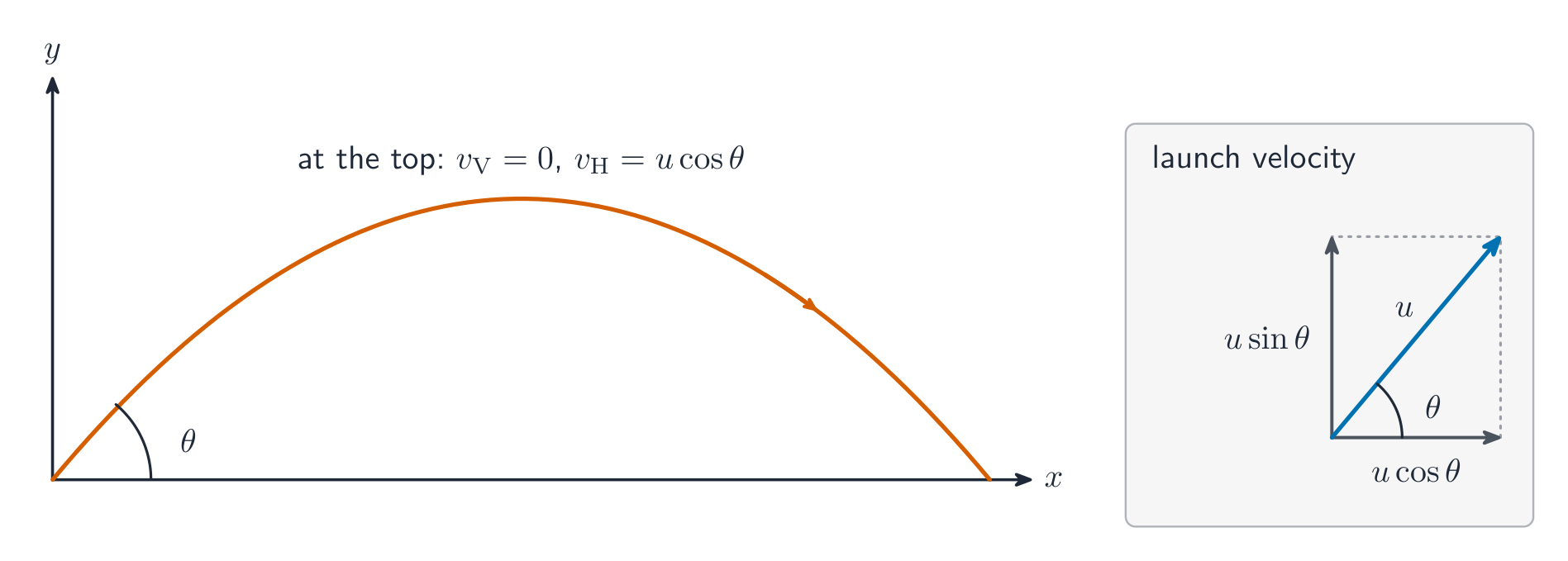
Projectile 抛体 launched at angle $\theta$ — horizontal and vertical motions are independent
Select all the statements that are true for a projectile (ignore air).
Difficulty 2/5 · 140 coins + a small bonus on first completion today
At the top only the vertical velocity is zero — the horizontal velocity $u\cos\theta$ carries on, so the ball keeps moving. Mass does not change free fall.
That projectile has a vertical launch velocity of $10\ \dfrac{\text{m}}{\text{s}}$. How long does it take to reach the top? (Use $g = 9.81\ \dfrac{\text{m}}{\text{s}^2}$.)
Difficulty 2/5 · 140 coins + a small bonus on first completion today
Time to the top $= \dfrac{u\sin\theta}{g} = \dfrac{10}{9.81} \approx 1.0\ \text{s}$.
A bouncing ball
- Between bounces the velocity–time graph is a straight sloping line (constant $g$).
- Each bounce is a sudden jump: the velocity flips direction (and shrinks if energy is lost).
On the velocity–time graph of a bouncing ball, each bounce appears as:
Difficulty 1/5 · 100 coins + a small bonus on first completion today
At a bounce the velocity flips from downward to upward almost instantly — a sudden vertical jump on the graph (smaller if energy is lost).
Two objects meeting
- Write a displacement equation for each, using the same start time and positive direction.
- They are level again when their displacements are equal — set $s_1 = s_2$ and solve.
Two objects moving along the same line are level again when their ____ are equal.
Difficulty 1/5 · 100 coins + a small bonus on first completion today
Set the two displacement equations equal ($s_1 = s_2$) and solve for the time.
Worked example: thrown off a cliff
- A ball is thrown horizontally at $15\ \text{m/s}$ from a cliff $20\ \text{m}$ high. Find the time to land and how far from the base it lands. Take $g = 9.81\ \text{m/s}^2$.
- Vertical, to get the time. The initial vertical velocity is zero, so $s = \tfrac{1}{2}gt^2$ gives $20 = \tfrac{1}{2}(9.81)t^2$ and $t = 2.02\ \text{s}$.
- Horizontal, to get the range. There is no horizontal acceleration, so $x = ut = 15 \times 2.02 = 30\ \text{m}$.
- The horizontal speed plays no part in finding the time. A ball dropped from the same cliff lands at exactly the same moment.
- Time is the only quantity the two motions share, and it is always the bridge between them.
A ball is thrown horizontally at $15\ \dfrac{\text{m}}{\text{s}}$ from a $20\ \text{m}$ cliff. How long does it take to land, in seconds? ($g = 9.81\ \dfrac{\text{m}}{\text{s}^{2}}$)
Difficulty 2/5 · 140 coins + a small bonus on first completion today
Vertical only: $20 = \tfrac{1}{2} \times 9.81 \times t^{2}$, so $t = 2.02\ \text{s}$. The $15\ \dfrac{\text{m}}{\text{s}}$ plays no part; a dropped ball lands at the same moment.
That same ball, thrown horizontally at $15\ \dfrac{\text{m}}{\text{s}}$ and landing after $2.02\ \text{s}$, lands how far from the base of the cliff, in metres?
Difficulty 2/5 · 140 coins + a small bonus on first completion today
Horizontal has no acceleration, so $x = ut = 15 \times 2.02 = 30\ \text{m}$. Time is the bridge between the two directions.
Worked example: launched at an angle
- A ball leaves the ground at $18\ \text{m/s}$ at $60°$ to the horizontal. Show that it reaches its greatest height at $t = 1.6\ \text{s}$.
- Resolve first. Vertical: $u_y = 18\sin 60° = 15.6\ \text{m/s}$. Horizontal: $u_x = 18\cos 60° = 9.0\ \text{m/s}$.
- At the top the vertical velocity is zero, so $v = u + at$ gives $0 = 15.6 - 9.81t$ and $t = 1.59 \approx 1.6\ \text{s}$.
- The horizontal velocity is still $9.0\ \text{m/s}$ at the top. The speed there is $9.0\ \text{m/s}$, not zero.
- Total time of flight is twice this, $3.2\ \text{s}$, and the range is $u_x \times 3.2 = 29\ \text{m}$.
Put the method for a projectile launched at an angle in order.
Difficulty 3/5 · 200 coins + a small bonus on first completion today
Time is the only quantity the two directions share, which is why it is always found from the vertical motion first.
At the highest point of a projectile's flight, match each quantity to its value.
Difficulty 2/5 · 140 coins + a small bonus on first completion today
The speed at the top is the horizontal component, not zero. And the acceleration never pauses, not even for an instant at the top.
Marks that slip away
- Resolve before you start. Every projectile question is two one-dimensional problems sharing a value of $t$.
- The horizontal velocity is constant and takes no part in the time calculation.
- At the highest point the vertical velocity is zero, not the speed. The horizontal component is unchanged.
- A ball thrown horizontally and a ball dropped from the same height land at the same time.
- Keep the sign convention for the whole flight. With up positive, $a = -9.81\ \text{m/s}^2$ on the way down too.
A ball thrown horizontally from a cliff lands later than a ball dropped from the same cliff at the same moment.
Difficulty 1/5 · 100 coins + a small bonus on first completion today
They land together. The vertical motion is identical, and the horizontal velocity has no effect on it, which is the whole point of treating the two directions separately.
You've got it
- horizontal and vertical motion are independent — share only the time $t$
- a horizontal throw lands in a time set only by its height
- resolve a launch: $u\cos\theta$ stays constant, $u\sin\theta$ behaves like a vertical throw