Effectiveness of policy options
Introduced| English | Meaning |
|---|---|
| demand-side/dɪˈmænd saɪd/ | demand-side |
| cyclical/ˈsaɪklɪkl/ | Related to recurring expansions and contractions in economic activity. |
| supply-side/səˈplaɪ saɪd/ | Concerned with the productive capacity, costs or efficiency of an economy's producers. |
| structural/ˈstrʌktʃərəl/ | Describing economic effects caused by underlying features or changes in the organisation of production and labour markets. |
| time lags/taɪm læɡz/ | Delays between a change or decision and its implementation or effects. |
| crowding out/ˈkraʊdɪŋ aʊt/ | A reduction in private spending or investment caused by increased government activity, often through higher interest rates. |
| government failure/ˈɡʌvənmənt ˈfeɪlɪə/ | A situation in which government intervention creates inefficiency or worsens the outcome it was intended to improve. |
Does the policy actually work?
- A government can cut taxes, slash rates, or train workers — but each tool is slow, blunt, or has side effects. Picking the right one is the art of macro policy.
- Evaluating effectiveness means weighing speed, certainty, and unintended consequences.
Economics case lab
Classify real examples by the economic idea they show.
Structural unemployment is best tackled by:
Difficulty 1/5 · 100 coins + a small bonus on first completion today
Structural problems need supply-side fixes; demand stimulus won't give workers the right skills.
Match each problem to the most suitable policy type.
Difficulty 2/5 · 140 coins + a small bonus on first completion today
Demand-side for cyclical issues; supply-side for structural ones.
Matching tool to problem
- Demand-side 需求侧 tools (fiscal, monetary) tackle cyclical 周期性 problems — a recession or a demand-driven inflation.
- Supply-side 供给侧 tools tackle structural 结构性 problems — low productivity, structural unemployment, long-run growth.

Financial markets react quickly to policy, which affects how well a policy works
A key limitation of supply-side policy is that it:
Difficulty 1/5 · 100 coins + a small bonus on first completion today
Education, infrastructure and R&D take years to raise capacity.
Crowding out is when heavy government borrowing reduces private investment.
Difficulty 1/5 · 100 coins + a small bonus on first completion today
Government borrowing can raise interest rates and squeeze private investment.
Why policies fall short
- Time lags 时滞: fiscal and especially supply-side policies take months or years to bite.
- Crowding out 挤出效应: heavy government borrowing can squeeze private investment.
- Uncertainty: the size of the multiplier or the response to rates is hard to predict.
- Government failure 政府失灵: intervention with unintended consequences.
The right tool for the job. You can't fix structural unemployment with demand stimulus (the jobs need different skills) — you need supply-side retraining. Matching tool to cause is half the battle.
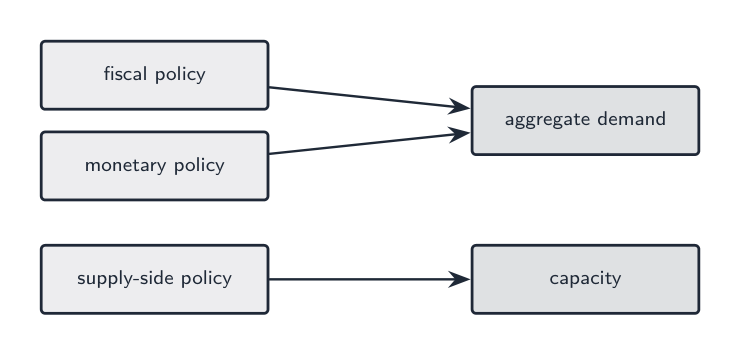
Fiscal and monetary policy act on demand; supply-side on capacity
Fiscal and supply-side policies are slowed by time ______.
Difficulty 1/5 · 100 coins + a small bonus on first completion today
It takes time for these policies to affect the economy.
Evaluating in an answer
- Strong analysis asks: how fast, how certain, at what cost, and with what side effects — then judges whether the policy suits the specific problem.
You've got it
- demand-side policy suits cyclical problems; supply-side suits structural ones
- policies are limited by time lags, crowding out, uncertainty and government failure
- evaluate by speed, certainty, cost, side effects — and match the tool to the cause